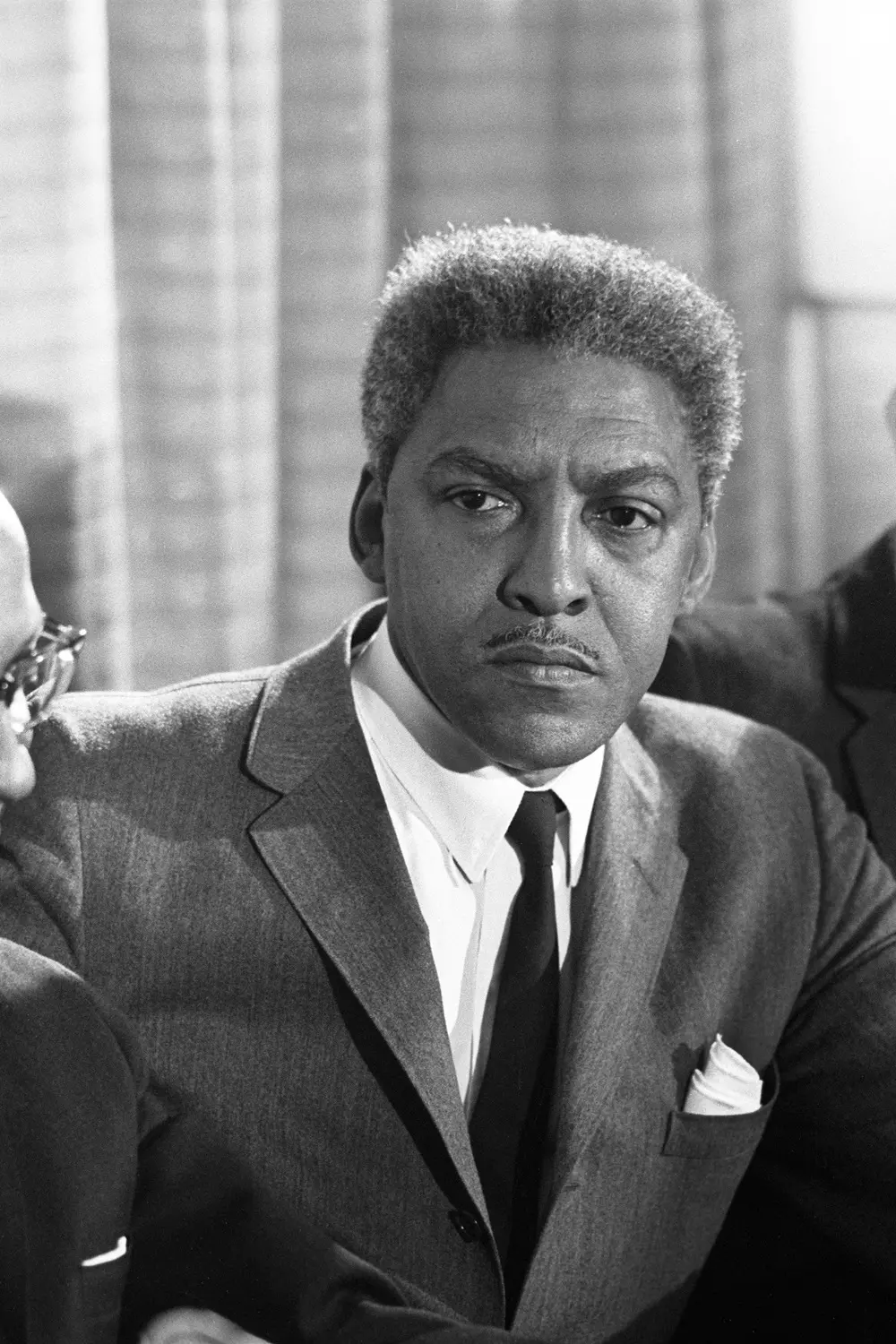
At a Glance
West Chester, the Quakers, and a Grandmother Who Hosted Frederick Douglass
Bayard Rustin's formation began with his grandparents' Quaker faith and his grandmother Julia's active civil rights commitments — a combination that gave him, from his earliest years, a framework in which principled resistance to injustice was both religiously grounded and practically expressed. The Religious Society of Friends had been opponents of slavery since the eighteenth century; their commitment to the equality of all persons before God translated, in the activist Quaker tradition, into concrete action against the structures of racial hierarchy. Julia Rustin was that kind of Quaker: she was an NAACP member, and her home had been a place where figures from the tradition of Black resistance — including, reportedly, Frederick Douglass in an earlier era and W.E.B. Du Bois in Rustin's childhood — were received as guests.
Growing up in that household gave Rustin something that many civil rights activists had to acquire through experience and education: a pre-existing moral framework in which racial equality was not a political position to be argued for but a religious conviction to be acted on. The pacifism that went alongside it — the Quaker commitment to non-violence as a matter of principle, not merely strategy — became the foundation of his political methodology in ways that distinguished him from civil rights activists whose commitment to nonviolence was tactical rather than principled.
His path through Cheyney State Teachers College and then to New York City in the 1930s took him through the radical political culture of Depression-era Harlem, where his intelligence and his oratorical gifts brought him into contact with the full range of Black and interracial radical politics. His brief involvement with the Young Communist League reflected a genuine engagement with Marxist analysis of racial capitalism that many Black intellectuals of his generation shared; his break with the Communist Party over its shifting positions on race during the Second World War — the party subordinated its civil rights commitments to the demands of the Soviet-American alliance, which Rustin found morally unacceptable — was also characteristic of a man who measured political organisations by their consistency with principle rather than their tactical convenience.
The Fellowship of Reconciliation and the Discovery of Gandhi
Rustin joined the Fellowship of Reconciliation in 1941, the pacifist organisation that was the primary American vehicle for studying and applying Gandhi's methods of nonviolent resistance. The FOR was not a civil rights organisation in the conventional sense — it was a religious pacifist organisation whose commitment to nonviolence extended from conscientious objection to military service through to the application of Satyagraha to American racial injustice — but its analysis of the connection between pacifism and racial justice was exactly what Rustin needed to give systematic form to his inherited convictions.
He was imprisoned as a conscientious objector during World War II, serving time in federal prison for refusing induction — an experience that tested and confirmed his commitment to principled nonviolence under conditions of genuine personal cost. The prison experience also gave him an intimate knowledge of the American carceral system's racial dimensions: Black prisoners were housed in segregated facilities, received worse food and treatment than white prisoners, and were subject to the same racial hierarchy inside the prison walls as outside them. Rustin refused to accept segregated seating in the prison dining hall, an early act of direct action that prefigured the lunch counter sit-ins of the 1960s.
His 1948 trip to India was the most important single intellectual experience of his political life. Gandhi had been assassinated earlier that year, but the movement he had built was still very much alive, and Rustin was able to study its methods with people who had participated directly in the independence struggle — the satyagrahis who had filled the jails, the organisers who had coordinated the non-cooperation campaigns, the theorists who had developed the strategic logic of nonviolent resistance to state power. He returned to the United States as the most knowledgeable American practitioner of Gandhian methods, with a depth of understanding of the theory and practice of nonviolent direct action that no other American activist possessed.
Montgomery, 1956: Giving King a Framework
When Rustin arrived in Montgomery, Alabama, in February 1956 — during the Bus Boycott that had been launched in December 1955 following Rosa Parks's arrest — he found a young pastor named Martin Luther King Jr. who had become, through a combination of circumstance and personal gifts, the movement's public leader and whose instinct had been to organise the boycott on nonviolent principles. What King had not yet developed was the systematic theoretical framework that would allow him to articulate why nonviolence was the right strategy — not merely tactically useful but morally necessary, not merely the best available option but the expression of a comprehensive political and ethical philosophy.
Rustin provided that framework. Over weeks of conversation, correspondence, and intense collaboration, he introduced King to the full architecture of Gandhian thought: the distinction between passive nonresistance and active nonviolent resistance, the concept of Satyagraha as soul force that could transform an opponent's conscience by making him confront the injustice of his own violence, the strategic logic of making the state's repression visible through the willingness to accept suffering without retaliation, the organisational requirements of sustaining a mass nonviolent movement over time. King had the gifts to take this framework and make it his own, to articulate it with a theological depth and an oratorical power that Rustin himself could not match. But the framework was Rustin's gift, and it shaped everything that followed.
The contribution was made at personal risk. Rustin's presence in Montgomery was kept quiet precisely because his 1953 arrest made him a potential liability — if white segregationists could link the boycott's intellectual architect to a man with a morals conviction, the narrative about the movement's leadership would shift from the inspiring to the disqualifying. He was there, he did the work, and he left before his presence could become a public issue. This pattern — contributing essentially while remaining invisible — would define the next decade of his career.
Eight Weeks to a Quarter Million: Organising the March on Washington
The 1963 March on Washington for Jobs and Freedom is remembered primarily through the speeches delivered at it — above all King's "I Have a Dream" address — and secondarily through the political context that made it both possible and necessary: the Birmingham campaign of spring 1963, the Kennedy administration's belated commitment to civil rights legislation, the growing national momentum behind what would become the Civil Rights Act. What is less often remembered is that the march was organised in approximately eight weeks, by a single man working with a small staff, and that it was logistically flawless.
Rustin worked from the offices of the Brotherhood of Sleeping Car Porters, under the nominal direction of A. Philip Randolph, who had first proposed the march and who was its public face. The division of labour was deliberate: Randolph provided the public credibility and the political relationships; Rustin provided the organisational genius. The two men had worked together for years and understood each other's contributions completely. Randolph's insistence that Rustin remain in the chief organiser role, over the objections of Roy Wilkins and other civil rights leaders who feared the political exposure of his homosexuality, was one of the defining acts of loyalty and political courage in the movement's history.
The logistical challenge was enormous. Getting 250,000 people to Washington D.C. in August 1963 required coordinating buses and trains from dozens of states, arranging food and water distribution for a crowd of a quarter million people on the National Mall, establishing medical stations and communications infrastructure, writing and distributing a programme booklet, managing the political dynamics of an event that included every major civil rights organisation and several labour and religious organisations, coordinating sixteen scheduled speakers with precise timing requirements, and ensuring that the day's message — that the movement demanded both civil rights and economic justice — was conveyed clearly and consistently throughout.
Rustin managed all of this with the precision of a military operation. The march came off without a single significant incident. The crowd was larger than anyone had predicted. The programme ran on time. The logistics that a quarter million people required — food, water, portable toilets, first aid, communications — were provided seamlessly. The day's most celebrated moment, King's "I Have a Dream" speech, was delivered from a platform that Rustin's organisation had built, to a crowd that Rustin's logistics had assembled, through a sound system that Rustin's staff had installed. He was not on the platform when King spoke. He was behind the scenes, where he had always been.
The Political Cost of Being Gay: Sidelined by the Movement He Built
The treatment of Bayard Rustin by the civil rights movement's mainstream leadership is one of the most uncomfortable aspects of the movement's history — the story of a man whose contributions were indispensable, whose abilities were universally recognised, and who was systematically denied the public recognition and the leadership roles that those contributions warranted because he was gay. The rationalisation offered by movement leaders was always the same: that Rustin's homosexuality would be used by opponents to discredit the movement, that the political risk was too great, that protecting the cause required sacrificing the man.
The argument was not entirely without substance — Strom Thurmond's entry of Rustin's arrest record into the Congressional Record, timed to coincide with the March on Washington, was exactly the kind of attack that the movement's leaders had feared. But the conclusion drawn from this risk — that the answer was to hide Rustin rather than defend him — said something revealing about the limits of the movement's commitment to the dignity of all persons. The movement that was fighting for the principle that no human being should be treated as less than fully human because of a characteristic they did not choose was simultaneously treating one of its own members as less than fully human because of a characteristic he did not choose.
Rustin himself navigated this contradiction with a complexity that resists simple characterisation. He did not primarily identify himself as a gay rights activist during the years of his civil rights work — his political identity was built around racial justice, economic justice, and pacifism, and he understood that his effectiveness in pursuing those goals required accepting, to a significant degree, the political constraints that his homosexuality imposed. But he was never closeted in the sense of denying his identity; he was open about who he was to the people who knew him, and the marginalisation he experienced was not because he concealed himself but because others concealed him.
The Later Career: Labour-Civil Rights Coalition and the Turn to Economics
After the March on Washington and the legislative victories of the mid-1960s, Rustin's political focus shifted increasingly toward the argument that formal legal equality was insufficient without economic transformation — that the Civil Rights Act and the Voting Rights Act had removed the formal barriers to Black participation in American life but had not addressed the economic structures of poverty and inequality that were the material foundation of Black subordination. This argument, which had always been implicit in the "Jobs" half of the 1963 march's title, became the central theme of his work through the A. Philip Randolph Institute and through his writing and speaking in the late 1960s and 1970s.
His 1965 essay "From Protest to Politics," published in Commentary magazine, was one of the most important strategic documents of the post-Civil Rights Act period — an argument that the movement needed to transition from direct action protest to electoral coalition politics, building the Black-labour-liberal coalition that could win legislative majorities for economic justice programs. The essay was prescient about the direction that Black political power would need to take, but it was also controversial within a movement that was simultaneously moving toward Black Power politics and toward a more confrontational relationship with the liberal establishment that Rustin was urging Black America to work with.
His position put him at odds with both the Black Power movement, which he regarded as politically counterproductive, and with younger radicals who found his coalition politics too accommodationist. The criticism that he had become a defender of the liberal establishment — that his labour connections and his anti-communist positions had aligned him with forces that were failing Black America — was one that he engaged seriously but ultimately rejected. He remained committed to the proposition that the political conditions for economic justice required broad coalition rather than separatism, and he accepted the political isolation that this position brought him in the movement's more radical currents.
Death, Posthumous Honours, and the Expunging of an Injustice
Bayard Rustin died in New York City on August 24, 1987, of a ruptured appendix complicated by heart failure, at the age of seventy-five. He had been in Haiti with his partner Walter Naegle — whom he had met in 1977 and who was the companion of his final decade — on a humanitarian mission when he became ill; he died in a New York hospital two days after returning. His death received respectful but not extensive coverage: he was a significant figure in civil rights history, but he had never been a famous one, and the invisibility that had been imposed on him for so much of his career continued to shape how his death was marked.
The posthumous recognition came slowly. President Obama awarded him the Presidential Medal of Freedom in 2013, more than a quarter century after his death — the citation explicitly acknowledging both his civil rights contributions and his identity as a gay man, noting that he had been "an unyielding activist for civil rights, dignity, and nonviolence" who had lived openly as a gay man "at a time when such candour was an act of courage." In 2020, New York Governor Andrew Cuomo signed a posthumous pardon expunging Rustin's 1953 conviction — the arrest that had been used for decades to justify his marginalisation — on the grounds that the law under which he had been convicted was both unconstitutional and unjust.
These acts of recognition matter, and they are insufficient. Rustin deserved the recognition during his lifetime that he received after his death. The movement he served deserved a leadership that had defended him rather than hidden him. The gay rights movement that emerged in the years after his death — catalysed partly by the AIDS crisis that was killing people Rustin knew as he died — was a movement whose principles he had embodied decades before it existed as an organised political force. He was, in multiple senses, ahead of his time: a man whose commitment to the dignity of every human being was comprehensive enough to include himself, who paid the price for that comprehensiveness throughout his career, and whose life's work outlasted the compromises that were made at his expense.