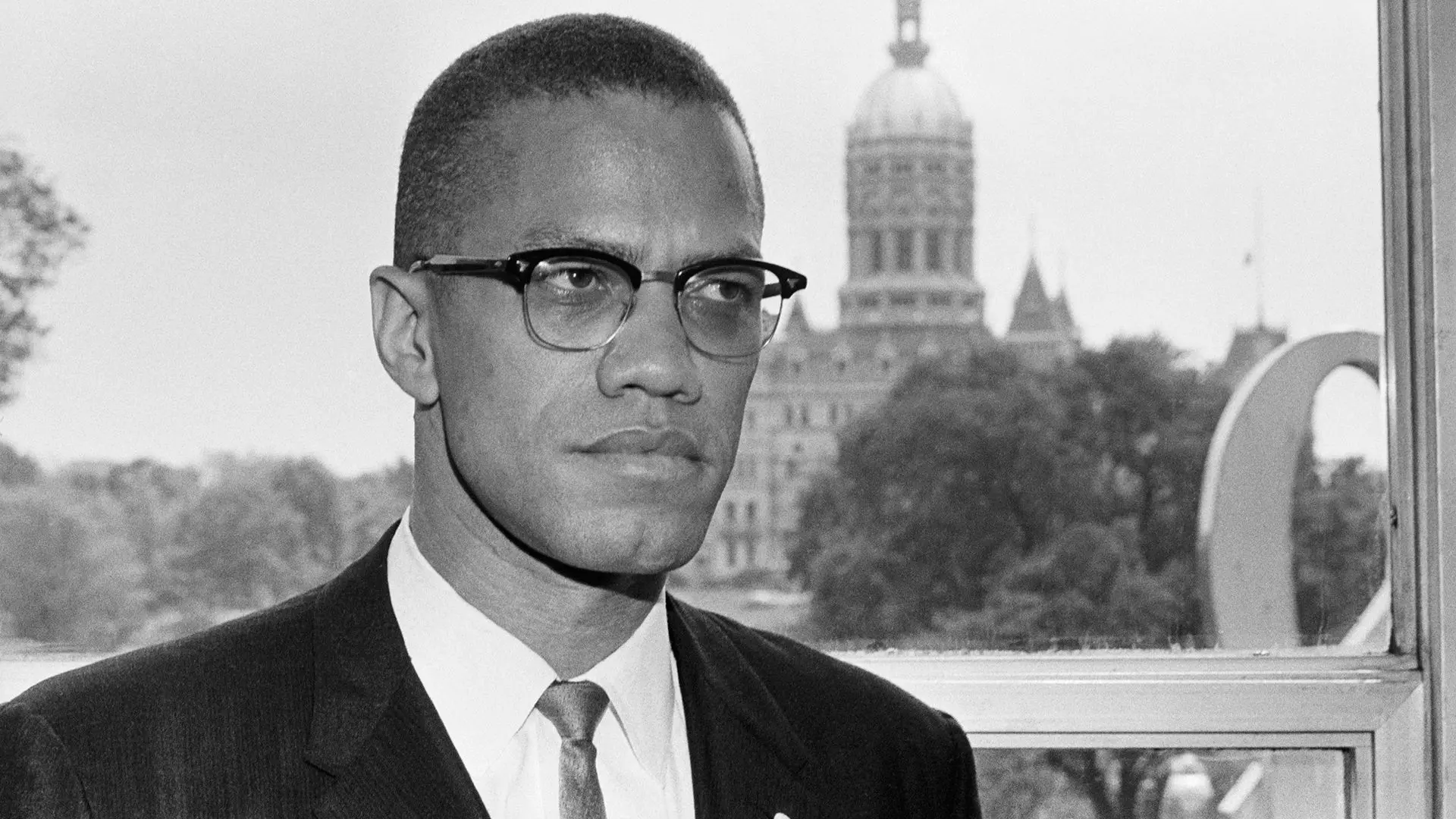
Malcolm X, Nation of Islam national spokesman and founder of the Organization of Afro-American Unity.
United States · Civil Rights Movement

Malcolm X

Malcolm Little was born on May 19, 1925, in Omaha, Nebraska, the son of Earl Little, a Baptist preacher and Garveyite organiser whose civil rights work made the family a target of white supremacist violence — the home was burned in Omaha when Malcolm was an infant; the family moved to Lansing, Michigan, where Earl Little died in 1931 under circumstances the family believed were murder by the Black Legion. His mother Louise subsequently had a psychological breakdown and was institutionalised when Malcolm was thirteen. He entered the world of Boston and Harlem street life, was convicted of burglary in 1946, and entered prison at twenty. In prison he educated himself systematically through the library, encountered the Nation of Islam through his siblings, converted, and upon his release in 1952 became the organisation's most effective recruiter and most electrifying speaker, building it from approximately 400 to 40,000 members. He articulated the critique of American racism that the nonviolent movement could not articulate in the same terms: that white America's racism was structural, intentional, and not correctable by moral suasion alone. He was suspended from the NOI in December 1963, left in March 1964, made the Hajj to Mecca where his experience of a multiracial Muslim community transformed his racial theology, took the name El-Hajj Malik El-Shabazz, and founded the Organization of Afro-American Unity as a human rights organisation. He was assassinated at the Audubon Ballroom in New York City on February 21, 1965, at thirty-nine years old, by members of the NOI. The autobiography he had dictated to Alex Haley, published posthumously in 1965, is one of the most important books in American literature.

United States Nation of Islam Black Nationalism El-Hajj Malik El-Shabazz OAAU Self-Defence

Born: 19 May 1925, Omaha, Nebraska, USA  |  Died: 21 February 1965, New York City, USA — aged thirty-nine

At a Glance

Full NameBorn Malcolm Little; took the surname X in the NOI tradition of renouncing the slave name; took the name El-Hajj Malik El-Shabazz after his Hajj conversion to Sunni Islam; born 19 May 1925, Omaha, Nebraska; father Earl Little was a Baptist preacher and Marcus Garvey organiser; father died 1931; mother institutionalised 1938; convicted of burglary 1946; imprisoned Charlestown State Prison; converted to NOI in prison; released 1952; built NOI from 400 to approximately 40,000 members; suspended from NOI December 1963; made Hajj April 1964; founded OAAU; assassinated 21 February 1965 at the Audubon Ballroom, New York City; Autobiography published posthumously 1965
Born19 May 1925, Omaha, Nebraska; his father Earl Little's Garveyite organising made the family a target; their home was burned in Omaha; they moved to Lansing, Michigan, where Earl was found dead on a streetcar track in 1931 under circumstances the family believed were murder by the white supremacist Black Legion; his mother Louise subsequently suffered a psychological breakdown and was institutionalised when Malcolm was thirteen; he and his siblings were distributed to foster care; he was a brilliant student whose white teacher suggested he think about carpentry rather than law; he moved to Boston to live with his half-sister Ella Collins and entered street life
Died21 February 1965, Audubon Ballroom, Washington Heights, New York City; shot fifteen times while approaching the podium to address an OAAU meeting; three members of the Nation of Islam were convicted; two of the three convictions were posthumously vacated in 2021 after review found the FBI and NYPD had withheld exculpatory evidence; Malcolm had been receiving death threats from the NOI in the months before his death and had publicly identified the NOI leadership as the source; the investigation remains formally unresolved
Prison Education and NOI ConversionEntered Charlestown State Prison in 1946 at twenty; educated himself systematically through the prison library, copying the entire dictionary word by word to master the English vocabulary he had been denied; encountered the NOI through siblings who had converted and began corresponding with Elijah Muhammad; his conversion was an intellectual as well as a religious transformation: the NOI's analysis of white supremacy gave him the framework for understanding the specific losses of his own life as political rather than merely personal; released in 1952 and immediately began organising
Building the NOI and the National VoiceWas the primary force behind the NOI's growth from approximately 400 members in 1952 to approximately 40,000 by the early 1960s; established mosques in Boston, Harlem, Philadelphia, Detroit, Chicago, Los Angeles, and dozens of other cities; conducted debates and interviews with an intellectual rigour and rhetorical precision that demanded serious engagement from everyone who encountered him; became the NOI's national spokesman and its primary public face; his appearances in media and in university debates made the NOI's critique of American racism available to audiences who had not encountered it
The Hajj and El-Hajj Malik El-ShabazzMade the Hajj to Mecca in April 1964 after leaving the NOI; the experience of the Hajj — of a multiracial community of Muslim worshippers where his race was irrelevant to his standing as a believer — produced a genuine transformation in his racial theology; wrote letters home describing Muslims of all colours worshipping together and explicitly acknowledging that his prior categorical condemnation of white people had been wrong; took the name El-Hajj Malik El-Shabazz; founded the OAAU as a secular human rights organisation and was developing a more sophisticated political framework connecting Black American struggle to global decolonisation when he was killed
The AutobiographyDictated his autobiography to journalist Alex Haley in the years before his assassination; the book was published posthumously in November 1965; it is one of the most important books in American literature — a narrative of self-creation and political transformation that remains one of the most widely read accounts of Black American experience in the twentieth century; its account of Malcolm's childhood losses, his street life, his prison education, his NOI years, and his final transformation toward a more universal humanism was shaped by the awareness that he might not live to see its publication, which gave it a quality of retrospective honesty that published-while-alive memoirs rarely achieve

Omaha, Lansing, and the Violence That Preceded Everything

Malcolm X's life story begins not with his own choices but with the violence done to his family before he was old enough to make choices. His father Earl Little's Garveyite organising — his work for Marcus Garvey's Universal Negro Improvement Association, which preached Black pride and Black return to Africa as the response to American white supremacy — made the family a specific target of the white supremacist organisations whose purpose was to prevent exactly the kind of Black political consciousness that Earl Little was cultivating. The burning of the family home in Omaha when Malcolm was an infant was not random; it was a political act. The death of Earl Little on a Lansing streetcar track when Malcolm was six was, in the family's understanding and in the available evidence, not an accident; it was murder.

The specific pedagogical content of what happened to Malcolm's family in his early childhood — the lesson that white supremacy was not merely a set of social attitudes but a violent political force that would destroy Black people who organised against it — was the foundation on which everything he later said and believed was built. When he later argued that the nonviolent movement's analysis of white racism was inadequate to its actual character, he was drawing on a direct, family-specific experience of what that character was at its most brutal and most deliberate.

His mother's institutionalisation when he was thirteen — the cumulative breaking of a woman by widowhood, poverty, and the weight of raising eight children alone in Depression-era Michigan — was a second demonstration of the same point: that the consequences of white supremacy were not merely formal or legal but material and psychological, that they destroyed people and families in ways that were not always visible as political acts but were inseparable from the political conditions that had produced them. Malcolm understood his mother's breakdown as a political injury, and that understanding shaped everything he subsequently thought and said about the relationship between Black suffering and white power.

Street Life, Prison, and the Education That Mattered

The years between his mother's institutionalisation and his entry into prison were the years in which Malcolm, deprived of family and formal education and navigating the underworld of Boston and Harlem, developed the street intelligence and the understanding of how marginalised communities actually worked that would later give his political analysis its specific texture of lived experience. He was not theorising about poverty and exclusion; he had lived inside them, had made the decisions that poverty and exclusion made seem rational, had experienced what the criminal justice system looked like from inside a cell.

His conviction for burglary and his entry into Charlestown State Prison at twenty were the beginning, paradoxically, of his real education. He had been a poor student in Michigan partly because the educational system had communicated to him — through the teacher who suggested carpentry rather than law — that intellectual aspiration was not for him. In prison, with time and a library and the motivating fury of someone who understood that he had been cheated of something, he became the most thorough self-educator the civil rights movement produced. He copied the dictionary word by word. He read voraciously and systematically. He debated with other inmates. He developed the command of language and argument that would later make him the most formidable speaker in the movement's broad landscape.

The NOI's arrival in his intellectual life, through his siblings who had converted, was the convergence of his self-education with a framework that gave it political meaning. Elijah Muhammad's analysis of Black American suffering — its attribution to specifically white evil rather than to Black inadequacy — was not historically precise (the NOI's cosmology was theologically heterodox and empirically dubious), but it was psychologically liberating for people who had been told their entire lives that their condition was their own fault. For Malcolm, the NOI provided a vocabulary and a framework for the political understanding that his family's experience had already instilled: the understanding that what had happened to his family was not personal misfortune but political violence.

The NOI Spokesman: Naming the Thing

Malcolm X's function in the civil rights movement's broader landscape was to say things that the nonviolent mainstream could not say — and that, said by him in the terms he used, had the political effect of making the mainstream's more moderate demands seem reasonable by comparison. This was not a coordinated strategy; it was the organic consequence of two genuinely different analyses of the same situation being expressed simultaneously. King and the SCLC were arguing, in the language of American democratic idealism, that Black Americans deserved the rights that the Constitution guaranteed. Malcolm was arguing, in the language of unvarnished analysis, that a system that had been built on Black subjugation could not be expected to reform itself through moral suasion, that self-defence was a right rather than a betrayal, and that the expectation of white goodwill was a fantasy that Black Americans could not afford.

The debates between Malcolm and the nonviolent mainstream — sometimes conducted directly, sometimes through the medium of press conferences and speeches — were among the most intellectually serious exchanges in American political life in the early 1960s. Malcolm consistently drove his interlocutors to the question of what they would do if the moral suasion and the legal challenges and the marches did not produce the change they were seeking, and the movement's leaders did not always have comfortable answers. His presence as the explicit alternative — not merely a critic but someone who embodied a different analysis and a different programme — was one of the factors that made King's approach politically viable: it was easier for white moderates to support King when the alternative was Malcolm.

The Hajj and the Transformation That Assassination Interrupted

The Hajj of April 1964 is the hinge moment of Malcolm's biography — the experience that produced the transformation from El-Hajj Malik El-Shabazz toward a political framework that was expanding beyond the NOI's racial theology toward a more universal humanism grounded in Islamic brotherhood and in the connection between Black American liberation and global decolonisation. The letters he wrote home from Mecca — describing white Muslims and Black Muslims and brown Muslims worshipping together, describing the irrelevance of race in the community of the Hajj — were the documents of a genuine transformation rather than a tactical repositioning.

His founding of the Organization of Afro-American Unity after his return was the institutional expression of this transformation: a secular human rights organisation rather than a religious one, designed to connect the Black American struggle to the United Nations human rights framework and to the global anti-colonial movements of the 1960s in ways that the NOI's separatist theology had prevented. He was developing the OAAU's programme and building its international connections in the months before his assassination — a period in which he was also receiving death threats from NOI members and had survived at least one attempt to burn down the house where his family was living.

He was thirty-nine when he was shot at the Audubon Ballroom. The assassination interrupted what was clearly a process of political development whose direction was toward something more comprehensive and more strategically sophisticated than anything he had previously articulated. The autobiography that Haley published posthumously is the most complete account available of who he had been; who he was becoming when the bullets arrived remains one of the most significant unanswered questions in the history of the American freedom struggle.

Other Civil Rights Movement Profiles

USA · Civil Rights Martin Luther King Jr. The nonviolent mainstream whose moral argument Malcolm challenged and whose political viability Malcolm's presence paradoxically strengthened USA · Civil Rights Louis Farrakhan The NOI minister whose public statements in 1964 called Malcolm a traitor worthy of death and who later became the organisation's leader USA · Civil Rights Ella Baker Whose group-centred leadership philosophy stood in direct contrast to the NOI's charismatic-minister model — the movement's two poles USA · Civil Rights Gloria Richardson Maryland movement leader whose self-defence position paralleled Malcolm's and who met with him during the Cambridge campaign USA · Civil Rights Bayard Rustin Who debated Malcolm publicly and whose integrationist coalition politics represented the most direct strategic alternative to Malcolm's separatism USA · Civil Rights Fannie Lou Hamer Whose grassroots democratic organising embodied the alternative to Malcolm's separation — the same goal of Black liberation by different means USA · Civil Rights John Lewis SNCC chairman who engaged seriously with Malcolm's critique while maintaining the nonviolent interracial approach Malcolm challenged USA · Civil Rights Bob Moses Whose interracial Mississippi voter registration model embodied the specific approach Malcolm considered insufficient USA · Civil Rights A. Philip Randolph Labour organiser whose Garveyite connection through his own background placed him in a complex relationship with the Black nationalist tradition Malcolm inherited USA · Civil Rights James Baldwin Who wrote about Malcolm with the kind of intellectual seriousness he deserved and who refused to choose between Malcolm and King as the movement required
Share X Facebook WhatsApp LinkedIn