At a Glance
Calloway, Selma, and the Geography of Disenfranchisement
Annie Lee Cooper was born in 1910 in Calloway, Alabama, into a world in which the systematic exclusion of Black Americans from political participation was not an abuse of the democratic system but one of its structural features — built into the law, enforced by violence, and maintained by the combined power of the state, local government, and private economic actors who had a shared interest in keeping Black Alabamians politically powerless. The disfranchisement machinery that had been constructed in the aftermath of Reconstruction — literacy tests, poll taxes, white primaries, grandfather clauses, and the ever-present threat of economic and physical retaliation against anyone who challenged these mechanisms — had been in place for decades by the time she reached adulthood, and it was not weakening but strengthening as the twentieth century progressed.
Selma, the Dallas County seat where Cooper settled as an adult, was a particularly extreme example of this machinery in operation. Dallas County had a Black population of approximately fifteen thousand by the early 1960s, making Black residents a majority of the county's total population. But the voter registration rolls showed fewer than three hundred and fifty Black registered voters — a number that represented approximately two percent of the Black population eligible to vote. This was not the result of Black indifference to political participation; it was the result of a voter registration apparatus whose every element was designed to produce exactly this outcome. The registrar's office was open only two days per month. Applications were evaluated by white registrars with complete discretion over what questions to ask and how to evaluate the answers. Black applicants were routinely rejected for errors that white applicants were allowed to correct. The process was designed to fail, and it failed on schedule.
Cooper worked as a nursing home attendant, doing the difficult and poorly compensated work of caring for elderly residents — work that was available to Black women in Selma precisely because it was work that white women preferred not to do and that paid too little to attract competition. Her working life was embedded in Selma's racial economy in the most direct possible way: she provided essential care to people who were often white, in a system that treated her labour as necessary and her political participation as impermissible.
The Cost of Trying: Lost Jobs and Persistent Defiance
Cooper's voter registration attempts in the 1950s and early 1960s were acts of civil courage that most accounts of the civil rights movement fail to adequately recognise. The movement's history tends to centre the dramatic confrontations — the marches, the sit-ins, the nationally photographed moments of violence and resistance — while the years of patient, dangerous, individually costly attempts that preceded those confrontations recede into the background. Cooper's experience was representative of what preceded the Selma campaign for the Black residents of Dallas County who had been trying to register for years or decades before the SCLC arrived.
Each time she went to the courthouse to attempt registration, she was taking a professional risk as well as a personal one. Dallas County's white employers — the hotels, the businesses, the institutions that employed Black workers — maintained informal but effective surveillance of Black employees' political activities. If a worker was known to have attempted to register, the employer would often fire them, both as punishment for the individual and as a warning to other Black employees who might be considering the same. Cooper lost her job at the Albert Hotel on this basis. The economic consequences of attempting to vote were a deliberate part of the disenfranchisement system's architecture: by making voter registration attempts professionally costly, the system created a financial incentive for self-policing among Black workers that reduced the registrar's need to actually process and reject applications.
Cooper kept trying anyway. This persistence — unrewarded, unrecorded, conducted without organisational support or national attention — was the foundation of everything that followed. The Selma Voting Rights Campaign that the SCLC launched in January 1965 found in Cooper and hundreds of people like her a community that had been trying to register for years, that had the organisational memory and the personal motivation to sustain a campaign, and that needed not awakening but amplification. The SCLC provided the amplification; Cooper and her neighbours had been awake for a long time.
Jim Clark: The Sheriff as an Instrument of Terror
Dallas County Sheriff Jim Clark was, in some respects, the ideal antagonist for the SCLC's Selma strategy — a man whose aggression, whose contempt for Black demonstrators, and whose instinct to respond to nonviolent protest with physical violence made him the perfect instrument for generating the confrontations that the movement needed to attract national media attention and federal intervention. The SCLC had used Bull Connor's brutality in Birmingham in 1963 as the catalyst for national outrage; Clark served the same function in Selma in 1965.
Clark was not subtle. He wore a lapel button that read "NEVER" — his response to the question of whether Dallas County would ever permit Black voter registration — and he approached the voter registration lines outside the courthouse with the physical aggression of a man who regarded the presence of Black people attempting to exercise constitutional rights as a personal affront that required a physical response. His standard tactics included pushing and prodding demonstrators with his billy club, shouting at them, making mass arrests on charges of unlawful assembly or contempt, and — when he believed the cameras were not watching closely enough — the kind of direct physical violence that he employed against Cooper on January 25.
The SCLC's strategy relied in part on Clark's predictability. If Clark could be provoked into nationally visible brutality, the images would generate the political pressure that would force the Johnson administration to move on voting rights legislation. The strategy worked, but it worked by exposing ordinary Black Selma residents — including Annie Lee Cooper — to the physical consequences of Clark's aggression. The people who suffered Clark's billy clubs and mass arrests were not abstract strategic assets; they were people with jobs and families and bodies that could be hurt, and they accepted those risks voluntarily because they had decided that the right to vote was worth the risk of Clark's violence.
The Punch: January 25, 1965
The morning of January 25, 1965, was cold — January in Selma is cold, and the voter registration lines that had been forming outside the Dallas County courthouse before dawn in the weeks since the SCLC campaign launched had required demonstrators to stand in the dark and the chill for hours before the registrar's office opened. Annie Lee Cooper had been doing this, along with hundreds of other Black Selma residents, as part of the daily rhythm of the campaign. They would come before dawn, form a line, wait, and be turned away — sometimes by the registrar's office refusing to process applications, sometimes by Clark's deputies breaking up the line before it could reach the courthouse steps, sometimes by mass arrests on pretextual charges.
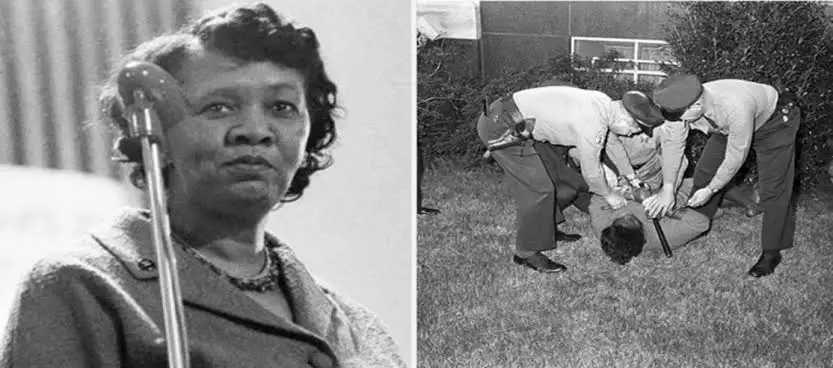
On January 25, Clark moved through the line with his characteristic physical aggression, shoving demonstrators with his club to disperse them. When he grabbed Cooper, he encountered someone who was not going to accept being manhandled. She threw a punch that connected with Clark's face with enough force to knock him down. The physical incongruity of the image — a fifty-four-year-old nursing home attendant flooring the county sheriff — was part of what made it so powerful. Clark was a large man with a club and three deputies; Cooper was a middle-aged Black woman who had been standing in the cold since before dawn trying to register to vote. The normal expectation of who would hit whom and with what effect was inverted, and the inversion captured in the AP photograph told a story that required no caption.
The deputies who tackled Cooper and held her down while Clark struck her on the head with his club were, in one sense, simply doing what the situation required of them as instruments of Dallas County's enforcement apparatus. In another sense, they were demonstrating exactly what the Selma campaign was about: the full weight of the county's official violence being deployed against a Black woman who had done nothing more threatening than attempt to register to vote and then defend herself when the sheriff put his hands on her. The photograph of that moment — Cooper on the ground, multiple deputies restraining her, Clark's club — was a more complete argument for the Voting Rights Act than any speech could have been.
Bloody Sunday and Its Aftermath: The Campaign's Culmination
The January 25 confrontation was one of many similar moments in the weeks before Bloody Sunday — before the March 7, 1965 march across the Edmund Pettus Bridge that produced the nationally televised violence that made the Voting Rights Act politically irresistible. Cooper's punch was not, in the context of the campaign's total scale, a singular event; it was one of dozens of confrontations between Clark's forces and the voter registration demonstrators that the SCLC and local organisers were sustaining day after day through January and February 1965.
What made it singular was the photograph. The AP image captured something that the movement's organisers understood intuitively but that was difficult to convey in words: the daily reality of what it cost ordinary Black Selma residents to assert their constitutional rights. The marches and the mass demonstrations were the visible tip of a campaign whose base was the patient, daily, dangerous work of lining up outside the courthouse before dawn, waiting for hours in the cold, being turned away or arrested or beaten, and coming back the next time the registrar was open to try again. Cooper's confrontation with Clark was an image of that base reality, in its most compressed and powerful form.
The Voting Rights Act that President Johnson signed on August 6, 1965, was the legislative result of the campaign that Cooper and hundreds of other Black Selma residents had sustained, at personal cost, for years before the SCLC arrived and for the months of the campaign that followed. The Act abolished the literacy tests and other devices that had been used to prevent Black voter registration, established federal oversight of elections in jurisdictions with histories of voting discrimination, and within months produced a transformation of Dallas County's voter rolls: by the end of 1965, more Black voters had registered in Dallas County than had been registered in the entire preceding century. Jim Clark, who had spent a decade preventing exactly this outcome, ran for re-election in 1966 against Wilson Baker, the Selma Public Safety Director who had taken a less confrontational approach to the demonstrators; Clark lost, his electoral base having been eliminated by the very Act whose passage his brutality had helped to ensure.
Ninety-Seven Years Old and Casting a Ballot
Annie Lee Cooper voted for Barack Obama in November 2008. She was ninety-seven years old. It was the first time she had ever successfully cast a ballot in a presidential election — the first time, after decades of attempts and rejections and lost jobs and a punch thrown at a sheriff and a billy club to the head and all the patient, costly years that preceded and followed January 25, 1965, that the system she had been fighting against had been sufficiently transformed to allow her vote to be cast and counted.
The fact that she lived to cast that vote — that she was one hundred years old when she died, and that she had ninety-four years of life after the Voting Rights Act's passage in which to watch the transformation she had helped to produce — is part of what makes her story unusual in a movement whose most celebrated figures often died young or lived into embittered old age watching their victories eroded. Cooper's century encompassed the full arc: born in 1910 into a world of legal apartheid and comprehensive disenfranchisement, alive in 2008 to vote for the first Black president of the United States, and still present in 2010 when she died at an age that gave her the perspective of someone who had seen the worst and the best of what America was capable of.
Oprah Winfrey, Ava DuVernay, and the Preservation of an Untold Story
Cooper's story was not widely known outside of Selma and civil rights scholarship before Ava DuVernay's 2014 film "Selma" made it the subject of one of the film's most memorable scenes. Oprah Winfrey, who played Cooper and who also served as a producer of the film, brought to the role both her own personal investment in the civil rights legacy and her understanding of what Cooper's story represented: not the story of a leader or an organiser or a strategist, but the story of an ordinary Black southerner whose extraordinary persistence and courage in the face of systematic oppression was representative of the thousands of people whose names are not in history books but whose actions made the movement possible.
The film's Cooper scene — depicting the voter registration line confrontation, the punch, and the beating — was based on the historical record and conveyed with considerable fidelity the essential facts of what happened on January 25, 1965. Its emotional power derived from the same source as the AP photograph's power: the clarity with which it showed what the Voting Rights Act was actually about, at the level of individual human beings. Not the legislative strategy, not the lobbying, not the presidential address — but a fifty-four-year-old Black woman in Selma, Alabama, who had been trying to register to vote for more than a decade, who was grabbed by the county sheriff while standing in a registration line, and who hit back.
Annie Lee Cooper's life was not defined by that single moment of defiance, but the moment distilled something essential about the life: the persistence in the face of systematic obstacles, the refusal to accept the subordination that the racial order required, the willingness to pay personal costs in defence of the principle that she was a citizen entitled to the rights of citizenship. She was not a strategist or an orator or an organiser. She was a nursing home attendant in Selma who wanted to vote, and she wanted it badly enough to keep trying for more than a decade while losing jobs and enduring rejections, and when the sheriff of Dallas County put his hands on her, she hit him. These facts are the entirety of her civil rights biography, and they are enough.