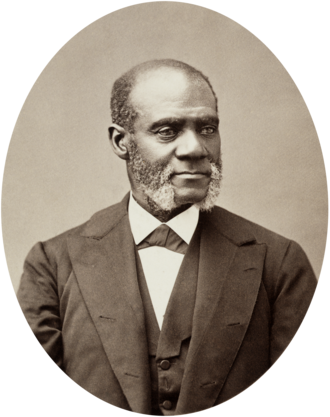
At a Glance
Maryland, Flight, and the Making of a Radical
Henry Highland Garnet's radicalism was not a position he arrived at through theoretical reflection — it was a response to the specific violence that he had personally experienced and personally witnessed, beginning with the flight his family made from slavery when he was nine years old. The escape, organised by his father while their enslaver was briefly absent, took the family north to New York City; but they were discovered, and the pursuit that followed scattered them, exposed them to the terror of the city's slave-catching networks, and left the child Henry navigating a city in which the line between freedom and recapture was thin and constantly shifting. His sister was seized by a slave catcher; other members of the family were threatened; the experience of flight, pursuit, and the fragmentation of a family that had been intact until the moment of escape was the formative event of his childhood and one of the deepest sources of his subsequent radicalism.
He was educated in New York, first at the African Free School and then through the various educational opportunities that the city's Black community provided, before making his way to the Noyes Academy in New Hampshire — one of the first American educational institutions to admit Black and white students on equal terms. The destruction of the Noyes Academy by a white mob in 1835, and the subsequent violence directed at the Black students who had attended it, was another chapter in his education in the realities of white hostility to Black advancement. He and his fellow students were forced to flee Canaan, New Hampshire under armed threat; the school building was destroyed; the experiment in integrated education was ended by precisely the kind of organised white violence that the opponents of racial equality were always prepared to deploy when other methods of suppression failed.
He continued his education at the Oneida Theological Institute in Whitesboro, New York, where he was trained for the Presbyterian ministry and where he came into contact with the network of Christian abolitionists — influenced by Charles Grandison Finney's evangelical revivalism — who understood antislavery as a religious obligation rather than merely a political preference. His ordination as a Presbyterian minister gave him both the institutional platform and the theological vocabulary that he would deploy throughout his subsequent career, and the combination of evangelical Christian conviction with the specifically Black radical tradition he was developing from David Walker's example produced the distinctive voice that made his 1843 Address so extraordinary.
Buffalo 1843: The Most Dangerous Speech in Abolitionist History
The National Negro Convention that met in Buffalo, New York in August 1843 was one of the most important gatherings of Black political leadership in the antebellum United States — a meeting at which the major figures of the free Black community came together to debate the strategies and the tactics that the struggle for Black liberation required. The convention's proceedings were dominated by the question that had divided the antislavery movement since its organised beginning: whether the movement should rely on moral suasion and legal advocacy, working within the political system to persuade white Americans of slavery's injustice, or whether it needed to move toward more direct and more confrontational forms of resistance.
Garnet's Address to the Slaves of the United States of America, which he delivered at the convention, was the most direct and most uncompromising answer that the convention had heard to that question. It was addressed not to the white audience that conventional abolitionist rhetoric targeted, and not to the free Black community that was the convention's actual audience, but to the enslaved themselves — to the people who were not present in Buffalo but whose liberation was ostensibly the entire point of the movement. And it told them, in language that was as clear and as direct as language can be, that they had the right and the obligation to resist their enslavement by every means available, including violence.
He invoked specific names and specific examples — Nat Turner, Denmark Vesey, Joseph Cinqué of the Amistad — as models for the enslaved to emulate rather than aberrations to be deplored. He argued that the God of the Bible was on the side of those who struck for their own freedom. He dismissed the argument that armed resistance would be futile or counterproductive, arguing that a people who died fighting for their freedom died with more dignity than a people who lived accepting their bondage. And he ended with a direct command: "Brethren, arise, arise! Strike for your lives and liberties."
The speech was defeated by a single vote — not on a motion to endorse it, but on a motion to print and distribute it, which the convention declined by the narrowest possible margin. Frederick Douglass, who voted against the motion, later explained that he found the Address too radical for the movement's current situation, too likely to provoke reprisals against the enslaved without providing them with the means of successful resistance. The disagreement between Garnet and Douglass was genuine and deep, and it reflected a real tactical question about what strategies were most likely to produce liberation in the specific conditions of 1843. But the narrowness of the vote also indicated how divided the Black abolitionist community was on the question of radical resistance, and how many of those present in Buffalo found Garnet's position more compelling than Douglass's caution.
Walker's Heir: The 1848 Publication and the Radical Tradition
The decision to publish his 1843 Address together with David Walker's 1829 Appeal in a single volume in 1848 was one of the most significant acts of political positioning in the history of Black abolitionism. By placing the two documents side by side, Garnet was making an explicit argument about intellectual lineage — claiming the tradition that Walker had inaugurated as his own, positioning himself as the continuation and the completion of the project that Walker's mysterious death had interrupted, and insisting that the tradition of Black radical thought that called directly on the enslaved to resist was not a marginal or aberrant strand of the antislavery movement but its most authentic and most historically necessary expression.
Walker's Appeal had been published nineteen years earlier and had produced an immediate and violent response from the slaveholding South; its author had died under suspicious circumstances less than a year after its publication. The passage of time had not made the arguments less dangerous — if anything, the failure of gradualist antislavery to make significant progress in the intervening two decades had made them more urgent. Garnet's 1848 edition was a statement that the tradition Walker had founded was alive, that it had a successor who was prepared to carry it forward, and that the movement's mainstream attempts to suppress or ignore the radical wing of Black abolitionism would not succeed.
The volume circulated widely in the Black community and had an influence on the development of Black political thought that went well beyond the specific arguments it contained. It established a canon of Black radical writing — Walker and Garnet together as the foundational texts of a tradition — and it provided subsequent generations of Black intellectuals and activists with a lineage they could claim and build on. The Walker-Garnet tradition is one of the most important intellectual genealogies in the history of African American political thought.
Ministry, Emigrationism, and the Deepening Divide
Garnet spent the 1840s and 1850s simultaneously pursuing his career as a Presbyterian minister — serving congregations in Troy, New York and then in New York City — and developing the political positions that made him one of the most controversial and most influential figures in Black public life. His emigrationism — the position that African Americans should establish independent communities outside the United States, in Africa or elsewhere — put him in direct conflict with Frederick Douglass, who consistently argued that African Americans should fight for their rights within the country of their birth rather than abandoning it to the people who had enslaved them.
The Garnet-Douglass debate over emigrationism was one of the most important political debates in antebellum Black America, and it reflected a fundamental disagreement about the nature of the American republic and the prospects for Black freedom within it. Garnet's position was grounded in a historical pessimism about white America's capacity for racial justice — a pessimism that the experience of his own life, from the slave catchers of New York to the mob that had destroyed the Noyes Academy, gave him ample reason to hold. If white America was not going to provide genuine freedom for Black people, then Black people needed to build their own — somewhere else, on their own terms, without depending on white goodwill that had proven so consistently unreliable.
Douglass's counter-position — that African Americans had fought too hard for their place in America to cede it to those who had oppressed them, and that emigration would simply remove the pressure that Black resistance placed on the American conscience — was also grounded in genuine conviction and genuine analysis. The debate was never resolved, and both positions have continued to animate Black political thought in the century and a half since Garnet and Douglass argued about them.
Civil War, the Thirteenth Amendment, and a Life's Culmination
The Civil War resolved, at least in the formal sense, the question that had defined Garnet's public career. He supported the Union cause with the same directness he had brought to every other political commitment, advocating for Black military enlistment from the earliest days of the conflict and working to build the Black military force that became both a practical contribution to the Union war effort and the most powerful argument for Black citizenship and equal rights in the post-war republic. His congregation at Shiloh Presbyterian Church in New York City was a centre of Civil War-era Black community organising, and his voice was one of the most important in the chorus of Black leadership that pushed the Lincoln administration toward the full use of Black military capacity.
The passage of the Thirteenth Amendment in January 1865 and the invitation to deliver the memorial sermon in the House of Representatives on 12 February 1865 placed Garnet at the symbolic centre of the moment of formal emancipation. He was the first Black American to preach in the United States Capitol — a fact whose symbolic weight was not lost on him or on his audience — and his sermon on that occasion was both a celebration of the formal victory and a warning that the work of liberation was not complete, that constitutional abolition was the beginning rather than the end of the struggle for genuine Black freedom.
Legacy: The Radical Tradition's Most Consistent Voice
Henry Highland Garnet died on 13 February 1882 in Monrovia, Liberia, two months after arriving as the United States Minister to that country — a posting that had come to him in the final year of his life as a recognition of a career of extraordinary range and consistent principle. He had been born enslaved, had escaped as a child, had survived the destruction of his first school by a white mob, had been ordained as a minister, had delivered the most radical speech in abolitionist convention history, had spent forty years as the most uncompromising voice for Black liberation in the movement, had preached in the House of Representatives on the day of emancipation, and had died in Africa — the continent from which his grandfather had been taken and to which he had always, in some sense, been trying to return.
His legacy in the tradition of Black radical thought is foundational. The line that runs from David Walker through Garnet to the Black nationalism of the twentieth century — through Marcus Garvey, through Malcolm X, through the Black Power movement — is one of the most important intellectual genealogies in American political history, and Garnet's place in it is secure. He was the man who, at a convention in Buffalo in 1843, told the enslaved directly to rise up — who said what the movement's mainstream was not prepared to say, who refused the comfortable position of arguing against slavery from a safe distance, and who placed himself and his career in the service of the most radical version of the Black freedom movement that his era produced.