At a Glance
Hartford, Service, and an Education Built from a Minister's Library
Maria Stewart's childhood was shaped by the kind of poverty and institutional vulnerability that the antebellum period offered, with particular efficiency, to free Black children in Northern cities. Orphaned at five, bound out to service in a clergyman's household in Hartford, she spent the decade between five and fifteen as a domestic worker in a world that provided her with neither formal education nor legal protection but that gave her, through the accident of her placement in a minister's home, access to the books and the religious culture that would eventually produce her public voice.
The evangelical Protestant tradition in which she was immersed as a domestic servant in a minister's household was, in the 1810s, a living and generative tradition — the Second Great Awakening was reshaping American religious culture in ways that had direct political implications, producing not only personal piety but a sense of social obligation and a vocabulary for political argument that drew on the deepest resources of the Christian tradition. Stewart absorbed this tradition through worship, through reading, and through the conversations she was present for in the household she served, and she developed from it the theological formation that would make her public lectures so distinctive — the combination of biblical authority and political argument that was characterised by the prophetic tradition rather than the devotional one.
Her marriage to James W. Stewart in 1826 gave her, for the first time, economic stability and social standing. James was a successful ship provisioner in Boston, a man of business who had built a modest prosperity in the free Black community of the city, and the four years of their marriage were the most materially secure years of Maria's life. His death in 1829 left her with an estate that should have provided her with continuing security — and then the white lawyers and executors who administered it systematically stripped her of her inheritance through legal manoeuvres that were possible because the legal culture of Massachusetts provided very limited protection for Black widows against the machinations of white legal professionals who regarded a Black woman's estate as an accessible resource rather than a protected inheritance.
The Religious Conversion and the Making of a Public Voice
The year that followed James's death and the theft of her inheritance was a year of grief, outrage, and spiritual crisis that produced, eventually, a religious conversion of the most serious and most consequential kind. Stewart did not simply deepen an existing faith; she arrived at a new understanding of the relationship between Christian belief and political obligation that transformed her from a private person with political grievances into a public figure with a divine mandate to speak.
The conversion drew directly on the prophetic tradition of the Hebrew Bible — the tradition of figures called by God to speak uncomfortable truths to their communities regardless of the personal cost — and it produced in Stewart a sense of obligation to public speech that overrode both the social conventions that barred women from public platforms and her own natural preferences for private rather than public life. She understood herself as called — not in the sense of an institutional calling that required ordination or ecclesiastical authority, but in the direct, personal, prophetic sense of an individual compelled by divine necessity to speak what others were unwilling to say.
She also came into contact with William Lloyd Garrison's Liberator in 1831, and with the abolitionist network that Garrison was building around his newspaper, and these connections gave her both a platform and an audience for the writing that her conversion was producing. She began contributing essays to the Liberator, and the quality of her writing attracted attention — including the attention of Garrison himself, who recognised in her both a serious thinker and a powerful voice and who provided the platform that made the Boston lectures possible.
Four Lectures That Changed the Terms of What American Women Could Do
The four public lectures that Stewart delivered in Boston between April 1832 and September 1833 were, in their historical consequences, among the most important speeches delivered in antebellum America — not because they were widely known at the time (they were not, beyond the Boston abolitionist community) but because they established a precedent that could not subsequently be denied: that an American woman was capable of delivering public lectures on political subjects to mixed audiences, and that a Black American woman was capable of making arguments of genuine intellectual seriousness and moral force about the most urgent questions of her era.
The first lecture, delivered to the African-American Female Intelligence Society in April 1832, was addressed specifically to Black women and made arguments that the mainstream abolitionist movement was not prepared to make: that Black women were not merely victims of slavery and racism but agents of their own liberation, that their education and their self-development were not luxuries but necessities, and that the degradation of Black women was not an argument against investing in their development but an argument for it. She told her audience directly that they were capable of more than the society around them was prepared to allow, and that the first step toward claiming what they were capable of was to believe it themselves.
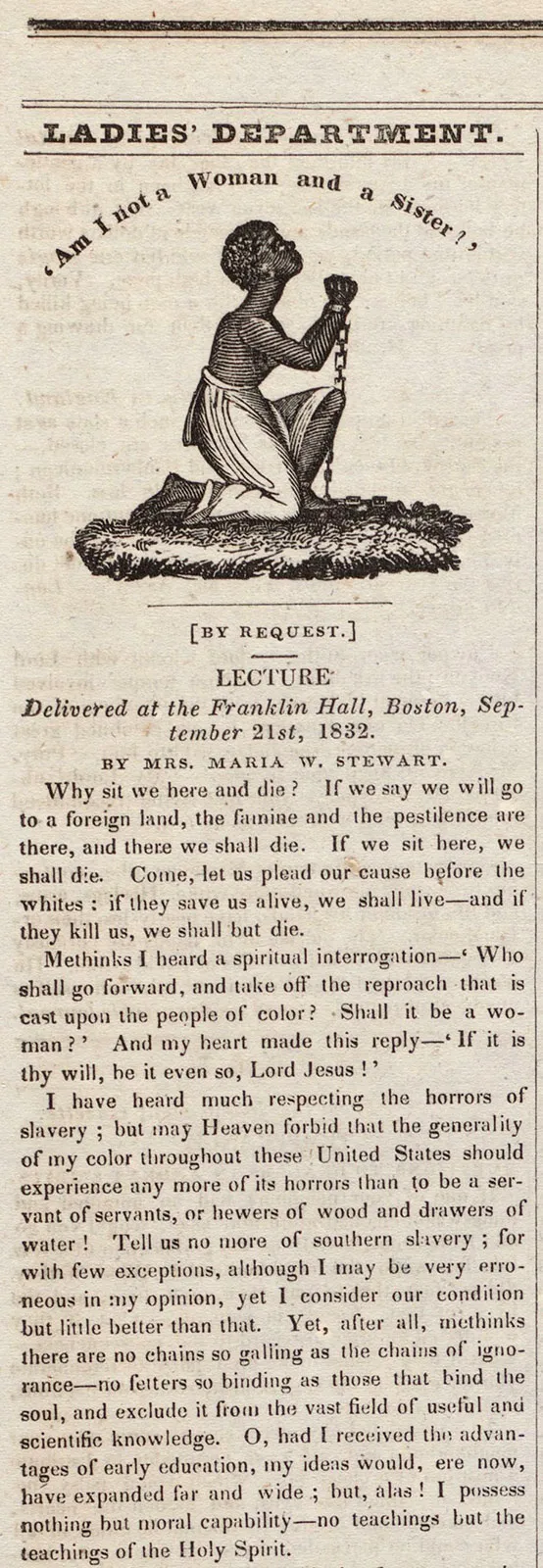
The Franklin Hall lecture of September 1832 was addressed to a more general audience and took up the political arguments that David Walker's Appeal had introduced — the case for Black self-determination, the critique of a society that denied Black people the opportunity to develop their full capacities, and the call for immediate rather than gradual change. She was explicitly building on Walker's legacy, and she acknowledged it: Walker had died in 1830, and Stewart understood herself as carrying forward the tradition he had founded, now with a woman's voice added to the radical Black tradition that Walker had established.
The Hostility and the Farewell: Speaking Back to the Opposition
The hostility that Stewart's lectures generated came from multiple directions, and the multiplicity of the opposition was itself instructive about the specific position she occupied in the social landscape of antebellum Boston. White opponents of Black equality objected to the content of what she was saying — to her calls for Black liberation, her critique of racial discrimination, her demands for Black education and Black rights. But some members of the Black male community of Boston objected to the form: to the fact that a woman was speaking publicly on political subjects, to the presumption of a woman who addressed men on questions of public life, to the departure from the conventional gender roles that even many Black abolitionists were unprepared to challenge.
Her farewell address at the African Meeting House in September 1833 engaged directly with both forms of opposition, but it was the challenge from within the Black community that she addressed with the most pointed and the most lasting force. She cited the women of the Old Testament who had acted and spoken in public — Deborah who judged Israel, Esther who saved her people, the women who had served as prophetesses — and she asked, with a directness that her audience could not easily deflect, whether the God who had inspired these women had somehow withdrawn that possibility from her. She asserted her right to speak, grounded it in biblical authority rather than in secular arguments about women's rights, and then announced her retirement from public lecturing with a dignity that made the announcement itself a kind of challenge to those who had driven her from the platform.
The retirement was complete. She did not return to public lecturing for the rest of her long life. Whether the decision reflected the depth of her exhaustion with the hostility she had encountered, or a private judgment that the specific moment of her public career had passed, or something more complex about the intersection of her ambitions and the limits that her society was prepared to tolerate, is not entirely clear from the historical record. What is clear is that she left the public platform having said what she needed to say, and that what she said has proven more durable than the circumstances that drove her from it.
Teaching, Washington, and the Private Life of a Public Legacy
The decades that followed Stewart's retirement from public lecturing were decades of private commitment to the educational work that had been the practical heart of her public arguments. She taught in schools in New York, in Baltimore, and eventually in Washington, D.C., where she settled in the years after the Civil War and where she spent the last decades of her life as a teacher and as the matron of the Freedmen's Hospital — the institution that served the Black community of Washington and that was one of the most important legacies of the federal government's Reconstruction-era commitment to the formerly enslaved.
Her educational work was the daily practice of the arguments she had made publicly in Boston thirty years earlier: that Black women's education was not a luxury but a necessity, that the cultivation of Black intellectual and professional capacity was the most fundamental precondition for Black freedom, and that the people who did this work — the teachers, the institution-builders, the women who stayed in the classroom when the more dramatic forms of public activism were unavailable or impossible — were as essential to the movement for Black liberation as the orators and the conductors and the organisers who received more public recognition.
She requested and received a pension from the federal government in her final years, in recognition of her service to the Union cause during the Civil War — a pension that provided her with a degree of material security that she had not known since the death of her husband more than four decades earlier. She died on 17 December 1879, in Washington, D.C., at the age of seventy-six, having produced in two years of public life a body of work whose importance subsequent generations would recognise even as her contemporaries had not fully grasped it.
Legacy: The First Voice and Its Long Silence
Maria W. Stewart was, by the most precise historical measure available, the first American woman of any race to deliver public lectures on political subjects to mixed-race audiences. The Grimké sisters — Angelina and Sarah — who are usually credited with pioneering women's public lecturing in America, began their famous lecturing tour in 1837, four years after Stewart had retired from the Boston platform. The precedent that Stewart established was not acknowledged at the time, was not widely known even within the antislavery movement, and was not recovered by historians until the twentieth century — when the specific significance of her lectures as the first instance of American women's public political speech was recognised and documented.
The arguments she made in those lectures — particularly the arguments about Black women's education, Black women's dignity, and the specific double subordination of Black women in a society organised around both racial and gender hierarchy — were arguments that the mainstream abolitionist movement was not prepared to fully absorb in 1832 and that took generations to become the common property of the Black feminist tradition that they had helped to found. Frances Watkins Harper, Sojourner Truth, Ida B. Wells, and the long line of Black women activists who followed them were building on a foundation that Stewart had laid, even when they did not know her name.
The recovery of her work — the reprinting of her lectures and essays, the recognition of her priority in the history of American women's public speaking, the acknowledgment of her place in the tradition of Black feminist thought — is one of the important achievements of twentieth and twenty-first-century scholarship on the antislavery period. She deserves to be known not merely as a footnote to the more famous figures of the movement but as a founding voice in her own right — the woman who, in two extraordinary years in Boston, said things that needed to be said and said them in a form that could not be unsaid.