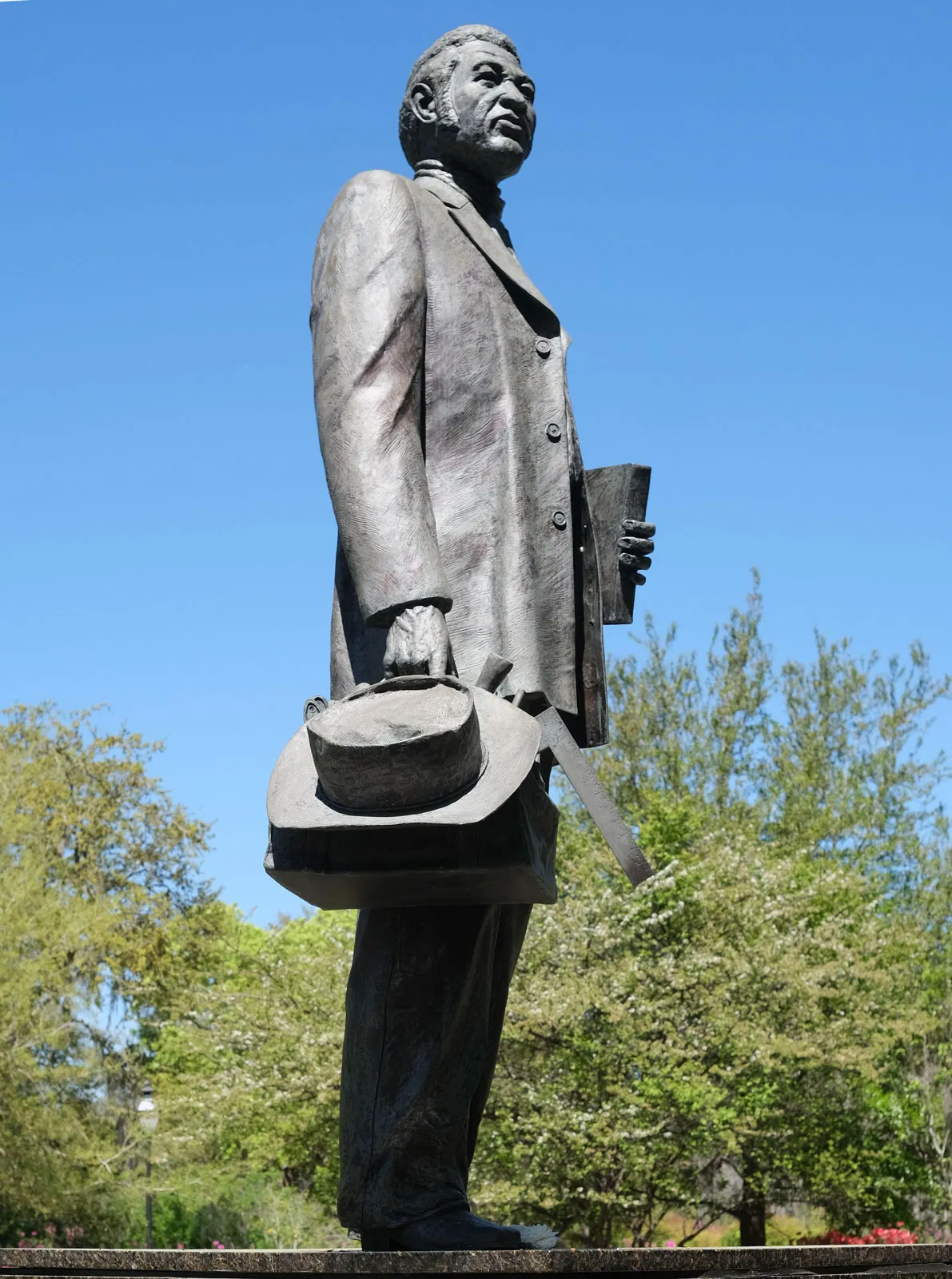
At a Glance
The Caribbean Origins and the Making of a Revolutionary
The precise origins of Denmark Vesey remain uncertain in ways that are typical of enslaved people's biographies — the historical record that documents the lives of the free and the powerful has little to say about the births and early years of those held in bondage, and what we know about Vesey's early life comes primarily from the documents generated by the conspiracy investigation of 1822, which were focused on his criminal acts rather than his biography. What is clear is that he was born somewhere in the Caribbean in the late 1760s, that he spent time on the Danish-controlled island of St. Thomas or one of the other Caribbean islands before being brought to South Carolina, and that he was the property of Captain Joseph Vesey — a Charleston slave trader and ship captain who had built his fortune on the human beings he transported across the Atlantic and the Caribbean.
Captain Vesey appears to have recognised in his enslaved property an unusual intelligence and skill that made Denmark valuable in ways that went beyond his labour. He brought Denmark with him on his voyages, which gave the enslaved man an exposure to the broader Atlantic world — to the Caribbean islands, to the other colonies and trading posts along the sea routes that Vesey's ship navigated — that was unusual for an enslaved person and that may have contributed to the geographic and political imagination that the conspiracy would later require. The young Denmark witnessed slavery from the inside of its commercial machinery, saw the Atlantic slave trade in operation, observed the spectrum of colonial societies in which it operated, and accumulated an understanding of the system's workings that was both more detailed and more comprehensive than that available to most of its victims.
His eventual settlement in Charleston — when Captain Vesey retired from the sea and established himself in the city — placed him in one of the most complex and contradictory social environments in the antebellum South. Charleston was the capital of South Carolina's slaveholding society, the port through which much of the Atlantic slave trade had passed, a city whose entire economy and social structure rested on the institution of slavery. It was also a city with a substantial and in some respects relatively autonomous free Black community — artisans, tradespeople, and professionals who occupied the social space between the enslaved majority and the white elite, navigating with varying degrees of success the elaborate and constantly shifting rules that governed Black life in the slave South.
Freedom, Prosperity, and the Uses of Position
The lottery win of 1799 transformed Denmark Vesey's life in ways that went far beyond the simple fact of legal freedom. Six hundred dollars purchased his liberty from Captain Vesey; the remaining nine hundred provided the capital for establishing himself as an independent carpenter. He built his business on the skill that his years of enslaved labour had developed and on the social connections — within both the Black and white communities of Charleston — that his position in the Vesey household had given him. By the early years of the nineteenth century he had established himself as one of the most skilled and prosperous carpenters in Charleston, a man whose services were sought by the white elite and whose reputation within the Black community was that of a man of substance and authority.
He became a leader — and by some accounts one of the founders — of the Emanuel African Methodist Episcopal Church, the institution that had been established in Charleston as part of the broader AME movement that Richard Allen had founded in Philadelphia. The Emanuel Church was not simply a place of worship; it was the central institution of Black community life in Charleston, a space where the enslaved and the free came together in a context that white authorities could not fully control, where the Bible's language of liberation and dignity could be spoken without the constant surveillance that governed Black social and political life in public spaces. Vesey used the church as a platform for developing the theology and the politics that underlay his conspiracy — a theology that drew heavily on the Exodus narrative, on the God who heard the cry of the enslaved and commanded them to go free, and on the prophetic tradition that understood divine justice as requiring the liberation of the oppressed.
The apparent contradiction — a free man, prosperous and respected, risking everything he had built for a cause that could offer him nothing beyond the satisfaction of striking against a system he had escaped — is one of the most discussed aspects of Vesey's story. He had achieved, within the brutal constraints of Charleston's racial order, a degree of security and comfort that was extraordinary for a Black man of his era. He chose to risk all of it, to organise a conspiracy that he knew would end in his death if it were discovered, because he could not accept the condition of the four million enslaved people around him as permanent, because he understood that his own freedom was inseparable from the freedom of those still in bondage, and because the theology and the politics he had developed gave him a framework within which the attempt was not merely justified but required.
Building the Conspiracy: Scale, Structure, and Ambition
The conspiracy that Vesey built between approximately 1817 and 1822 was remarkable for its scale, its organisational sophistication, and the clarity of its ultimate ambition. He and his principal lieutenants recruited participants through the networks of the AME Church and through personal relationships extending into the plantation districts surrounding Charleston — the Neck, the island communities, the rice and cotton plantations of the Low Country whose enslaved workers would need to be mobilised if the revolt was to have the numbers to succeed. The estimates of the conspiracy's size range widely, from the several hundred that historians who are skeptical of the court testimony tend to accept, to the nine thousand that some contemporary accounts claimed; the truth is probably somewhere between these extremes, but even at the lower end of the estimates, Vesey had organised a network of remarkable size and geographic extent.
The plan was operationally specific. Vesey and his lieutenants had assigned particular responsibilities to particular individuals and groups — the seizure of the arsenal on Meeting Street, the capture of the guardhouses that would prevent rapid military response, the taking of the stables to prevent the mounted pursuit that would otherwise cut down fleeing rebels, the liberation of the enslaved in the city and in the surrounding districts. They had stockpiled weapons, planned the timing for a Sunday night in July when the white population would be maximally vulnerable, and worked through the logistics of what would happen after the initial seizure of the city — including the plan to sail the entire liberated community to Haiti, where the Black republic that Toussaint Louverture and Jean-Jacques Dessalines had built offered both sanctuary and the proof that Black self-government was viable.
Gullah Jack Pritchard — an Angolan-born conjurer and Vesey's most important recruiter — brought to the conspiracy a spiritual dimension rooted in the African religious traditions that had survived the Middle Passage in the consciousness and the practice of the Low Country's enslaved Gullah community. Jack's claim that his protective charms would make the conspirators invulnerable was not simply a superstition but a mobilising force — it addressed the deepest fear of potential recruits, the fear that the revolt would simply be crushed by the overwhelming military power of the slaveholding state, and it offered a spiritual counterweight to that fear that helped Vesey recruit in communities that might otherwise have been paralysed by the rational calculation of the consequences of failure.
Betrayal, Trial, and the Judicial Murder of an Organiser
The betrayal of the conspiracy in May and June 1822 was, in one sense, the inevitable consequence of its scale. A conspiracy that recruited thousands of participants could not maintain perfect security — the more people who knew of the plan, the greater the probability that someone would inform, whether from fear, from calculation of personal advantage, or from a genuine conviction that the revolt would lead to catastrophic reprisals against the entire Black community of Charleston. The informants who revealed the plan — Peter Devany and George Wilson, both enslaved men — were probably acting from a combination of these motives, and their decision to report the conspiracy to their enslavers set in motion the arrests, trials, and executions that followed.
The trials that convicted Vesey and his co-conspirators were exercises in judicial power rather than judicial process. The special court convened to try the conspirators operated without the procedural protections that might have constrained the outcome — no defence counsel, no right to confront accusers, no requirement for corroborating evidence, no standard of proof adequate to distinguish actual conspirators from people whose names had been mentioned by frightened informants seeking to satisfy the court's appetite for convictions. The court produced thirty-five executions and forty-three transportations in a process that was designed to demonstrate the power of the slave system over those who challenged it rather than to establish the facts of individual guilt.
Vesey was hanged on 2 July 1822, on Blake's Lands outside Charleston, along with five of his principal co-conspirators. He was approximately fifty-five years old. He died as he had lived — with dignity, without breaking, without naming collaborators beyond what the court already knew, without providing the spectacle of fear and contrition that the authorities hoped his execution would produce. His silence in the face of death was itself a form of resistance, and the authorities' evident frustration at their inability to extract from him the complete confession they wanted was a tribute to the quality of the man they were killing.
Aftermath: Fear, Repression, and the Suppression of Memory
The aftermath of the Vesey conspiracy reshaped the social order of Charleston and of South Carolina in ways that lasted for decades. The state legislature passed new laws restricting the movement and activities of free Black people, tightening the surveillance of African American churches, and expanding the powers of the slave patrol. The Emanuel AME Church was torn down — the institution that Vesey had led and used as the organisational base for his conspiracy was physically destroyed, a demonstration of the authorities' determination to eliminate the institutional infrastructure that had made the conspiracy possible.
The suppression of memory was equally systematic. South Carolina authorities worked to prevent the story of the conspiracy from circulating — fearing, correctly, that the knowledge of what Vesey had attempted would inspire further attempts. The official narrative that the white South constructed around the conspiracy emphasised the smallness of its actual support, the ease with which it had been suppressed, and the treachery of the informants rather than the courage of the conspirators. For generations, Vesey's name was suppressed in Charleston, and the history of what he had organised was buried under layers of self-serving official distortion.
The recovery of that history took more than a century, and it was not until the civil rights movement of the twentieth century, and the subsequent development of Black history as a serious scholarly discipline, that Vesey's story was told with anything approaching the fullness it deserves. Today he is recognised as one of the most significant figures in the history of American Black resistance — a man who chose, from a position of relative safety and prosperity, to risk everything for the liberation of people he could have simply left to their fate, and who organised in pursuit of that liberation a conspiracy of ambition and sophistication that the slaveholding South had no way to respond to except with execution and terror.