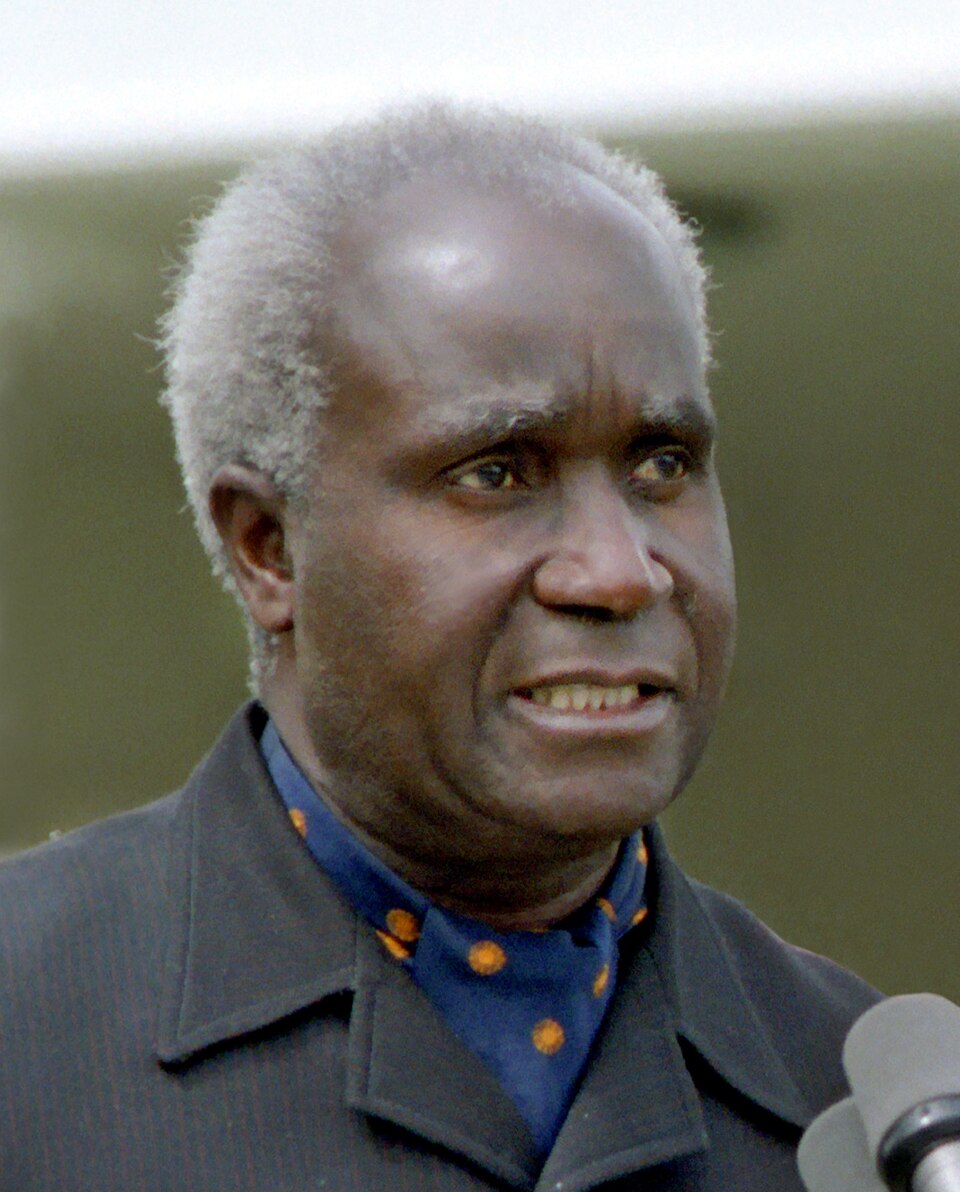
At a Glance
Lubwa, the Missionary Household, and the Making of a Humanist
Kenneth Kaunda was born in 1924 in Lubwa, a mission station in the Chinsali District of Northern Rhodesia's Northern Province — the son of David Kaunda, a Church of Scotland minister who had walked from Nyasaland to Northern Rhodesia to serve as a missionary teacher, and of Helen Kaunda, herself a teacher. The household into which he was born was one shaped by Christian values, educational commitment, and a sense of public vocation that were formative for everything that followed. The combination of Christian humanism — the belief in the fundamental dignity of every human person, the moral obligation to serve the community, the importance of education as a tool of human development — and the practical experience of a mission station that was simultaneously a school, a church, and a community institution gave Kaunda a formation that distinguished him from many of his contemporaries in the African independence generation.
He trained as a teacher at the Munali Secondary School and taught at Lubwa Mission before entering politics full-time. The teaching career was not merely a stopgap before politics — it was a vocation that shaped his political style throughout his career. He was, even in the most difficult political circumstances, a teacher and an explainer: someone who believed that the right argument, made clearly enough, could change minds and build the consensus that governance required. This faith in persuasion over coercion was both one of his most attractive qualities and, occasionally, a source of the political naivety that made him less effective than his circumstances required.
The Northern Province background connected him to the tradition of mission education and intellectual seriousness that had also produced Dunduzu Chisiza across the border in Nyasaland, and the northern communities would remain among UNIP's strongest constituencies throughout the independence period. His imprisonment alongside Harry Nkumbula in 1955 — both men jailed for distributing anti-Federation literature — was formative in the specific political sense of conferring the moral authority of colonial imprisonment while simultaneously revealing the political differences between them that would produce the 1958 split.
Breaking with Nkumbula: The 1958 Split and Its Logic
The formation of the Zambia African National Congress in 1958 — the organisation that Kaunda and Simon Kapwepwe led after breaking from Nkumbula's ANC — was the decisive event in the political reorganisation of Northern Rhodesian nationalism that ultimately produced Zambia's independence. The break reflected genuine political differences. Kaunda and his allies believed that Nkumbula's ANC was too willing to make tactical accommodations with the colonial authorities, too inclined toward the negotiated approach that the more militant nationalists considered inadequate, and insufficiently committed to the kind of mass civil disobedience that the independence timetable required.
The ZANC was banned almost immediately — within months of its formation — and Kaunda was imprisoned. The subsequent reorganisation as the United National Independence Party gave the movement a new institutional form that proved more effective than either predecessor organisation at building the mass mobilisation required for independence. UNIP's network of branches across Northern Rhodesia's varied communities — urban and rural, Copperbelt and rural north and south — was built with an organisational energy and systematicity that reflected both Kaunda's personal commitment and the capabilities of the team he worked with, including Kapwepwe, Mainza Chona, and others.
The constitutional negotiations that eventually produced independence in October 1964 were conducted by Kaunda as the undisputed leader of the independence movement — a position he had consolidated through the civil disobedience campaign, the political education work, and the demonstration of mass support that the UNIP organisation had built. The independence elections gave UNIP 55 of the 65 seats in the new National Assembly, establishing Kaunda as Prime Minister and, from the republican constitution of 1966, as President of the new republic.
The Copper Years: Development, Nationalisation, and the Philosophy of Humanism
The first decade of Zambia's independence was, economically, one of the more favourable periods of post-colonial development in Africa. The copper revenues that flowed from the Copperbelt were substantial and growing — Zambia was, through the late 1960s and early 1970s, one of Africa's wealthiest countries on a per capita basis, with revenues sufficient to fund significant investment in education, health, and infrastructure. The rapid expansion of the university, of secondary school enrolment, and of health facilities across the country in this period was a genuine achievement — the visible expression of a development programme that had the resources to begin closing the colonial-era gaps in service provision.
The 1969 nationalisation of the copper mines — which gave the Zambian government controlling stakes in the Nchanga Consolidated Copper Mines and Roan Selection Trust — was the most significant economic decision of Kaunda's presidency and one that was broadly popular domestically at the time. The argument for nationalisation was consistent with the Zambian Humanism framework: the country's primary resource should serve the country's development rather than the returns of foreign shareholders, and state control of the mines would enable the government to direct revenues toward public investment rather than corporate profit. The practical management of the nationalised mines proved considerably more challenging than the principled case for nationalisation had suggested — the technical expertise required to run major copper operations efficiently was not easily replaced when the expatriate managers who had run them departed, and the political pressures on mine management often undermined the commercial judgements that profitability required.
Zambian Humanism — the philosophy that Kaunda developed and articulated across a series of publications — was a genuine intellectual contribution to the debates about African development that the independence generation was conducting. Its insistence on the dignity of the human person, the value of African communal traditions as resources for development rather than obstacles to it, and the necessity of a specifically African path to development that was not simply the replication of European or Soviet models was serious and engaged with real questions. The gap between the philosophy's aspirations and the economic programme's achievements was real, but the philosophy itself represented more than rhetorical cover for conventional governance.
Frontline State: The Real Cost of Southern African Liberation Solidarity
Kaunda's commitment to the liberation of southern Africa was genuine, sustained, and materially costly in ways that deserve recognition alongside the one-party state's constraints on Zambia's own democratic development. Zambia under Kaunda was the most important operational base for the liberation movements fighting white minority rule across the region — the ANC of South Africa, ZAPU of Zimbabwe, SWAPO of Namibia, and others maintained offices, training camps, and logistical infrastructure on Zambian soil throughout the 1960s, 1970s, and 1980s.
The costs were not abstract. Rhodesian and South African forces conducted cross-border raids into Zambia — bombing raids on camps near Lusaka, ground operations in the western and eastern border areas, assassination attempts on liberation movement leaders on Zambian soil. Zambian civilians were killed in these raids. Infrastructure was destroyed. The Zambian security forces were stretched by the requirement to protect both the national territory and the liberation movement presence that attracted attack. And the economic costs of the liberation solidarity were also real: Kaunda's closure of the border with Rhodesia in 1973 — in solidarity with the Zimbabwean liberation struggle — cost Zambia access to its most economical trade route to the sea and imposed significant additional transport costs on the copper exports that were the economy's foundation.
These costs were borne by ordinary Zambians — in higher prices, reduced services, and physical danger — in the service of a pan-African solidarity commitment that reflected a genuine political value rather than narrow national interest. The liberation movements that Kaunda hosted eventually succeeded: Zimbabwe achieved independence in 1980, Namibia in 1990, South Africa in 1994. The role that Zambia's material support played in making these outcomes possible — providing the operational bases, the logistics, the diplomatic advocacy, and the physical sanctuary that the liberation struggles required — was significant and should be counted among the genuine achievements of Kaunda's governance alongside the economic mismanagement and political authoritarianism that characterised the same years.
The One-Party State: The Wrong Answer to a Real Question
The declaration of Zambia as a one-party participatory democracy in 1972 was the decision in Kaunda's career that most clearly contradicted the democratic values that his humanist philosophy claimed to embody. The motivation was mixed: genuine concern about the ethnic and regional dimensions of multiparty competition, which appeared to be organising voters along ethnic lines in ways that threatened national unity; increasing political pressure from opposition parties that was making governance more difficult; the economic difficulties that were beginning to emerge and that made the government less willing to risk the verdict of fully competitive elections; and the authoritarian tendencies that come with extended power regardless of the specific political philosophy of the leader who holds it.
The political competition that the one-party state suppressed had real dimensions that were not simply manufactured by ethnic manipulation — there were genuine regional and economic grievances in Zambia that multiparty competition gave voice to and that the one-party system suppressed rather than resolved. The long-term consequences of suppression — the accumulation of unaddressed grievances, the atrophying of the political participation mechanisms that genuine democracy requires, the erosion of the governing legitimacy that free competition sustains — contributed to the political and economic crisis that ultimately brought Kaunda's government down.
Simon Kapwepwe's defection from UNIP in 1971 — the departure of the man who had been Kaunda's closest political ally since their days together in the independence movement — was the most significant expression of the internal tensions within UNIP that the one-party framework was partly designed to manage. Kapwepwe's formation of the United Progressive Party and his subsequent imprisonment when the one-party state was declared illustrated the specific cost of the political closure: the people most capable of providing effective opposition were those with the deepest roots in the independence movement, and imprisoning them required the government to turn on its own history.
The Copper Collapse and the Long Crisis
The copper price collapse of 1975 — when the commodity markets turned decisively against the base metals that had funded Zambia's development decade — was the event that fundamentally changed the trajectory of Kaunda's government and created the economic crisis from which Zambia would not recover during his presidency. The fall in copper revenues, combined with rising oil prices and the increasing debt burden that the government had accumulated through the copper years, produced a fiscal crisis that required increasingly painful adjustments.
The International Monetary Fund and World Bank structural adjustment programmes that Kaunda negotiated through the 1980s — and then rejected in 1987, only to return to them in 1989 — imposed conditions that required the removal of subsidies on basic foodstuffs, the devaluation of the currency, and the reduction of government spending in ways that fell heavily on the urban poor who had been among UNIP's strongest supporters. The 1990 food riots in Lusaka — triggered by the removal of maize meal subsidies — and the attempted coup of the same year signalled that the political legitimacy of the government was in serious crisis, and Kaunda's eventual concession to the demand for multiparty democracy was a recognition of political reality rather than a principled choice.
October 1991: The Act That Defined His Legacy
The restoration of multiparty democracy and the October 1991 elections were, in many ways, forced on Kaunda by the combination of popular pressure, donor conditionality, and the internal party dynamics of a UNIP that had lost much of its governing legitimacy. Frederick Chiluba's Movement for Multi-party Democracy represented the urban labour movement's accumulated frustration with UNIP's economic management, and the 76% to 24% margin of Chiluba's victory over Kaunda was a decisive expression of popular judgement rather than a close result.
Kaunda's concession — made on election night, gracious, without precondition, without any attempt to use the security forces or party structures to overturn the result — was the act that, more than any other single moment, defined his place in African political history. He had governed for twenty-seven years, had declared a one-party state, had imprisoned political opponents, had mismanaged an economy. And then, when the people voted against him, he left. Peacefully. The same day.
The comparison with his contemporaries across the continent — leaders who died in office, who were removed by coup, who manipulated electoral processes to extend their tenures, who responded to electoral defeat with violence — makes Kaunda's peaceful departure stand out as something genuinely unusual, and genuinely admirable. It did not erase the one-party state or the economic failures. But it meant that Zambia's democratic transition was one of the more peaceful on the continent, that the institutional transfer of power occurred without violence, and that the precedent of electoral accountability for a sitting president was established in a way that mattered for the long-term health of Zambian democracy.
Kenneth Kaunda died in June 2021 at ninety-seven — the last of the major figures of the first generation of African presidents, and one whose legacy, in all its complexity, deserves engagement rather than the simple verdict that neither celebration nor condemnation can honestly provide.