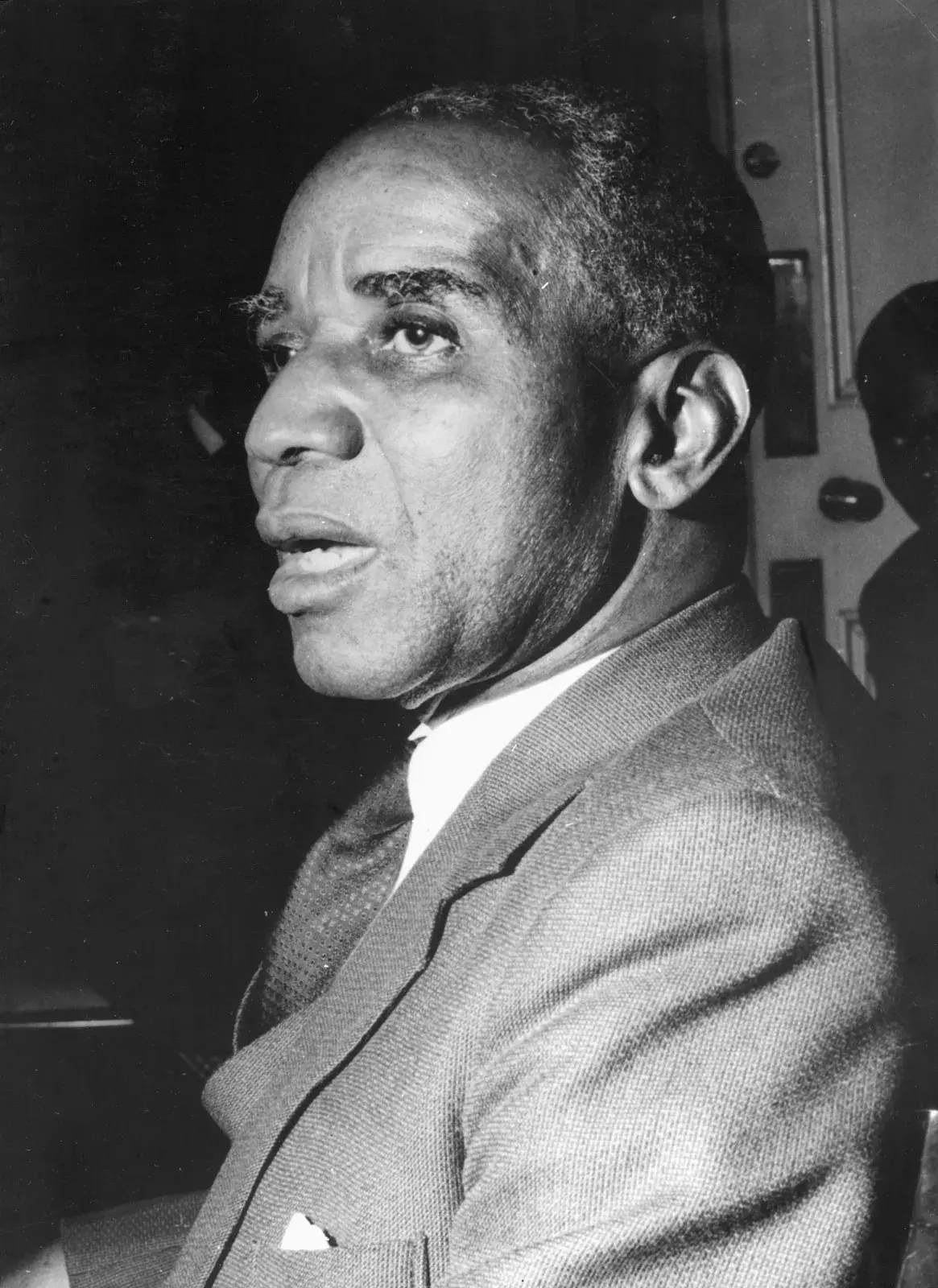
At a Glance
The Walking Boy: From Kasungu to America
The early life of Hastings Kamuzu Banda was, by any measure, extraordinary — an extraordinary personal journey that shaped the specific kind of authority he would eventually bring back to Nyasaland. Born in the late 1890s in Kasungu, in the central region of what was then a relatively recently established British protectorate, he grew up in a world shaped by the first generation of colonial rule, the early missionary presence, and the social upheaval that the colonial encounter had produced in the communities of central Nyasaland.
The journey he made as a young man — walking southward through Southern Rhodesia and eventually reaching South Africa, where he worked in the Rand gold mines while pursuing whatever education he could access — was a feat of physical endurance and personal determination that defined his self-understanding for the rest of his life. He would later speak of this journey as formative: the experience of seeing how Africans were treated across the southern African colonial landscape, of encountering the harsher forms of racial discrimination that the gold mines embodied, and of maintaining the determination to pursue education and advancement despite every structural obstacle that the system placed in his way.
From South Africa, his educational journey eventually took him to the United States — to Indiana and then to Nashville's Meharry Medical College, the historically Black medical institution that trained African American doctors in the segregated United States and that had become, by the early twentieth century, the most significant institution for Black medical education in the country. His time in America gave him exposure to both the African American experience of racial discrimination and the tradition of Black achievement and institution-building that had developed in response to it — a context that shaped his understanding of what African people could accomplish when given the opportunity.
His subsequent medical training and practice in Scotland and England, and his years as a general practitioner in Liverpool and then London serving primarily African and Caribbean communities, gave him the European formation that would be politically significant when he returned to Nyasaland. He was not an African who had been to Britain; he was a man who had built a successful career in Britain, who was respected by his patients and colleagues, who could speak with equal ease about Nyasaland's colonial grievances and about the detailed workings of the National Health Service. This combination was the source of his unique authority — the African who had not merely survived but thrived in the white world and was bringing those capabilities home.
The Return: July 1958 and the Transformation of Nyasaland Politics
The political context into which Banda returned in July 1958 was one of growing nationalist momentum but frustrated organisational energy. The Malawi Congress Party — the successor to the Nyasaland African Congress — had built a significant membership base and had been conducting the campaign against the Central African Federation with considerable determination, but it lacked a leader of national and international standing capable of projecting the movement's demands beyond the territory's borders and of speaking with the authority that the colonial government and British public opinion would be required to acknowledge.
Banda's arrival changed this immediately and dramatically. The crowds that met him at the airport were not merely enthusiastic — they were responding to something specific: the return of a man who had spent nearly forty years proving that an African from Nyasaland could achieve at the highest level in the wider world, and who had now come home to place those achievements in the service of his people's liberation. This was a powerful political narrative, and it worked in multiple registers simultaneously: inspiring to ordinary Nyasalanders, impressive to British political audiences who took seriously the credentials of a Scottish-trained doctor, and useful diplomatically because Banda could engage with international opinion in ways that the movement's domestic leadership could not.
His arrest in March 1959, during the colonial government's Operation Sunrise crackdown, and his subsequent thirteen months in the Gwelo prison in Southern Rhodesia, followed the established pattern of nationalist leaders gaining political authority through colonial imprisonment. The imprisonment confirmed his status, generated international sympathy, and returned him to the independence movement in 1960 with his authority significantly enhanced. From this point, his leadership of the MCP was unchallenged, and the path to independence — through the constitutional negotiations of 1960 to 1964 — ran through him.
Independence and Its Immediate Corruption: September 1964
Malawi achieved independence on 6 July 1964 — the same date, deliberately chosen, as Banda's 1958 return to Nyasaland. The independence celebrations were genuine: a country of eight million people had achieved self-governance, ending the colonial subjugation that had defined their political condition for nearly eighty years. The flag was lowered and raised, the speeches were made, and the reasonable assumption was that independent Malawi would begin the difficult work of post-colonial development under the leadership of the man who had led the independence movement.
The September 1964 cabinet crisis shattered this assumption within months. Six of Banda's ministers resigned in protest at his governing style — the autocratic dismissal of their views, the personal cult of authority he was constructing, the rejection of the African socialist development policies that several of them had advocated. The resignations were treated not as legitimate political disagreement but as treachery, and Banda's response established the pattern that would define his governance for the next three decades: independent political opinion, expressed by anyone with enough standing to pose a challenge, was intolerable and would be eliminated.
The specific content of the ministers' objections was significant. They were arguing, among other things, for development policies — cooperative agriculture, more equitable resource distribution, closer alignment with other African states' socialist development approaches — that would have given independent Malawi a genuine programme of economic transformation rather than the conservative, pro-Western, commercially oriented approach that Banda preferred. Their dismissal was therefore not only a political defeat for those specific individuals but the foreclosure of a development path that Malawi might have taken and did not.
The Machinery of Control: How the Banda State Worked
The political system that Banda constructed over the decade after independence was one of the most complete examples of personalised authoritarian rule in post-colonial Africa. Its instruments were varied and mutually reinforcing. The Malawi Young Pioneers — a paramilitary youth organisation that served simultaneously as an instrument of the ruling party, a surveillance network, and an enforcement arm — was deployed across the country to monitor political compliance and to intimidate those whose political reliability was in question. The Malawi Congress Party itself, which was the only legal political organisation from 1966 onward, maintained a system of mandatory membership and contribution that made civic participation inseparable from political loyalty. The network of informers that penetrated every level of Malawian society — every school, every workplace, every neighbourhood — meant that political conversation that deviated from the approved line was dangerous regardless of where it took place.
The detention system was the endpoint of this apparatus. The Preventive Detention Act gave the government authority to imprison without charge or trial for indefinite periods, and it was used extensively. Kondowe, Dzeleka, Mikuyu, and other facilities held, over the Banda years, hundreds of Malawians whose primary offence was independent political thought or expressed disagreement with the government. The conditions in these facilities ranged from harsh to lethal — starvation, torture, and inadequate medical care killed a number of detainees who had been imprisoned for political rather than criminal reasons.
The cultural dimension of the Banda state was equally comprehensive. Women were required to wear skirts or dresses that covered the knees — trousers were prohibited. Men were required to maintain haircuts and avoid the longer styles that Banda associated with decadence. Music was censored, with particular hostility to genres associated with political subversion or cultural autonomy. The Chichewa language was promoted at the expense of other Malawian languages — Tumbuka in the north, Yao in the south — in ways that reflected both Banda's own central region background and his use of cultural homogenisation as an instrument of political control. The national press was controlled, international publications that might carry critical reporting were banned or restricted, and the information environment was managed with considerable thoroughness.
South Africa and the Contradiction of Pan-African Solidarity
The most internationally conspicuous anomaly of Banda's foreign policy was his maintenance of commercial and diplomatic relations with apartheid South Africa throughout his presidency. While the Organisation of African Unity and virtually every other African state were maintaining the boycott of the apartheid regime that was one of the primary instruments of international pressure against it, Banda was visiting South Africa, receiving its Prime Ministers in Malawi, and maintaining the trade routes and economic relationships that Malawi's landlocked geography made commercially convenient.
The practical justification — that Malawi needed access to South African transport routes and markets — had some validity, though it did not explain the diplomatic recognition and the public cordiality that went beyond what economic necessity required. The ideological dimension was more revealing: Banda's conservatism, his anti-communism, his hostility to the African socialist and pan-Africanist politics of figures like Kaunda and Nyerere, and his comfort with the kind of hierarchical social order that apartheid represented — however differently from what he was building in Malawi — made him more naturally aligned with the white minority government than with the liberation movements that most African states supported.
The relationship with South Africa was also useful domestically. South African support — economic, intelligence-sharing, and occasionally security — gave the Banda government a powerful external patron whose interests in regional stability aligned broadly with Banda's interest in maintaining his own political control. The relationship was one of mutual convenience, and both parties maintained it for decades against the considerable criticism it attracted from the rest of the continent.
The Chirwa Case: The Full Measure of What the State Did
The kidnapping, trial, and imprisonment of Orton Chirwa and Vera Chirwa — the Malawian nationalist lawyer who had been one of the founding figures of the independence movement and who had subsequently gone into exile and opposition — was one of the most internationally noted of the Banda government's political persecutions. The Chirwas were abducted from Zambia in December 1981 in an operation that involved Malawian security agents crossing an international border to seize a citizen who had committed no extraditable offence. They were tried by a traditional court — not a regular judicial body — for treason, convicted, and sentenced to death. The sentences were eventually commuted to life imprisonment following sustained international pressure, but Orton Chirwa died in detention in 1992, still imprisoned, having spent the last decade of his life in Banda's jails for the crime of political opposition.
The Chirwa case crystallised, for international audiences who might not have followed the details of Malawian domestic politics, what the Banda state actually was. The abduction from a neighbouring country, the trial before a non-judicial body, the death sentences for political opposition, the international campaign that eventually won commutation but not release, and the death of the prisoner before he could be freed — this was not the governance of an independence leader who had made some difficult choices in difficult circumstances. It was the systematic use of state power to eliminate, imprison, and kill people whose only offence was independent political activity.
The Democratic Transition: Removed by a Vote at Ninety-Six
The democratic transition that ended Banda's rule was driven by a combination of internal pressure and external conditionality that converged in the early 1990s. The 1992 Pastoral Letter from the Catholic bishops of Malawi — a sustained and specific critique of the government's human rights record, signed collectively by the hierarchy and read from pulpits across the country — opened political space for dissent that three decades of repression had kept closed. Donor governments, responding to the changed international environment of the post-Cold War period and to the growing human rights evidence about Malawi, began conditioning their aid on political reform. And the internal opposition — much of it operating from exile in Zambia, Zimbabwe, and Britain — found new channels through which to make itself heard.
The June 1993 referendum — in which Malawians were asked to choose between a one-party system and multiparty democracy — produced a 63% majority for multiparty democracy. Banda accepted the result, though the acceptance was more a recognition of political reality than a principled concession to democratic values. The May 1994 elections that followed were genuinely competitive: Banda stood as a candidate, aged approximately ninety-six, representing the MCP that had governed Malawi for thirty years. He received 33% of the presidential vote. His party came third. Bakili Muluzi of the United Democratic Front won the presidency.
The defeat was accepted without violence. Whatever else might be said about Banda's governance — and much can be said, most of it unfavourable — the peaceful acceptance of an electoral defeat by a Life President was not a common outcome in African politics, and it deserves acknowledgement as a significant moment in Malawian democratic history. It did not erase what preceded it, but it did provide the transition with a character that might have been much worse.
The Reckoning That Came and the One That Did Not
After the transition, Banda faced legal proceedings related to the political murders that had occurred during his governance. He was charged in connection with the deaths of four politicians — Dick Matenje, Aaron Gadama, David Chiwanga, and Twaibu Sangala — who had died in 1983 in circumstances that strongly suggested political assassination staged as a road accident. The trial, which began in 1995, was eventually abandoned when Banda's deteriorating health made it impossible to continue — he was, by this point, genuinely very old and genuinely very ill, whatever the uncertainty about his exact birth year. He died in Johannesburg in November 1997, having escaped the full legal reckoning that his victims and their families deserved.
The broader accountability for thirty years of authoritarian rule — the detention system, the deaths in custody, the political murders, the systematic suppression of civil and political rights — was not achieved through any formal transitional justice mechanism. Malawi's transition, like many transitions in the post-Cold War period, prioritised political stability and forward movement over backward accountability, with consequences for the sense of justice among those who had suffered and for the completeness of the historical record about what the Banda years actually involved.
Hastings Kamuzu Banda remains one of the most difficult figures in African independence history to assess simply. He achieved something real — the liberation of Malawi from colonial rule — and then used the authority that achievement conferred to build a system of personal dominion that betrayed the values the liberation movement had claimed to serve. That is the arc of his political career, and the honest account of it must hold both dimensions simultaneously, without allowing the genuine achievement of independence to erase the genuine atrocity of what followed, or allowing the atrocity of what followed to erase the genuine significance of how it began.