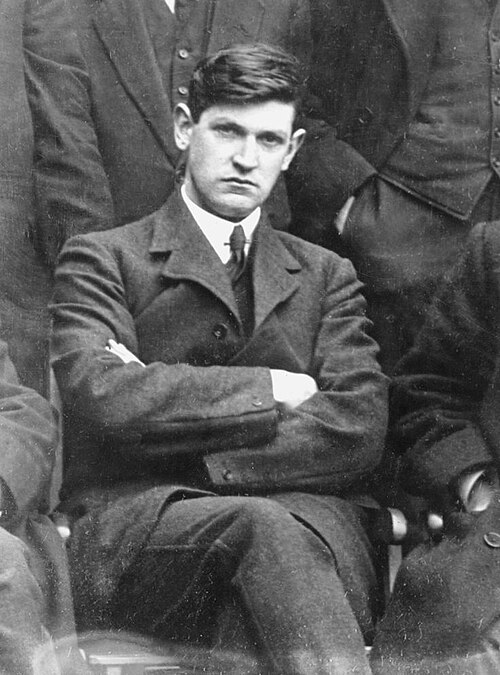
West Cork: A Farmer's Son with a Fenian Inheritance
Michael Collins was born on 16 October 1890 at Woodfield, Sam's Cross, near Clonakilty in west County Cork, the youngest of eight children of Michael John Collins, a tenant farmer, and Mary Anne O'Brien. His father was sixty years old at the time of the marriage and seventy-five when Michael was born — a detail that lent the child an unusually direct relationship with an older republican tradition. The elder Collins had been a member of the Irish Republican Brotherhood in his youth, a fact that filtered into the household atmosphere even if it was rarely spoken of directly. Michael grew up on a small farm in the rich but remote landscape of west Cork, attending the local national school at Lisavaird where his teacher Denis Lyons — himself an IRB member — deepened the patriotic instinct the boy already carried. The local blacksmith James Santry told him stories of 1798 and 1848 and 1867, and Collins absorbed them as practical rather than romantic history.
His father died in 1897, when Michael was six. His mother continued to work the farm and raise the eight children. At fifteen, having passed the British Civil Service examination in Cork, he moved to London to live with his sister Hannie and take up a position as a boy clerk at the Post Office Savings Bank at Blythe House, West Kensington. He was resourceful, quick-tempered, and physically imposing — well-built, around six feet tall, with an energy that struck everyone who met him. In London he joined the GAA, through which he met Sam Maguire — a Church of Ireland republican from Dunmanway in Cork — who introduced him to the IRB at the age of nineteen. By 1915 he was working at the Guaranty Trust Company and was treasurer of the IRB's South England circle. He returned to Ireland in January 1916, prepared for whatever was coming.
Easter Rising and Frongoch: The School of the Revolution
Collins fought in the Easter Rising of April 1916 as aide-de-camp to Joseph Plunkett at the GPO — the rebel headquarters on Sackville Street. He was a witness to the entire week: the proclamation of the Republic, the street-by-street fighting, the civilian casualties, the fires, and the eventual surrender. He was scathing about some of the tactical decisions — the occupation of indefensible positions like St Stephen's Green — and drew operational lessons that shaped everything he did afterwards. After the surrender he was arrested with the other GPO garrison and interned at Frongoch prison camp in Wales, where he spent the rest of 1916.
Frongoch was, in retrospect, the formative experience of the Irish revolution. Fifteen hundred republican prisoners were held there together and Collins emerged from the camp as an organiser and leader of the first rank. He identified the men who would matter, built relationships across provincial and social boundaries, and returned to Ireland in December 1916 with a card-index of contacts that was the embryo of everything that followed. He was twenty-six years old.
The War of Independence: Building an Intelligence Machine
Between 1917 and 1921, Collins accumulated roles at a pace that would have been impossible for a man of lesser energy. He was elected Sinn Féin MP for South Cork in December 1918 and took his seat in the First Dáil in January 1919, serving as Minister for Finance — in which capacity he raised a National Loan of almost £400,000 from Irish people at home and in the diaspora to fund the parallel republican state. He was simultaneously president of the IRB and, from September 1919, Director of Intelligence of the IRA. The combination was unprecedented and made him effectively the dominant operational figure of the independence campaign.
His intelligence network was his greatest creation. He recruited agents throughout the Dublin Metropolitan Police and the Royal Irish Constabulary, including Ned Broy, who smuggled Collins into the G Division's archives in April 1919, enabling him to identify every British intelligence agent operating in Ireland by name and address. He established a unit known as the Squad — twelve men selected for nerve and discipline — specifically to assassinate British intelligence operatives. On 21 November 1920, in the operation that became known as Bloody Sunday, the Squad and affiliated IRA units killed fourteen British intelligence agents across Dublin in a single morning, decapitating the British intelligence capability in Ireland at a stroke. That afternoon, British forces fired into a crowd at Croke Park during a Gaelic football match, killing fourteen civilians.
The British government offered a reward of £10,000 — equivalent to millions today — for information leading to Collins's capture. He moved openly around Dublin throughout the war, cycling to meetings, sitting in public houses, conducting business in plain sight. He was never caught. His ability to exist in plain sight — unknown to the British because their intelligence apparatus was too broken to identify him — was itself a product of the very intelligence war he was winning. By mid-1921 the RIC was demoralised, penetrated, and increasingly unable to operate in rural Ireland. The IRA's flying columns — small, mobile guerrilla units operating in the countryside — had made large swaths of Munster and Connaught ungovernable. The British entered negotiations.
The Treaty: Signing His Own Death Warrant
The truce of July 1921 ended the fighting. Éamon de Valera conducted preliminary talks with Lloyd George in London and then, controversially, sent Collins and Arthur Griffith to lead the final negotiations while he remained in Dublin. Collins was reluctant to go. He was a soldier and an intelligence operator, not a politician, and he had no experience of diplomatic negotiation with a prime minister of Lloyd George's skill and guile. He went because de Valera sent him.
The Anglo-Irish Treaty, signed on 6 December 1921, established the Irish Free State as a self-governing dominion of the British Empire. It required members of the Dáil to take an oath of allegiance to the Crown. It partitioned the island, leaving the six northern counties within the United Kingdom subject to a Boundary Commission that Collins hoped would make the northern statelet economically unviable. He signed it in the conviction that it was the best available settlement — that the IRA was not in a position to withstand the resumed full-scale military campaign Lloyd George had threatened — and with the explicit acknowledgement, in a letter written that night, that he might be signing his own death warrant. He was right on both counts.
The Treaty split the republican movement. De Valera rejected it. The Dáil ratified it by 64 votes to 57. Collins became Chairman of the Provisional Government of the Irish Free State and worked simultaneously to implement the Treaty and to maintain some version of republican unity. He held secret meetings with anti-Treaty IRA leaders. He authorised arms transfers to northern nationalists. He attempted to produce an election pact with de Valera that would defer the civil war. None of it worked. In June 1922, the anti-Treaty IRA occupied the Four Courts in Dublin. Collins ordered the bombardment that began the Civil War on 28 June — using artillery borrowed from the British Army, an act that made his position among former comrades irrecoverable.
Béal na Bláth: The Death of the Big Fellow
By August 1922, both Arthur Griffith and Collins were under enormous strain. Griffith died of a cerebral haemorrhage on 12 August. Collins, who had become Commander-in-Chief of the National Army, insisted on touring west Cork — his own territory — to assess Free State military positions and, it has been suggested, to explore back-channel contacts with anti-Treaty commanders he still knew personally. On the afternoon of 22 August 1922 his convoy drove through the crossroads at Béal na Bláth, between Crookstown and Bandon in County Cork. An anti-Treaty ambush party had been waiting there all day and was in the process of withdrawing when the convoy appeared. In the firefight that followed, Collins was shot in the head. He was the only casualty on the Free State side. He was thirty-one years old.
Who fired the fatal shot has never been definitively established. The anti-Treaty commander on the road that day was Liam Deasy; the firing was from positions on the hillside above the road. The most widely accepted candidate among the men present is Tom Hales, but the question remains officially unresolved. Collins's body was taken to Dublin, where it lay in state in the City Hall and was viewed by tens of thousands of mourners. He was buried in Glasnevin Cemetery.
Legacy: The Argument That Never Ends
The argument about Michael Collins has never stopped and probably never will. Those who regard him as the architect of Irish freedom point to the intelligence campaign that made British administration in Ireland impossible, the Treaty that gave the Free State the basis for developing into a fully sovereign republic over the following decades, and the financial and administrative structures he built that gave the new state institutional coherence from the beginning. Those who regard him more critically note that the Treaty accepted partition, that the oath of allegiance was a real and not merely symbolic humiliation, and that the Civil War — which Collins helped to start — was the most destructive conflict in modern Irish history and poisoned Irish political culture for generations.
The fascination with Collins as a personal figure remains intense, fed by the combination of extraordinary competence, personal charm, physical courage, and early death. Neil Jordan's 1996 film with Liam Neeson brought him to a global audience and cemented a heroic narrative that historians have complicated but not displaced. The annual commemoration at Béal na Bláth draws thousands of people every August, from across the political spectrum, united at least in the recognition that something irreplaceable was lost at that crossroads in west Cork on a summer evening in 1922. Collins himself knew the Treaty was incomplete. He called it a stepping stone — a foundation on which a fully independent Ireland could eventually be built. The Republic of Ireland declared in 1949, and the Good Friday Agreement of 1998, can both be read as movements toward the destination he identified, however imperfectly, at the negotiating table in London.