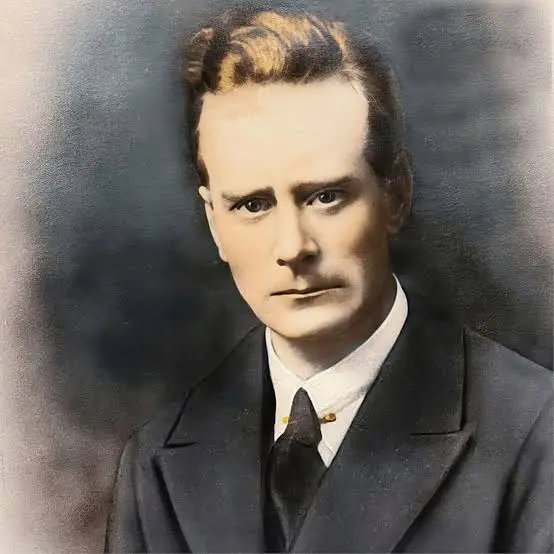
An English Birth, an Irish Soul
William Joseph Mellows was born on 25 May 1892 at Hartshead Military Barracks in Ashton-under-Lyne, Lancashire, the son of William Joseph Mellows, an English non-commissioned officer in the British Army, and Sarah Jordan, an Irish woman from the townland of Monalig, Castletown, County Wexford. His origins were entirely without romance for a future republican martyr: the son of a British soldier, born in an English barracks, with a father who would have preferred his boy to follow him into the army. The family moved around with the father's postings — to Dublin's Fairview in 1895, then to Cork — but because of poor health, the young Liam was sent to live with his maternal grandparents in Wexford until 1898, and it was among the fields and traditions of rural County Wexford, the county of the 1798 rebellion, that his Irish identity took root.
He attended military schools in Cork and Dublin — at Wellington Barracks and Portobello — which his father hoped would lead him toward an army career, but he refused. Instead, after leaving school in 1907, he worked as a clerk in Dublin firms, including the Junior Army and Navy Stores on D'Olier Street. The pivot came in 1911 when he purchased a copy of Irish Freedom, the IRB's newspaper, and walked into the shop of Thomas Clarke — the veteran Fenian who would later be the first of the 1916 leaders to be executed — who recruited him into Fianna Éireann, the republican boy scout organisation founded by Constance Markievicz. He Gaelicised his name from Willie to Liam, a gesture of cultural identification that was common in the nationalist movement of the time. He met James Connolly during the 1913 Dublin Lock-Out and was deeply affected by the socialist leader's analysis of the relationship between national liberation and economic justice.
In the summer of 1913, he gave up his clerk's job to become a full-time Fianna organiser, funded in part by Roger Casement. For the next three years he cycled across Ireland — literally, on a bicycle — building local Fianna branches, recruiting young men, and becoming the most widely connected organiser of his generation in the republican movement outside of Dublin. Dozens of men who later led the IRA in provincial Ireland had Liam Mellows as their first point of contact with advanced nationalism.
Easter Rising 1916: Leading Galway
When the Easter Rising came in April 1916, Mellows commanded the rising in County Galway — the only significant action outside of Dublin, and the one that most nearly extended the revolt into the provinces. He had been arrested and deported to England by the British authorities in February 1916, in an attempt to neutralise him before the planned rising, but he escaped from his place of internment in Leamington Spa, disguised in the habit of a priest, and returned to Ireland in time for Easter Week. His arrival in Galway — by boat, in disguise, with only a few days' warning — and his ability to mobilise the local Volunteers speaks to both the force of his personality and the organisational network he had spent years building.
He led approximately 700 Volunteers in attacks on Royal Irish Constabulary barracks across County Galway over Easter Week, engaging British forces at Clarenbridge, Oranmore, and Athenry. The action was tactically limited — the Galway Volunteers were poorly armed, the coordinated support from other counties did not materialise as planned, and the garrison held out only until news of the Dublin surrender arrived — but it demonstrated that the Easter Rising, however localised in practice, had genuine roots beyond the capital. After the collapse of the rising, Mellows escaped to the United States, where he was arrested on arrival in New York and interned for a period before being released in 1917 under pressure from Irish-American organisations.
America, the War of Independence, and Arms
Between 1916 and 1920, Mellows served as the IRA's representative in the United States, working alongside the veteran Fenian John Devoy in New York and helping to organise Éamon de Valera's fundraising tour of America in 1919–1920. The American years were not easy. He was suspected at one point of being an informer by the Mayor of New York — a charge that was deeply damaging in republican circles and that he worked strenuously to disprove — and he found the world of Irish-American politics, with its layers of faction and personal rivalry, alien to his direct and uncompromising temperament. His letters from America reveal a man conscious of the gap between the talk and the deed, writing to a friend that he felt he had "failed lamentably" because "talk is cheap — it is the deed that counts."
He returned to Ireland in 1920 and was appointed IRA Director of Supplies — responsible for acquiring and distributing weapons to the republican forces fighting the War of Independence against the British Army and the Black and Tans. It was a crucial logistical role, conducted under conditions of intense British surveillance, and Mellows performed it with considerable skill. He was also elected a Sinn Féin TD for Galway East and for Meath North in the 1918 general election — the election that swept Sinn Féin to dominance and produced the First Dáil — though he was unable to take his seat in the Dáil due to his continued status as a fugitive.
The Treaty Debates: An Implacable Opponent
The Anglo-Irish Treaty of December 1921 — which ended the War of Independence and established the Irish Free State as a dominion of the British Empire, requiring an oath of allegiance to the Crown — divided the republican movement with shattering consequences. Mellows was one of the most uncompromising opponents of the Treaty in the Dáil debates. He argued that the Treaty was not merely a political compromise but a betrayal of the Republic proclaimed in 1916 and confirmed in the Democratic Programme of the First Dáil. In the Treaty debates he declared: "We do not seek to make this country a materially great country at the expense of its honour in any way whatsoever. We would rather have this country poor and indigent, we would rather have the people of Ireland eking out a poor existence on the soil; as long as they possessed their souls, their minds, and their honour."
When a conference of nine TDs met privately in January 1922 to try to reach a compromise position, the other four anti-Treaty members said agreement had been reached — but Mellows refused, and from that point he was regarded by the pro-Treaty side as among their most intransigent opponents. He was also one of the few voices in the anti-Treaty leadership who argued that the republican cause needed to connect itself explicitly to the social and economic grievances of the Irish working class and small farmer — that political independence without economic transformation would merely substitute an Irish ruling class for a British one. This analysis, influenced by his reading of James Connolly, placed him to the left of most of his comrades.
The Four Courts and Capture
In April 1922, as the Irish Civil War approached, anti-Treaty IRA forces under Rory O'Connor occupied the Four Courts in Dublin — the historic seat of the Irish legal system — in a direct challenge to the Provisional Government. Mellows was among the leadership of the garrison. The occupation lasted until late June, when the Free State government, under pressure following the assassination of Field Marshal Henry Wilson and facing British ultimatums, bombarded the Four Courts with artillery borrowed from the British Army. The garrison held out for two days before surrendering on 30 June 1922. Mellows had an opportunity to escape alongside Ernie O'Malley in the confusion of the fall — O'Malley managed it — but he did not take it, for reasons that remain a matter of speculation. O'Malley later wrote that Mellows's early death was "our greatest loss."
He was imprisoned in Mountjoy Gaol in Dublin, where he spent the remaining months of his life. In captivity he wrote the document that became known as "Notes from Mountjoy" — a social programme for the anti-Treaty IRA that drew explicitly on the Dáil's Democratic Programme of 1919 and on Connolly's socialist analysis. The notes called for state ownership of heavy industry, complete state control of the transport system, and a land redistribution programme. They were a remarkable document — produced in prison by a man under sentence of possible death, attempting to give the republican movement a coherent social and economic vision rather than a merely political one. The Labour Party published the document posthumously in 1922.
Execution: 8 December 1922
On 7 December 1922, a pro-Treaty TD, Seán Hales, was shot dead by the IRA in Dublin. The following morning — 8 December 1922, the Feast of the Immaculate Conception — the Free State government, without trial, without charge, and without any legal process whatever, executed four senior anti-Treaty prisoners in reprisal: Liam Mellows, Rory O'Connor, Joe McKelvey, and Dick Barrett. They were shot by firing squad in Mountjoy Gaol at 7:30 in the morning. Mellows was thirty years old.
His last written message was to his fellow prisoners in C Wing of Mountjoy, delivered by a prison guard to his cell-mate and close friend Eamon Martin. It ended with the words "An Poblacht Abu" — Long Live the Republic. He had written to his mother during his final hours: "Until the shadow of shame is lifted from our country... We die for the truth." The executions were widely understood, even by some supporters of the Free State, as an act of governmental terror — a deliberate killing of prisoners without due process, carried out to intimidate the anti-Treaty side rather than as a measured judicial response to the killing of Hales. Peadar O'Donnell, who was imprisoned in Mountjoy at the time, wrote that the prison fell into a profound silence when the shots were heard.
Legacy: Soldier, Socialist, Icon
The assessment of Liam Mellows by those who knew him was remarkably consistent in its admiration. Ernie O'Malley, who had fought alongside him, described him as "our greatest loss" and "a clear flame, steadfast, burning of its own strength." Robert Briscoe called him "a bright golden flame of conscience and courage." Peadar O'Donnell, the socialist republican writer, wrote that the execution had "spilled the richest mind our race had achieved for many a long day." These were not the words of hagiography alone but of men who had seen him in action, under pressure, in the compromising circumstances of revolution, and found him consistently without calculation or self-interest.
His commemoration has taken multiple and sometimes contradictory forms. Fianna Fáil — the party founded by Éamon de Valera, who led the anti-Treaty side — named a bridge over the Liffey in Dublin after him in 1942, an army barracks in Galway (Dún Úi Maoilíosa), and an agricultural college in Athenry. GAA clubs in Galway and Wexford carry his name. A statue stands in Eyre Square, Galway. Annual commemoration ceremonies are held at his grave in Castletown Cemetery, County Wexford, a few miles from Arklow. These commemorations sit uneasily alongside each other, because Mellows himself would have been deeply uncomfortable with his memory being claimed by a Fianna Fáil party that, in his analysis, represented precisely the bourgeois nationalism he opposed.
For the Irish republican left, Mellows remains a foundational figure — the man who, alone among the leaders of his generation, attempted to articulate a republican politics that was also a social politics, a vision of Irish freedom that was inseparable from the economic liberation of the working class and the small farmer. His "Notes from Mountjoy" are read as the first serious attempt by an IRA leader to synthesise Connolly's socialism with the republican tradition. Whether that synthesis is coherent, whether Mellows was genuinely a socialist or simply a republican who borrowed socialist language in extremis, is a question that historians and republicans continue to debate. What is not debatable is that he was thirty years old when he was shot without trial in the courtyard of an Irish prison, and that the Ireland he died for was still being built, and is still imperfect, long after his name was carved on it.