At a Glance
From Husinec to Prague: The Making of a Reformer
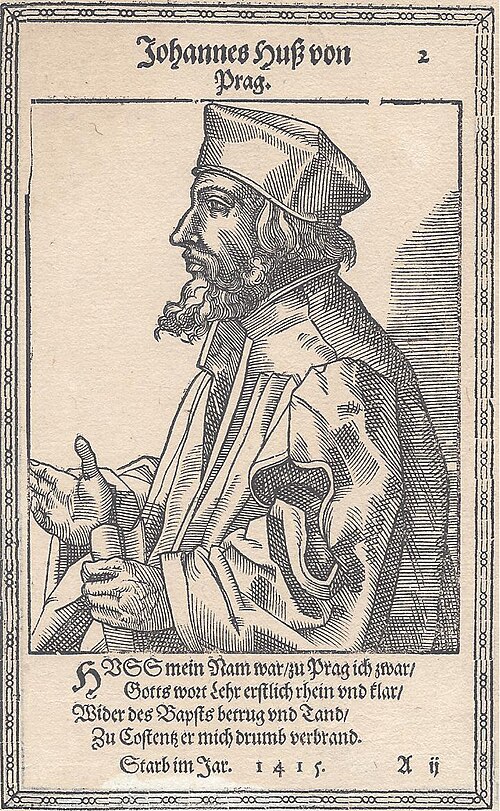
Jan Hus was born around 1369 in the small South Bohemian village of Husinec, from which he took his name — Hus simply means goose in Czech, a fact that he referenced himself with a dry humour that characterised his correspondence throughout his life. His family was of modest means, but the intelligence he displayed was sufficient to secure him an education, and he made his way to the University of Prague — founded by Holy Roman Emperor Charles IV in 1348 and one of the most intellectually lively institutions in Central Europe — where he studied theology, was ordained a priest in 1400, and rose to become rector of the university in 1402.
The Prague in which he found himself was a city in ferment. The late fourteenth and early fifteenth century was a period of profound crisis for the Catholic Church — the Great Schism had divided the papacy between competing claimants in Rome and Avignon, and across Europe there was a growing sense that the institutional church was more concerned with its own wealth and political power than with the spiritual needs of the faithful. In Bohemia, this general discontent was sharpened by a specific Czech dimension: the church was perceived, not without reason, as an institution dominated by German clergy whose use of Latin excluded Czech speakers from full participation in their own religious life and whose landholdings and corruption made them targets of Czech resentment on social as well as spiritual grounds.
Into this environment came the writings of John Wycliffe — the English theologian who had argued that the Bible, not the Pope, was the ultimate authority in matters of faith, that the church had no legitimate claim to temporal power, and that clergy who lived in sin forfeited their spiritual authority. Wycliffe's ideas had been condemned in England but found fertile ground in Bohemia, partly because of the marriage connections between the English and Bohemian courts and partly because they offered exactly the intellectual framework that Czech reformers were looking for. Hus read Wycliffe carefully, translated some of his works, and built on his ideas while adapting them to the specific Bohemian context.
Bethlehem Chapel and the Czech Sermon
The most politically significant of Hus's decisions — the one that made him famous and eventually fatal — was his insistence on preaching in Czech rather than Latin. Bethlehem Chapel, where he became the chief preacher in 1402, had been built specifically for Czech-language preaching, and Hus used it as a platform for sermons that were accessible to ordinary Czech speakers in a way that Latin church services were not. He preached to large crowds, attracted enormous popular following, and used his sermons to develop his critique of church corruption, his arguments for scripture as the ultimate authority, and his defence of the rights of the Czech people against the German ecclesiastical establishment that dominated the institutional church in Bohemia.
This was not merely a theological argument — it was a political one. The question of who controlled the church in Bohemia was inseparable from the question of who controlled Bohemia. Czech national consciousness in the fifteenth century was intertwined with the religious reform movement in ways that later centuries, accustomed to sharper distinctions between political and religious identity, can find difficult to parse. When Hus argued that corrupt clergy — regardless of their rank — had no authority over the consciences of true Christians, he was simultaneously challenging the German ecclesiastical hierarchy, the political power structures it supported, and the cultural hegemony that made Czech a second-class language in its own country.
He also championed utraquism — the practice of giving the communion cup (containing wine) to the laity, rather than reserving it for the clergy. This may seem like a minor liturgical dispute, but in the context of the time it was a direct challenge to one of the most visible markers of clerical privilege. The cup had been reserved for priests as a symbol of their special status; giving it to ordinary worshippers implied an equality between clergy and laity that struck at the entire hierarchical structure of the medieval church.
"I appeal to Jesus Christ, the only judge who is almighty and completely just — in his hands I place my cause, since he will render to each person a verdict based on his merits."
— Jan Hus, written during his imprisonment at Constance, 1415
Condemnation, Safe-Conduct, and the Road to Constance
Hus's popularity in Prague alarmed both the church hierarchy and the political authorities who depended on it. He was excommunicated in 1411 — a sentence that he challenged on the grounds that it had been issued unjustly and by authorities whose own conduct disqualified them from making such judgements. His continued preaching and his attacks on the sale of indulgences (which Pope John XXIII was selling to finance a military campaign) led to an interdict being placed on Prague — a punishment that fell on the entire city for sheltering him — which forced him to leave the capital and preach in the countryside.
The Council of Constance was convened in 1414 with the primary purpose of ending the Great Schism and restoring unity to the Church. It also took up the question of heresy in Bohemia, and Hus was summoned to appear before it. The Holy Roman Emperor Sigismund issued him a safe-conduct — a formal guarantee of his physical safety during the journey and his right to return freely regardless of the council's verdict. Hus accepted, believing that the safe-conduct gave him the opportunity to make his case before the assembled authority of Christendom and to demonstrate that his teachings were orthodox.
The safe-conduct proved worthless. On arrival at Constance he was arrested, imprisoned in a dungeon adjacent to the Rhine, and subjected to months of interrogation and pressure to recant. The conditions of his imprisonment were brutal — he was chained, kept in darkness, fed inadequately, and repeatedly told that his life depended on his willingness to withdraw his theological positions. He refused. He was willing to retract specific statements if they could be shown to be scripturally incorrect, but he would not make a blanket recantation of positions he continued to believe were true simply to save his life.
The Burning at Constance: 6 July 1415
The Council condemned him on 30 May 1415. He was given further opportunities to recant, and further refused them. On 6 July 1415, he was led out to the place of execution dressed in his priestly vestments, which were ceremonially stripped from him and burned before he was. A paper crown painted with images of demons was placed on his head. He was chained to a stake, and the fire was lit. Witnesses reported that he sang psalms as the flames rose around him. According to the most famous account of his death, when an elderly woman approached to throw more wood on the fire in a gesture of pious fervour, Hus said quietly — Sancta simplicitas! — Holy simplicity. He died in the flames.
The news of his execution reached Bohemia like a thunderclap. The Czech nobility sent a letter to the Council of Constance signed by 452 lords and knights denouncing the burning as a disgrace and threatening consequences. Within five years, Bohemia was at war — the Hussite Wars, a series of conflicts between the Hussite movement in Bohemia and the combined forces of the Holy Roman Empire and the Papacy, lasted from 1419 to 1434 and were among the most significant military and political events in fifteenth-century Europe. The Hussites, fighting under the symbol of the communion cup, won a series of remarkable military victories against larger and better-equipped crusading armies, demonstrating that a motivated popular movement with capable military leadership could defeat the forces of a continent-wide institutional order.
The Forerunner of the Reformation and Czech National Hero
When Martin Luther began his own challenge to the Catholic Church in 1517, he initially did not know how closely his positions paralleled those of Hus — but when he discovered this, he acknowledged it explicitly. Luther wrote that he had unknowingly taught and held all the doctrines of Hus, and that it was the burning of an innocent man that had begun the chain of events that led to the Reformation. The connection was not merely symbolic: the Hussite reform movement, and the precedent it set for challenging papal authority on the basis of scripture, created the intellectual and political environment in which Luther's challenge became possible and eventually successful.
In Czech national consciousness, Hus occupies a place that transcends his specific theological contributions. His refusal to recant — his insistence that truth, as he understood it, was worth dying for — became the foundational narrative of Czech national identity: the small nation that told the truth and paid for it, that refused to submit to power that was both greater and wrong. This narrative was invoked in the nineteenth century during the Czech National Revival, and again in the twentieth century during both Nazi occupation and communist rule, as a model of the principled resistance that Czech history seemed to demand of its people with uncomfortable regularity.
His statue stands in the Old Town Square of Prague — unveiled in 1915, on the five-hundredth anniversary of his death — and is one of the most visited monuments in the Czech capital. The inscription reads: Love the truth, let others have it, and do not yield to force. It is a sentence that has lost none of its point in the six centuries since the man who embodied it was burned alive for living by it. In the long catalogue of individuals who chose integrity over survival, Jan Hus stands near the beginning — and his choice still resonates precisely because the pressures that shaped it are never entirely historical.