At a Glance
The Blacksmith's Son and the Life of the Mind
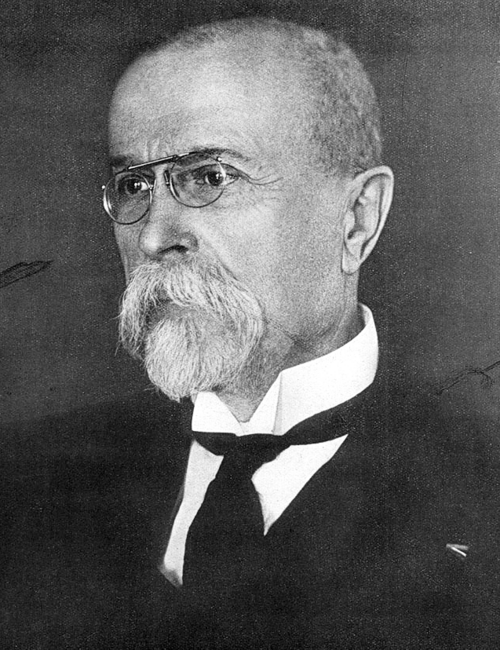
Tomáš Masaryk was born in 1850 in Hodonín, a small town in Moravia — the eastern part of the Czech lands, then part of the Austrian Empire. His father was a Slovak coachman who had risen to the position of imperial estate manager; his mother was a Moravian German cook. The family was neither noble nor wealthy, and Masaryk's path to the university was not straightforward — it required the support of patrons who recognised his exceptional intellectual ability and were willing to fund an education that the family could not afford.
He studied in Vienna and then in Leipzig, where he met Charlotte Garrigue — an American pianist from Brooklyn whose name he took as his own middle name when they married in 1878, in a gesture of egalitarian partnership that was remarkable for the era and characteristic of the man. Charlotte was not simply his wife but his intellectual companion and his connection to the Anglo-American liberal tradition that would profoundly shape his political philosophy. She introduced him to American transcendentalism, to the tradition of civic republicanism, and to a conception of democracy as a moral project rather than merely a political mechanism — ideas that would eventually find their practical expression in the constitution of the state he helped create.
He became a professor of philosophy at the Czech University in Prague in 1882, and his academic career immediately demonstrated the quality that would define his public life: an absolute unwillingness to subordinate intellectual honesty to political convenience, even when intellectual honesty was extremely inconvenient. His first major public controversy was characteristic — he challenged the authenticity of the Königinhof and Grünberg manuscripts, medieval Czech poems that had been celebrated as evidence of ancient Czech literary culture but that Masaryk, after careful examination, concluded were nineteenth-century forgeries. The manuscripts were beloved artifacts of Czech national identity, and his challenge provoked furious nationalist opposition. Masaryk maintained his position, was proved correct, and established in the process a reputation for intellectual integrity that survived every subsequent political attack.
The Hilsner Affair: Moral Courage Against the Crowd
The episode that most clearly demonstrated Masaryk's character was his intervention in the Hilsner affair of 1899–1900 — a Czech equivalent of the Dreyfus case that tested his willingness to act on his principles at substantial personal cost. Leopold Hilsner was a young Jewish vagrant accused of the ritual murder of a Czech girl in the village of Polná — a charge based entirely on antisemitic folklore, without physical evidence, that nonetheless resulted in a conviction and death sentence.
Masaryk was not a lawyer and had no personal connection to Hilsner. He intervened because he examined the evidence and concluded that the conviction was a miscarriage of justice built on prejudice rather than fact. He published pamphlets arguing for a retrial, was subjected to a student boycott at the university, received death threats, and was attacked in the nationalist press as a traitor to Czech interests. He persisted. The retrial he demanded did not acquit Hilsner — antisemitism ran too deep for that — but his intervention prevented the execution and contributed to the eventual commutation of the sentence. More importantly, it established him as a man who would defend principles against popular sentiment, who understood that genuine liberalism required the protection of the most vulnerable and despised, and who was willing to pay the political price of that understanding.
"Democracy is not merely a form of government. It is a view of life — the conviction that every human being has an equal claim to dignity, and that a state that denies this claim to any of its citizens has failed its own founding principle."
The War Years and the Creation of Czechoslovakia
When the First World War broke out in 1914, Masaryk was 64 years old — an age at which most European statesmen of his generation were considering retirement. He chose instead the most demanding political project of his life. Convinced that Austria-Hungary would lose the war and that its defeat would create an opportunity for Czech and Slovak independence, he left Habsburg territory in December 1914 and spent the next four years building the case for Czechoslovak statehood from the outside.
The campaign he conducted was primarily diplomatic and propagandistic rather than military — though the formation of the Czechoslovak Legion, which fought on the Eastern Front and then staged a remarkable military odyssey across Siberia, provided a military dimension that helped establish Czechoslovak credibility with the Allied powers. Masaryk himself spent the war years travelling between London, Paris, Rome, and eventually the United States, lobbying governments, writing articles and pamphlets, and building the international coalition that eventually persuaded the Allied powers to support Czechoslovak independence.
His time in the United States was particularly important. He arrived in 1918 and used his connections with Woodrow Wilson's administration — and with the large Czech and Slovak immigrant communities in America — to secure American support for independence. The Pittsburgh Agreement, signed by Czech and Slovak organisations in the United States in May 1918, provided the framework for the cooperative relationship between the two peoples that would define the new state. When Wilson's Fourteen Points included the principle of national self-determination, Masaryk had already spent years ensuring that the Czechoslovak case was the most thoroughly documented and most carefully argued application of that principle.
Czechoslovakia was declared independent on 28 October 1918, and Masaryk — still in America when the declaration was made — was named President. He returned to Prague in December 1918 to scenes of national jubilation, the philosopher-professor transformed into the liberator of his people, the man who had achieved through argument and patient diplomacy what earlier generations had attempted through armed uprising and failed.
The Democratic Presidency and Its Achievement
Masaryk served as President of Czechoslovakia for seventeen years, across three elected terms, retiring in 1935 at the age of 85 — the oldest serving head of state in Europe. The Czechoslovakia he presided over was, by any reasonable measure, the most successful new state created by the post-war settlement. While the successor states around it — Hungary, Poland, Romania, Yugoslavia, Austria — slid toward authoritarianism through the 1920s and 1930s, Czechoslovakia maintained functioning parliamentary democracy, a free press, civil liberties, and the rule of law.
This achievement was not automatic. Czechoslovakia was a genuinely multinational state — Czechs, Slovaks, Germans, Hungarians, Ruthenians, Jews, and other minorities all lived within its borders, and managing the tensions between them required both constitutional sophistication and consistent political will. The Sudeten German minority — which would eventually become the vehicle of Nazi destabilisation under Konrad Henlein — was granted extensive minority rights and political representation that Masaryk insisted on as a matter of principle. His treatment of national minorities was far from perfect, and Slovak complaints about Czech dominance within the state were not without foundation. But by the standards of interwar Central Europe, the Czechoslovak record on minority rights and democratic governance was exceptional.
His political philosophy — which he articulated in a series of books, interviews, and essays throughout his presidency — was distinctive in its combination of democratic idealism and practical realism. He believed that democracy was the political expression of Christian humanism, that the dignity of the individual was a moral category before it was a political one, and that the purpose of the state was to create conditions in which individual human beings could develop their full potential. These were not original ideas, but Masaryk's peculiar distinction was that he attempted to apply them consistently in practice, and that the gap between his principles and his policies was smaller than in virtually any comparable political leader of his era.
Retirement, Legacy, and the Shadow of Munich
Masaryk retired from the presidency in December 1935, handing over to his chosen successor Edvard Beneš, and died in September 1937 — less than a year before the Munich Agreement dismembered the country he had built. He was spared the experience of watching Czechoslovakia destroyed by the combination of Nazi aggression and Allied appeasement that produced Munich in September 1938. His son Jan, who served as Foreign Minister, lived through Munich and its consequences, eventually dying — in circumstances that have never been fully explained — by falling from a window of the Foreign Ministry in 1948, three weeks after the communist coup.
The communist regime that governed Czechoslovakia from 1948 to 1989 had a complex and instrumentalised relationship with Masaryk's legacy — acknowledging his role as a national liberator while distorting his philosophy to fit Marxist categories. The Velvet Revolution of 1989 restored him fully: Václav Havel, the playwright who became president of the restored democracy, explicitly cited Masaryk as the model he was attempting to follow — the intellectual in politics who understood that moral authority and political power were not separate categories, that what a statesman said and what he did had to be consistent, and that the credibility of democratic governance depended ultimately on the personal integrity of those who exercised it.
That is a demanding standard, and Masaryk himself did not always meet it. But the fact that his standard is still the one by which Czech political culture measures its leaders — more than eighty years after his death — is itself a measure of what he built. The philosopher who became a president, who took the principles he had spent his career articulating and turned them, however imperfectly, into a functioning state, left behind something rarer than military victories or territorial conquests: a tradition of governance that his successors, at their best, still aspire to.