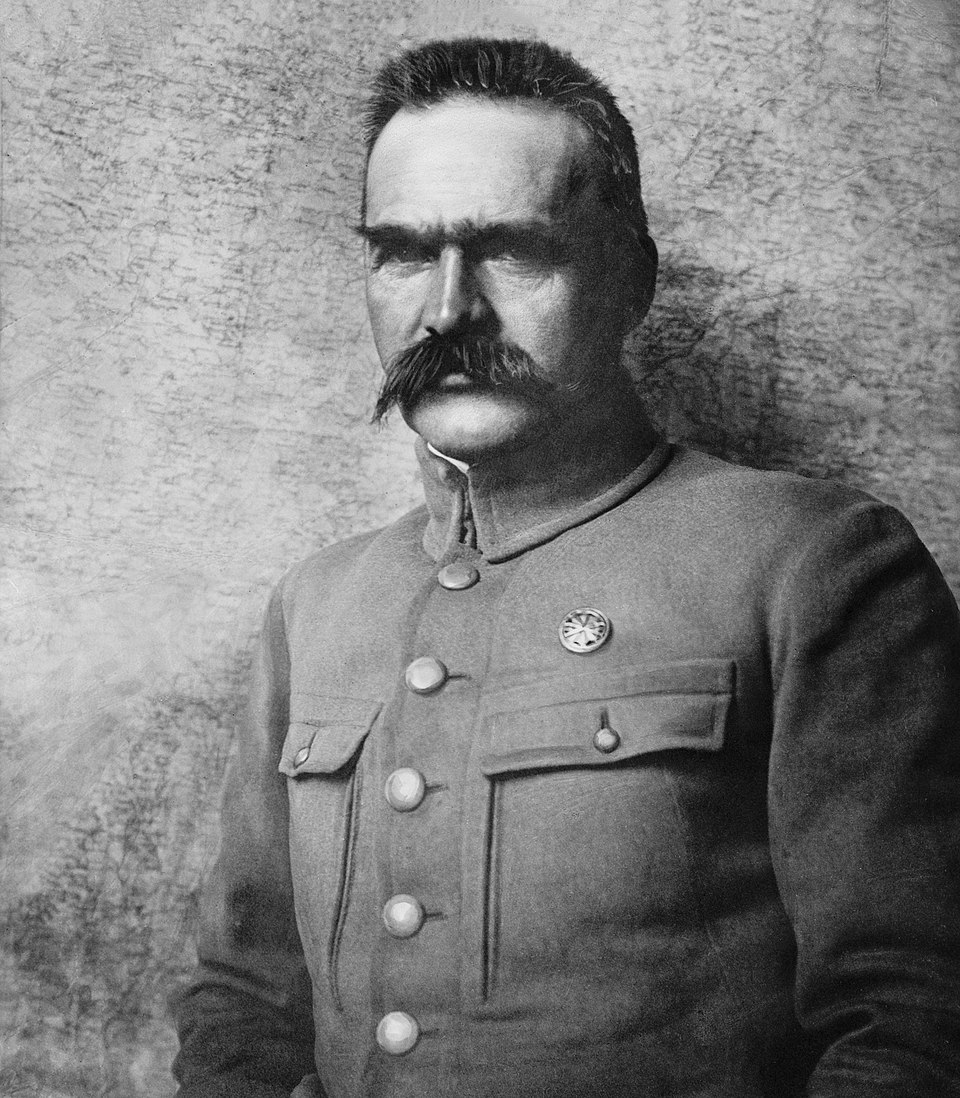
At a Glance
Born into Partition: The Formation of a Revolutionary
Józef Piłsudski was born in 1867 in a manor house near Vilna — a city that was simultaneously one of the great centres of Polish, Lithuanian, and Jewish culture and a place under Russian imperial rule that worked systematically to suppress all three. His family were Polish szlachta of the Lithuanian variety, rooted in the eastern territories of the old Polish-Lithuanian Commonwealth that had been divided between Russia, Prussia, and Austria in the partitions of the late eighteenth century. The Poland into which he was born did not exist as a state; it existed as a memory, a language, a culture, and a wound that three generations of Polish families had been carrying since the partitions stripped it from the map.
He grew up in a household that felt this wound acutely. His mother instilled a deep sense of Polish historical identity and the conviction that the partitions were a crime that could and should be reversed. The January Uprising of 1863 — the last great Polish insurrection against Russian rule before Piłsudski's generation — had been crushed five years before his birth, and the Russification policies that followed made the suppression of Polish identity an explicit programme of the imperial state. To be Polish in the Russian partition was to be conscious, from childhood, of living under occupation.
His political radicalisation came through the Polish Socialist Party (PPS), which he joined in the 1890s and quickly came to dominate as its most energetic organiser. His socialism was always instrumental: he cared about Polish independence, and the movement offered the infrastructure and willingness to contemplate illegal action that the independence cause required. When the interests of socialist internationalism conflicted with Polish national goals — as they did repeatedly — he chose Poland every time, without hesitation or apology.
Underground Work, Prison, and the Combat Organisation
The years between 1893 and 1914 were years of underground political work — editing the illegal PPS newspaper Robotnik (The Worker) under constant surveillance, organising strikes, building networks, and eventually creating the PPS Combat Organisation, which carried out expropriations of Russian government cash to fund the independence movement. He was arrested, sent to Siberia, escaped — feigning madness so convincingly, according to the most famous account, that he was transferred to a psychiatric hospital in St Petersburg from which escape proved easier than from a Siberian camp.
By the early 1900s he was operating from Austrian Galicia — where the Habsburg authorities were more tolerant of Polish political activity — building paramilitary organisations under the cover of legal sporting clubs, training the cadres of what he intended to become the military force that would fight for Polish independence when the inevitable European war created the opportunity. He was thinking in terms of decades: the partitioning powers would eventually go to war with each other, and when they did, Poland's chance would come.
The Polish Legions and the First World War
When war broke out in August 1914, Piłsudski moved immediately. He led Polish riflemen across the Russian border from Galicia on 6 August — one day after Austria-Hungary's declaration of war on Russia — hoping to trigger a Polish uprising in the Russian-controlled territories. The uprising did not materialise, but he adjusted quickly, accepting a position within the Austro-Hungarian military structure to command the Polish Legions through some of the most brutal campaigns on the Eastern Front.
The Legions became the nucleus of the future Polish army and training ground for the officer corps that would fight the Polish-Soviet War. His relationship with the Central Powers became increasingly tense as it became clear that Germany and Austria intended to exploit the Polish question for their own purposes. In 1917 he refused to swear an oath of loyalty to the Central Powers, was arrested by the Germans, and spent the rest of the war imprisoned in the fortress of Magdeburg. His refusal made him a hero in Polish eyes — the man who had chosen principle over expediency even when personal freedom was the cost — and his imprisonment meant he emerged from the war untainted by too close an association with either side.
"To be defeated and not to surrender — that is victory. To be victorious and to rest on one's laurels — that is defeat."
— Józef Piłsudski
Independence: November 1918
He was released from Magdeburg on 8 November 1918, three days before the Armistice. He arrived in Warsaw on 10 November to a reception that reflected the extraordinary position he occupied in Polish consciousness — not quite a messiah, but something close: the man who had been fighting for this moment for twenty-five years, who had sacrificed career, comfort, family, and freedom for it, and who now found himself holding authority that the collapsing German and Austrian occupations were abandoning in a vacuum of power.
On 11 November 1918, he assumed command of the Polish armed forces. Within days he was effectively the head of state of a Polish republic being assembled in real time from the fragments of three collapsed empires, with unclear borders, contested territory on every front, no established institutions, and enemies on all sides. He spent the next four years building the Polish state while simultaneously fighting the wars attempting to destroy it — against Soviet Russia to the east and against the border conflicts that attended the chaotic redrawing of the European map in the war's aftermath.
The Miracle on the Vistula: The Polish-Soviet War
The most significant of these conflicts was the Polish-Soviet War of 1919–1921 — a war that determined not only Poland's eastern borders but, in the judgement of many historians, the fate of the Bolshevik revolution's westward expansion. By the summer of 1920 the Red Army, commanded by Mikhail Tukhachevsky, had pushed deep into Polish territory and was approaching Warsaw. Western powers had largely written Poland off; the French military mission was preparing evacuation plans. Piłsudski refused to accept that the war was lost.
In mid-August 1920 he launched the counteroffensive that became known as the Battle of Warsaw — or, in Polish national mythology, the Miracle on the Vistula. A bold flanking manoeuvre struck the overextended Soviet forces from the south while the frontal defence held Warsaw. The Red Army was routed, losing between 60,000 and 100,000 prisoners and enormous quantities of equipment. The war ended with the Treaty of Riga in 1921, giving Poland substantially favourable borders. The Bolshevik ambition of linking the Russian revolution to Western European revolutionary movements — which required passage through Poland — was definitively blocked.
Lord Edgar Vincent D'Abernon, present in Warsaw during the battle, called it one of the decisive battles of world history. Whether Bolshevik expansion into Western Europe would have succeeded is debated; what is not debatable is that Piłsudski's victory foreclosed the possibility and shaped the political geography of interwar Europe in ways that reverberated for decades.
The Sanacja Coup and the Final Years
Piłsudski's relationship with Polish parliamentary democracy was complicated from the start. He believed in Polish independence absolutely; he was considerably less committed to the specific institutional form that independent Poland took. The parliamentary system was fractious, unstable, and in his view incapable of providing the decisive leadership that Poland's exposed geopolitical position required. In May 1926 he staged the coup — the Sanacja (Cleansing) — after three days of fighting in Warsaw that killed several hundred people.
He never took the title of dictator and never established a fully totalitarian regime — Poland under his post-1926 rule retained significant elements of civil society, press freedom, and political opposition. His primary concern in his final years was the foreign policy challenge presented by Germany to the west and Soviet Russia to the east. His response — non-aggression pacts concluded with both Nazi Germany and the Soviet Union in 1934 — was a pragmatic attempt to buy time, based on his accurate assessment that Poland could not afford to antagonise both simultaneously. It was not a policy of comfort but of a man who saw clearly what was coming and had no good options.
He died in Warsaw on 12 May 1935, of liver cancer, aged 67. His heart was buried in Vilna — the city of his birth, which embodied for him the multicultural Polish-Lithuanian heritage he had spent his life trying to preserve — while his body was interred in the royal crypt at Wawel Cathedral in Kraków, alongside the kings of Poland. The honour reflected what independent Poland thought of him: not a politician, not merely a general, but something more essential — the man without whom the country might not have existed at all.
In death as in life, Piłsudski remained contested. The left remembered his socialist origins and his subsequent suppression of the left in power. The right admired his nationalism and his authoritarianism. The nation as a whole, setting aside political tribalism, remembered that it existed — that Warsaw was a Polish capital, that Polish children went to Polish schools, that the Polish eagle flew over a Polish state — and understood that this was largely because one stubborn, difficult, visionary man had refused, for half a century, to accept that Polish independence was impossible.