At a Glance
Karlovo and the Calling
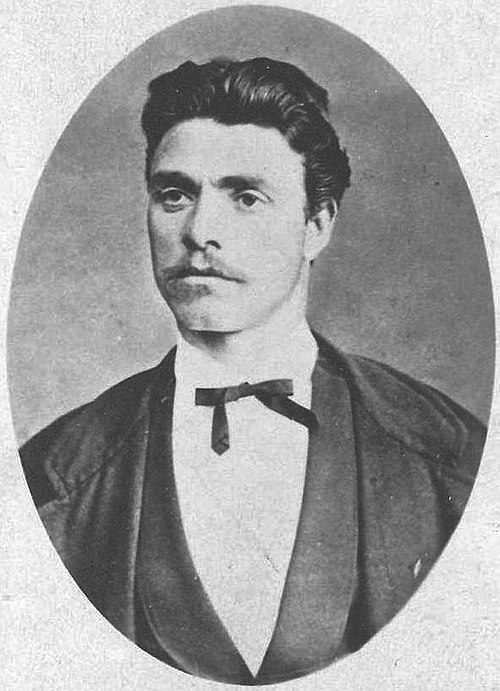
Vasil Levski was born in 1837 in Karlovo, a prosperous town in the Balkan Mountains of central Ottoman Bulgaria. His family was lower middle-class — his father was a craftsman who died when Vasil was young — and his early education was provided partly through the local church, where his uncle was a deacon. The path that initially seemed most available to a boy of his background and evident intellectual ability was a religious one: he entered the Hilendar Monastery on Mount Athos, was ordained as a deacon, and seemed, in his early twenties, to be embarked on an ecclesiastical career.
The ecclesiastical career lasted until he encountered the world of Bulgarian nationalist politics. Precisely how the transformation happened is not documented with the precision that later biographers would have wished, but the trajectory is clear: by the early 1860s Levski had abandoned the monastery, changed his name from Vasil Kunchev to Vasil Levski — the lion-like — and connected himself to the revolutionary underground that Georgi Rakovski was building among Bulgarian emigres in the Danubian Principalities. The nickname Levski was reportedly given to him by admiring comrades who had watched him vault over an obstacle during a military exercise with lion-like grace; he kept it for the rest of his life.
He served in Rakovski's first guerrilla detachment in 1862, gaining his first experience of armed resistance to Ottoman rule — and his first experience of the failure mode that would haunt Bulgarian revolutionary attempts throughout the 1860s: external detachments crossing the border expecting a popular uprising that did not materialise, because the internal organisation necessary to coordinate such an uprising had not yet been built. The lesson that Levski drew from the failures of the 1860s — including his own participation in a second unsuccessful expedition in 1867, the year of Rakovski's death — was the lesson that would define the rest of his life: external pressure could not substitute for internal organisation, and the revolution had to be built from within Bulgaria, not imported from the outside.
The Theory of Internal Organisation
The political theory that Levski developed in the late 1860s and articulated most fully in the statutes and documents of the Bulgarian Revolutionary Central Committee — which he co-founded with Lyuben Karavelov in Bucharest in 1869 — was a genuine intellectual achievement, not merely a tactical adjustment. He understood something about the sociology of revolution that Rakovski's more romantically heroic model had obscured: that an uprising requires not just willing fighters but a pre-existing network of people who know each other, trust each other, have agreed on objectives and procedures, and have the local knowledge and logistical capacity to act in coordination when the moment comes.
Building such a network in a country under foreign occupation — where every stranger was potentially an Ottoman informer, where the communications infrastructure was controlled by the occupying power, where carrying weapons or subversive literature was a capital offence — required a specific set of personal qualities that Levski happened to possess in exceptional measure: physical endurance, the ability to pass unnoticed among different social classes, a gift for reading people quickly and accurately, absolute personal courage, and an extraordinary capacity for maintaining confidentiality and operational security in conditions where a single betrayal could unravel years of work.
He also possessed, unusually for a revolutionary of his era, a political vision that extended beyond the ethnic and religious community of Bulgarian Orthodox Christians. His vision of the free Bulgaria he was fighting for was explicitly inclusive — a state in which Bulgarians, Turks, Jews, and other inhabitants would live under equal laws, with equal rights, free from the oppression of Ottoman authority but also free from any Bulgarian ethnic or religious chauvinism that would simply replace one form of domination with another. This was a genuinely radical position in the context of nineteenth-century Balkan nationalism, and it reflected a humanism that went beyond the ethnic and religious categories that most of his contemporaries took for granted.
"I want a pure and holy republic — free and equal for all who breathe Bulgarian air, regardless of faith, tribe, or origin. This is the Bulgaria I am working to create."
The Journeys: Building the Network
Between 1869 and 1872, Levski made several extended clandestine journeys through Ottoman Bulgaria, travelling on foot and on horseback through the mountain villages and market towns, meeting trusted contacts, establishing local revolutionary committees, recruiting members, depositing weapons, and building the network that he believed could eventually coordinate a general uprising. The journeys were physically demanding in the extreme — he often travelled in disguise, avoided main roads, slept in barns and haystacks, and maintained the appearance of an ordinary wandering artisan or merchant while carrying materials and information that would have resulted in his immediate execution if discovered.
The committees he established were modelled on the principles he had developed theoretically: democratic in their internal governance, with elected leadership and collective decision-making; disciplined in their operational security, with strict rules about who could be told what and when; and linked to the central organisation in Bucharest through a chain of trusted intermediaries who minimised the risk of the entire network being exposed through a single penetration. At the peak of his organising activity in 1872, the network extended across a substantial portion of Bulgarian territory, with functioning committees in dozens of towns and villages.
He moved continuously, never staying in one place long enough to become a known presence, always one step ahead of the Ottoman authorities who were aware that a dangerous organiser was at work but could not pinpoint him. His physical description circulated among Ottoman officials; there were rewards for his capture. He kept moving, kept building, kept writing the instructions and correspondence that maintained the coherence of a network that had to function without any secure communication infrastructure.
Capture, Trial, and Execution
The network was compromised in December 1872 through a combination of circumstances that included the arrest of a courier carrying incriminating correspondence, the subsequent interrogation of committee members in several towns, and — most critically for Levski personally — an attempt to rob an Ottoman post office near the town of Lovech that went wrong and led Ottoman investigators directly to the local committee. Levski, who had counselled against the operation, was in the area and was recognised and arrested near the village of Kakrina in December 1872.
His interrogation by Ottoman authorities lasted for weeks. He revealed nothing that he had not already decided to concede — nothing that would betray the existence of committee members who were not already compromised. How much he was tortured is debated; that he maintained the essential integrity of the network through his silence is not. The trial was brief and the outcome predetermined: he was convicted of organising armed conspiracy against the Ottoman state and sentenced to death by hanging.
He was hanged in Sofia — then called Serdika — on 18 February 1873, at the age of 35, on a scaffold erected in the open space near what is now the centre of the Bulgarian capital. Ottoman authorities buried him in an unmarked grave to prevent his burial site from becoming a place of pilgrimage. The grave was identified decades later and his remains are now interred in the Patriarchal Cathedral of Saint Alexander Nevsky in Sofia. The place of his execution is marked by a small chapel.
The April Uprising and the Independence He Made Possible
The organisation that Levski built was damaged but not destroyed by his capture and execution. His collaborators — Hristo Botev, Lyuben Karavelov, and others — rebuilt and expanded it, and the April Uprising of 1876, though it failed militarily, was a direct expression of the organisational infrastructure Levski had created. The committees he had established, the network of trust he had built, the doctrines of internal organisation he had articulated — all of these survived him and shaped the uprising.
The uprising's failure was accompanied by Ottoman atrocities — the Batak massacre and similar events — that shocked European public opinion, prompted Gladstone's famous pamphlet on the Bulgarian horrors, and created the political pressure that led to the Russo-Turkish War of 1877–78 and Bulgarian independence. The independent Bulgaria established by the Treaty of San Stefano and modified by the Treaty of Berlin was not the Bulgaria Levski had envisioned — it was smaller, it was a principality rather than a republic, and the equality of all its inhabitants regardless of ethnicity that he had placed at the centre of his political vision was not fully realised in its constitution. But the Bulgarian state existed, which it had not when Levski was making his clandestine journeys through the Balkan Mountains, and its existence was in direct lineage from the work he had done.
The Apostle and His Nation
Levski's position in Bulgarian national consciousness is without parallel. In surveys conducted over the decades since Bulgarian independence and consistently repeated in the post-communist era, he is voted the greatest Bulgarian in history — ahead of tsars, kings, generals, poets, and scientists. The reasons for this extraordinary and durable reverence are worth examining, because they illuminate something important about the values that the Bulgarian national tradition has chosen to emphasise.
He did not live to see independence. He achieved no military victories. He held no political office. He left no surviving buildings or institutions bearing his name. What he left was the example of a life given entirely and without reservation to a cause that he understood with complete clarity — the freedom of his people — combined with a vision of what that freedom should mean that went beyond ethnic nationalism to a genuinely universal conception of human dignity. The inclusiveness of his vision, the personal sacrifice that embodied it, and the youth at which he was cut off — all of these contribute to a national myth of considerable power.
But it is also, unusually, a myth grounded in documented historical reality. Levski really did build what he said he was building. He really did travel across Ottoman Bulgaria alone, at constant personal risk, for years on end. He really did articulate a vision of Bulgarian freedom that explicitly included non-Bulgarians. He really did maintain his silence under interrogation to protect his comrades. The myth, in his case, requires no inflation — the historical record is sufficient. That may be why, of all the figures who contributed to Bulgarian independence, he is the one who has never been seriously contested, whose image has appeared on the currency of every Bulgarian government regardless of its political character, and whose name is invoked across the political spectrum as the standard against which Bulgarian public life measures itself.