At a Glance
Damascus Origins and the Ottoman Military World
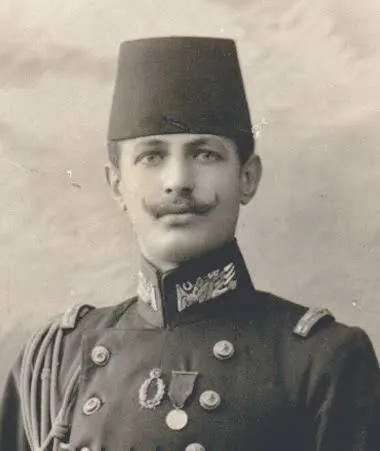
Yusuf al-Azmeh was born in Damascus in 1884 into a family of established Damascene notable standing — the al-Azmeh clan, which had produced Ottoman officials, military officers, and civic leaders across the preceding century. Damascus in the 1880s was a city fully integrated into the Ottoman imperial system: its notable families sent their sons to Ottoman schools, served in Ottoman administration and military, and navigated the complex relationship between Arab cultural identity and Ottoman imperial loyalty that characterised the educated Arab class of the late empire.
Al-Azmeh followed the military path. He received his education at Ottoman military schools and graduated from the Istanbul War College — the institution that trained the Ottoman Empire's officer corps and that was, in the early twentieth century, also producing a generation of Arab officers who were increasingly influenced by Arab nationalist ideas while still serving within the Ottoman military framework. He served as an Ottoman officer in the Balkans and other theatres of operation, accumulating the professional military experience that would make him, by 1920, the most qualified military commander available to Faysal's Syrian government.
The First World War and the Arab Revolt transformed his situation as it transformed that of all Arab officers in Ottoman service. The decision to join the Arab Revolt — the uprising against the Ottomans organised by Sharif Hussein of Mecca in alliance with Britain — was the decisive political act of many Arab officers' lives, requiring them to choose between their Ottoman institutional loyalty and their emerging Arab national identity. Al-Azmeh made this choice, joining the Arab forces that fought their way northward through the Hejaz, Palestine, and Syria and entered Damascus in October 1918 alongside British forces, bringing Faysal's Arab government into the Syrian capital.
The Arab Kingdom of Syria: Two Years of Fragile Hope
The Arab Kingdom of Syria that Faysal established in Damascus between 1918 and 1920 was the first attempt at modern Arab self-governance in the Fertile Crescent — a genuine state, however incomplete and contested, with a government, an army, political institutions, and a population that had overwhelmingly endorsed independence in the Syrian General Congress of March 1920. Al-Azmeh served this state as a senior military figure, eventually becoming War Minister — the cabinet officer responsible for the organisation and command of the Syrian Arab Army that was the government's primary instrument of defence.
The Arab Kingdom existed in a condition of permanent strategic anxiety. The Sykes-Picot Agreement of 1916 had assigned Syria to French influence over Arab objections and in contradiction of the promises of Arab independence that Britain had used to secure the Arab Revolt. The postwar peace settlement confirmed French claims, and it was clear from the earliest months of the Arab government that France intended to impose its Mandate authority by force if necessary. The only questions were when and on what pretext.
Al-Azmeh spent his time as War Minister attempting the nearly impossible task of building a credible military force from the available resources — former Ottoman officers, Arab Revolt veterans, nationalist volunteers, and whatever equipment could be acquired from British sources before Britain's tacit support for the Arab government evaporated under French pressure. The Syrian Arab Army he assembled was not negligible: it had professional officers, organisational structure, and genuine fighting spirit. What it lacked was the heavy equipment — artillery, aircraft, armoured vehicles — that modern warfare made decisive, and that France possessed in abundance.
The French Ultimatum and the Cabinet That Surrendered
In July 1920, the French moved. General Henri Gouraud delivered an ultimatum to Faysal's government on 14 July: Syria must formally accept the French Mandate; must reduce the Arab Army to a specified maximum size; must disarm irregular forces; must accept French garrisons in Syrian territory; and must suppress any anti-French activity. The deadline was four days. Failure to comply would be treated as a declaration of war.
The ultimatum placed Faysal's government in an impossible position. Acceptance meant the effective end of Syrian sovereignty — the transformation of the Arab Kingdom into a French protectorate in everything but name. Rejection meant war against a French military force that was, by any realistic assessment, capable of defeating the Syrian Arab Army and occupying Damascus. Faysal himself — aware that Britain would not intervene on Syria's behalf, that no other power would come to Syria's aid, and that a military defeat would be total and swift — was inclined toward acceptance, hoping to preserve what could be preserved of Syrian institutions and political life under a French umbrella rather than lose everything in a hopeless military confrontation.
The cabinet accepted the ultimatum. The decision to comply — however agonising for those who made it — was the decision of men who were calculating the least bad option available given the constraints they faced. It was politically defensible as realism, as the preservation of Syria's population from the casualties of a futile military resistance, as the choice to fight another day through political means rather than sacrifice everything in an unwinnable battle.
Yusuf al-Azmeh did not accept this calculation. He submitted his letter of resignation as War Minister immediately after the cabinet vote — making clear that he would not implement the disarmament orders that acceptance of the ultimatum required — and began organising what military resistance he could assemble. He was not naive about the military prospects. He knew the Syrian force could not defeat Gouraud's army. He went anyway, because he had concluded that there were things more important than survival — that a nation's honour, its refusal to accept occupation without armed resistance, was worth the lives of those willing to spend them on it, including his own.
The Battle of Maysalun: 24 July 1920
The force that Yusuf al-Azmeh assembled and led out of Damascus toward the French advance on 24 July 1920 was a mixture of regular Syrian Arab Army soldiers, nationalist volunteers who had flooded into Damascus when word spread that al-Azmeh was organising resistance, tribal fighters from the surrounding countryside, and armed civilians who wanted to be present for what everyone understood might be the last battle for Syrian independence. Estimates of its total strength vary — somewhere between three thousand and nine thousand men by different accounts — but its military quality was mixed and its heavy weapons were minimal: a few artillery pieces, machine guns, and the rifles and determination of men who had chosen to be there.
The Maysalun pass in the Anti-Lebanon mountains west of Damascus was the geographic chokepoint through which the French advance had to move. It was a defensible position — narrow, with high ground on either side — and if al-Azmeh's force had faced an equivalent enemy, it might have made a difference. Against Gouraud's army, equipped with modern artillery, aircraft for reconnaissance and support, and armoured vehicles that could exploit any breakthrough in the defence, the geographic advantage was insufficient to overcome the technological gap.
The battle lasted a few hours on the morning of 24 July 1920. French artillery and air support devastated the Syrian positions. The Arab forces fought with courage and sustained casualties, but the military outcome was never in doubt. By late morning the Syrian defensive line had broken. Yusuf al-Azmeh was killed in the fighting — shot while commanding his troops in the field, dying in the same place where his men died, refusing the survival that retreat would have offered. The French forces continued their advance, and on 25 July 1920 they entered Damascus. The Arab Kingdom of Syria was over.
Why Maysalun Matters: The Martyrdom That Founded a Nation
The Battle of Maysalun was a military defeat of no strategic significance — the French were going to occupy Damascus regardless of whether Yusuf al-Azmeh led a symbolic resistance or the Syrian government accepted the ultimatum quietly. The forces were too unequal, the international situation too clearly stacked against any Syrian military option, for any conceivable battle at Maysalun to change the outcome. Al-Azmeh knew this. He went anyway.
What made Maysalun historically significant was precisely its futility — the fact that it was a choice made in full knowledge that it would fail, that the men who died there died for something that could not be achieved by their dying, and that the value of what they did lay entirely in what it said about Syrian national character rather than in any military or political consequence it produced. Al-Azmeh's decision to fight when fighting was hopeless, to die rather than accept occupation, gave subsequent generations of Syrians a foundational narrative of national dignity — a story that said: when France came to take our country, one Syrian refused to let it happen without a fight, and he paid with his life, and we remember him because what he did matters regardless of whether it changed anything.
This is the logic of martyrdom in national memory, and it is a logic that recurs across the history of resistance movements globally: the Battle of Thermopylae, the Alamo, the Easter Rising, the Warsaw Uprising — battles that were lost, that had no prospect of success, that are remembered precisely because the willingness to fight in conditions of certain defeat says something about the character of those who chose to fight. Maysalun is Syria's version of this tradition, and Yusuf al-Azmeh is its central figure.
The Contrast with Faysal: Two Kinds of Political Courage
It is important to understand al-Azmeh's choice at Maysalun in relation to Faysal's choice to accept the French ultimatum, because the two choices represent different forms of political courage operating in the same impossible situation. Faysal's acceptance was not cowardice — it was the calculation of a leader who felt responsible for the lives of his entire population and who concluded that a hopeless military confrontation would cost Syrian lives without preserving Syrian sovereignty. The decision to accept occupation and attempt to preserve what could be preserved of Syrian institutions, political organisation, and national identity under French rule required its own kind of courage: the courage to make an unpopular decision, to be seen as surrendering, to accept the historical judgment that would follow.
Al-Azmeh's refusal was a different calculation — the choice of a man who concluded that some things could not be preserved by acceptance, that the act of resistance itself had a value independent of its military outcome, and that he was personally willing to pay the price of that choice. Both men were responding to the same situation with the same fundamental commitment to Syrian independence; they reached different conclusions about what form resistance should take in that specific moment.
Syrian national memory has, understandably, honoured al-Azmeh above Faysal in its commemorative tradition — because martyrdom is more memorialisable than pragmatic acceptance, because the man who died at Maysalun is more easily turned into a symbol than the man who accepted the ultimatum and went into exile. But the historical reality is more complex: both choices were made by men of honour under impossible conditions, and the Syria that eventually achieved independence in 1946 owed something to both the martyrdom that established the tradition of resistance and the pragmatic political work of the nationalist movement that negotiated independence through the channels that remained open after Maysalun.
Legacy: Martyrs' Day and the Living Memory of Maysalun
Yusuf al-Azmeh died at thirty-six, having held the position of War Minister for only a few months, having commanded a battle that lasted only a few hours. His historical footprint — measured by the brevity of his active career — is extraordinarily small. Yet he is arguably the most commemorated individual in Syrian national history, his name attached to streets and schools and public squares across the country, his portrait reproduced in textbooks and public buildings, his death observed every 24 July as a national day of remembrance.
The disproportion between the brevity of his historical action and the magnitude of his commemorative presence is itself the most eloquent testimony to what Maysalun meant and continues to mean. He did not build institutions, negotiate treaties, write influential books, or lead a successful military campaign. He died in a defeat that changed nothing militarily and everything symbolically — establishing that there had been Syrians who refused, who said no to occupation at the cost of their lives, who gave subsequent generations the right to say that Syrian national resistance began not with accommodation but with sacrifice.
His tomb at Maysalun — maintained as a national shrine — draws visitors who come not to commemorate a victory but to remember a choice: the choice that al-Azmeh made when he rode out of Damascus on the morning of 24 July 1920, knowing what waited for him in the pass, going anyway. In a region and a century full of compromises, accommodations, and the calculated acceptance of lesser evils, that choice — unambiguous, irreversible, made in full knowledge of its consequences — retains a moral clarity that time has not dimmed. Yusuf al-Azmeh died so that Syria would have a Martyrs' Day, and Syria has honoured the bargain ever since.