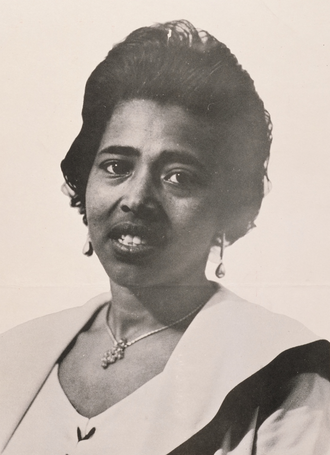
Victoria Gray Adams, Mississippi Freedom Democratic Party Senate candidate and civil rights organiser, who challenged John Stennis in 1964 and represented the MFDP alongside Fannie Lou Hamer at the Atlantic City Democratic National Convention.
United States · Civil Rights Movement

Victoria Gray Adams

Victoria Jackson Gray was born on May 4, 1926, in Palmer's Crossing, near Hattiesburg, Mississippi, the daughter of a family that was, by the standards of the Mississippi Black community, relatively prosperous — her grandfather had owned a farm, her mother was a teacher, and the household she grew up in placed a strong emphasis on education and civic engagement that distinguished her from the sharecropper poverty that defined most Black Mississippians' experience. She attended Tougaloo College and Clark College, earned her teacher's certification, and worked as a teacher and businesswoman in Hattiesburg — running a door-to-door cosmetics business that gave her both economic independence and community relationships with Black women across the Forrest County area. She tried to register to vote in 1962 and was rejected. She tried again and was rejected again. She tried a third time and finally registered. She became one of SNCC's most effective Hattiesburg area organisers, working on voter registration and community development, and she was involved in the founding of the Mississippi Freedom Democratic Party as the alternative Democratic Party organisation that challenged Mississippi's all-white regular delegation at the 1964 Democratic National Convention. The MFDP fielded its own slate of candidates in the 1964 elections to challenge the regular Democratic candidates, and Victoria Gray was the MFDP candidate for the United States Senate, running against John Stennis — one of the most powerful and most explicitly white-supremacist senators in the country, a man who had signed the Southern Manifesto and who had spent his Senate career defending segregation and obstructing civil rights legislation. She received more than 3,300 votes in an election whose regular process was designed to exclude the Black majority from participation, and she testified before the Credentials Committee at Atlantic City alongside Fannie Lou Hamer about the conditions of Black political life in Mississippi. She was one of three MFDP women who challenged the seating of five Mississippi congressmen in January 1965 by presenting evidence of voter suppression to the House of Representatives — a challenge that held up the seating of the Mississippi delegation for months and produced the most sustained congressional examination of voting rights violations in Mississippi before the Voting Rights Act's passage. She was ordained as a minister, earned her master's degree, taught at Eastern Mennonite University in Virginia, and worked in peace and reconciliation work in communities across the country. She died on August 12, 2006, in Petersburg, Virginia, at the age of eighty.

United States Mississippi MFDP Senate Candidate Hattiesburg Congressional Challenge

Born: 4 May 1926, Palmer's Crossing, Mississippi, USA  |  Died: 12 August 2006, Petersburg, Virginia, USA — aged eighty

At a Glance

Full NameVictoria Jackson Gray Adams; born 4 May 1926, Palmer's Crossing, near Hattiesburg, Mississippi; attended Tougaloo College and Clark College; teacher; door-to-door cosmetics businesswoman; attempted voter registration three times before succeeding; became SNCC organiser in the Hattiesburg area; MFDP U.S. Senate candidate 1964 against John Stennis; represented MFDP at Atlantic City DNC credentials challenge 1964; one of three MFDP women who challenged Mississippi congressional seating January 1965; ordained minister; MA degree; taught at Eastern Mennonite University; peace and reconciliation work; died 12 August 2006, Petersburg, Virginia, aged eighty
Born4 May 1926, Palmer's Crossing, near Hattiesburg, Mississippi; her family's relative prosperity by Mississippi Black standards — her grandfather had owned land, her mother was a teacher — gave her the educational emphasis and the economic independence that distinguished her from the sharecropper majority and that enabled her subsequent civil rights and political work; attended Tougaloo College and Clark College; worked as a teacher and cosmetics businesswoman in Hattiesburg before her civil rights involvement
Died12 August 2006, Petersburg, Virginia; died at the age of eighty; had been teaching at Eastern Mennonite University and working in peace and reconciliation for the years preceding her death; her death was mourned by the civil rights community as the passing of one of the movement's most principled and most persistent grassroots leaders — someone who had run for the United States Senate against John Stennis and had spent the subsequent forty years continuing to work for justice in different institutional contexts
Three Registration AttemptsAttempted to register to vote in 1962, was rejected; tried again, was rejected; tried a third time and finally succeeded; the three attempts were characteristic of the systematic obstruction that Mississippi's voter registration apparatus deployed against Black applicants — literacy tests, arbitrary evaluation standards, intimidation — and her persistence was characteristic of the movement's most effective grassroots figures, who understood that the obstacles were designed to discourage and who refused to be discouraged
MFDP Senate Candidate, 1964Was the Mississippi Freedom Democratic Party's candidate for the United States Senate in 1964, running against incumbent John Stennis — one of the Senate's most powerful and most explicitly white-supremacist members, a signer of the Southern Manifesto and a consistent opponent of civil rights legislation; received more than 3,300 votes in an election whose regular process systematically excluded the Black majority; her candidacy demonstrated that Black Mississippians were ready to participate in electoral politics and would do so through alternative mechanisms when the regular process excluded them
Atlantic City and the Congressional ChallengeWas one of the MFDP representatives who testified before the credentials committee at the 1964 Democratic National Convention in Atlantic City, alongside Fannie Lou Hamer, challenging the seating of Mississippi's all-white regular delegation; in January 1965, was one of three MFDP women — along with Fannie Lou Hamer and Annie Devine — who challenged the seating of five Mississippi congressmen in the House of Representatives by presenting evidence of voter suppression; the challenge held up the seating of the Mississippi delegation for months and produced the most sustained congressional examination of Mississippi voting rights violations before the Voting Rights Act's passage
Ministry, Teaching, and Peace WorkWas ordained as a minister; earned her master's degree; taught at Eastern Mennonite University in Harrisonburg, Virginia — an institution in the Mennonite tradition of nonviolence and peacemaking whose values aligned with the civil rights movement's own commitment to nonviolent resistance; worked in peace and reconciliation in communities across the country; her later career reflected the same fundamental commitment to human dignity and justice that her SNCC organising and MFDP candidacy had expressed, in the different institutional contexts that different periods of her life made appropriate

Palmer's Crossing, Hattiesburg, and the Businesswoman Who Organised

Victoria Gray grew up in the Palmer's Crossing community near Hattiesburg with the specific formation that a teacher's household provided in Mississippi's Black community — an emphasis on education, on civic engagement, on the understanding that one's gifts and one's opportunities carried obligations to the community rather than merely to oneself. Her family's relative economic stability within the conditions of Mississippi Black life gave her the independence that made subsequent civil rights work possible: she was not a sharecropper whose economic dependency could be weaponised against her political activity, but a woman with her own income from her cosmetics business and her own standing in Hattiesburg's Black community.

Her door-to-door cosmetics business was not merely an economic enterprise but a community-building one: she was in the homes of Black women across the Forrest County area, building relationships, understanding the conditions of their lives, and developing the community knowledge that effective organising requires. When SNCC's voter registration campaign reached Hattiesburg, Gray was already embedded in the community networks that made organising possible, and her transition from cosmetics businesswoman to SNCC organiser was not a departure from one world to another but an extension of the community engagement she had been practising professionally into the specifically political domain.

Her three attempts to register to vote — tried, rejected; tried, rejected; tried, succeeded — were the personal experience of what the SNCC voter registration campaign was fighting against in the most direct possible form. She understood the obstacles not abstractly but specifically, because she had encountered each of them personally, and her subsequent organising drew on that specific knowledge of what the obstacles were and how they operated.

Running Against Stennis: The MFDP Senate Campaign

The Mississippi Freedom Democratic Party's decision to field its own slate of candidates in the 1964 elections was a demonstration that Black Mississippians were ready and willing to participate in the democratic process and would create alternative mechanisms to do so when the regular process excluded them. Victoria Gray's candidacy for the United States Senate against John Stennis was the most ambitious of these alternative candidacies — Stennis was one of the Senate's most powerful members, a man who had served since 1947, who had signed the Southern Manifesto, and whose Senate career had been largely dedicated to defending segregation and obstructing the civil rights legislation that the movement was trying to pass.

The specific audacity of a Black woman from Hattiesburg running for the United States Senate against one of the most powerful white supremacist politicians in American history was the statement that the MFDP candidacy was designed to make. Gray knew she was not going to win in the conventional sense; the voter registration system that had required her three attempts to succeed had prevented the vast majority of Black Mississippians from registering at all, and the election was conducted under conditions that made a fair outcome impossible. What she was doing was demonstrating that Black Mississippians were politically capable and politically willing, that they had candidates who were qualified for national office, and that the democratic process's failure to include them was the democratic process's failure rather than their own.

The more than 3,300 votes she received were cast by Black Mississippians who had managed to register despite the obstacles, and they were cast as a political statement about what Mississippi's electorate would look like when the obstacles were removed. The Voting Rights Act that passed the following year, and the subsequent transformation of Mississippi's political landscape, confirmed the statement retroactively.

Atlantic City, the House Challenge, and the Sustained Confrontation

Gray's participation in the MFDP's credentials challenge at the 1964 Atlantic City convention was the national-stage expression of the same argument the Senate candidacy had been making in Mississippi: Black Mississippians were ready for political participation, they had the capacity and the will for it, and the Democratic Party's seating of an all-white Mississippi delegation was a betrayal of the democratic principles the party claimed to represent. Her testimony before the credentials committee, alongside Fannie Lou Hamer's more dramatic and more nationally noticed testimony, was part of the systematic presentation of evidence about Mississippi's political conditions that the MFDP had assembled over months of preparation.

The January 1965 congressional challenge — in which Gray, Hamer, and Annie Devine challenged the seating of five Mississippi congressmen by presenting evidence of voter suppression to the House of Representatives — was the most sustained and most constitutionally serious of the MFDP's challenges. The challenge held up the seating of the Mississippi delegation for months, required the House to formally acknowledge the evidence of voter suppression that was being presented, and produced the most sustained congressional examination of Mississippi's voting rights violations before the Voting Rights Act's passage. The challenge did not succeed in its immediate goal — the Mississippi delegation was eventually seated — but it contributed to the political pressure that produced the Voting Rights Act and demonstrated that the MFDP was not merely a convention protest but a sustained political organisation prepared to use every available constitutional mechanism.

Ministry, Eastern Mennonite, and the Long Work

Gray's later career — her ordination, her master's degree, her teaching at Eastern Mennonite University, her peace and reconciliation work — represented a continuation of the same fundamental commitments in different institutional contexts. Eastern Mennonite's tradition of nonviolence and peacemaking aligned with the civil rights movement's own commitment to nonviolent resistance in ways that made the institutional connection natural rather than incidental. She brought to her teaching and her peace work the specific authority of someone who had been on the front lines of the American freedom struggle and who understood from that experience what the work of reconciliation actually required.

She died in Petersburg, Virginia, in August 2006, at the age of eighty — having spent more than four decades after the MFDP's most public challenges continuing the work in the quieter ways that the post-movement period made appropriate. Her story is one of the movement's clearest examples of what sustained commitment looks like over a lifetime: not the dramatic gesture of a single act or a single campaign, but the patient, persistent application of the same fundamental values to the successive contexts that a long life provides. She ran for Senate against John Stennis. She challenged the Mississippi congressional delegation's seating. She taught nonviolence at a Mennonite university. She did peace and reconciliation work. The person doing all of these things was the same person, with the same commitments, in the different institutional forms that different decades required.

Other Civil Rights Movement Profiles

USA · Civil Rights Fannie Lou Hamer Fellow MFDP leader who testified at Atlantic City alongside Gray and whose more dramatic testimony received more national attention USA · Civil Rights Bob Moses SNCC director who organised the MFDP whose Senate candidacy Gray led and whose Atlantic City challenge she represented USA · Civil Rights Lawrence Guyot MFDP chairman who led the organisation that Gray's Senate candidacy was part of USA · Civil Rights Unita Blackwell Fellow Mississippi Freedom Democrat whose path from MFDP to elected office paralleled Gray's in its patient sustained commitment USA · Civil Rights John Lewis SNCC chairman whose organisation supported the MFDP challenge that Gray's candidacy was part of USA · Civil Rights Ella Baker SNCC founding mentor whose group-centred leadership philosophy Gray's organising in Hattiesburg embodied USA · Civil Rights Medgar Evers NAACP Mississippi field secretary whose assassination came the year before the MFDP's founding — in the same Mississippi political struggle Gray was part of USA · Civil Rights Septima Clark Citizenship School developer whose literacy education was the foundation of the voter registration work that Gray was organising in Hattiesburg USA · Civil Rights Dorothy Height NCNW leader whose institutional approach to Black women's civic leadership paralleled Gray's electoral and organisational approach USA · Civil Rights Shirley Chisholm Who ran for Senate and for president in years following Gray's Senate candidacy — the electoral tradition Gray's 1964 campaign was part of building
Share X Facebook WhatsApp LinkedIn