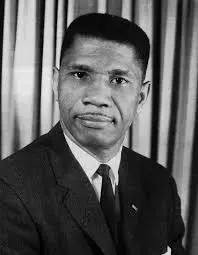
At a Glance
Decatur, Normandy, and the Veteran Who Came Home to Mississippi
Medgar Evers was formed by two experiences that were not as contradictory as they might appear: growing up in Mississippi as the son of a man who had managed to own his own land, and surviving the Allied campaign in Western Europe in a segregated Army that required him to fight for a country that denied him its basic protections. Both experiences were, in different ways, education in the same lesson: that the conditions of Black life in America were a political choice rather than a natural necessity, and that challenging that choice was both possible and obligatory.
His father James Evers's land ownership in Newton County was the specific form that Black independence took in that context — not prosperity by any general standard but the foundational difference between being a sharecropper entirely dependent on a white landlord's goodwill and being a man who owned what he worked. This difference shaped Medgar's understanding of what freedom actually required: not merely the absence of legal subordination but the material foundation that made resistance possible. His subsequent civil rights work consistently connected political rights to economic conditions in ways that reflected this formative understanding.
His Normandy landing and his participation in the European campaign were, by his own account and by the account of other Black veterans of his generation, not merely a military experience but a political formation. He had fought alongside white soldiers from other countries who treated him as an equal; he had seen the alternative to the racial order he had grown up in; and he had been asked to die for the proposition that fascism was wrong and democracy was right, while the country asking him to make that sacrifice was simultaneously maintaining a system of racial subordination that was not as different from fascism as its defenders preferred to believe. He came home prepared to say so.
Nine Years as Mississippi's NAACP Field Secretary
The nine years of Evers's work as the NAACP's Mississippi field secretary — from 1954 to his assassination in 1963 — were among the most consequential and most dangerous years of civil rights work in the movement's history. He was doing in Mississippi in the mid-1950s what SNCC's field workers would do there in the early 1960s: investigating murders, documenting evidence, building organisational infrastructure, registering voters, and maintaining a presence in counties where Black civil rights workers were targets of lethal violence and where the legal system offered no protection.
His investigation of the Emmett Till murder in 1955 placed him in the Delta counties where the murder had occurred, gathering the evidence and the testimony that the NAACP and the prosecution would use to document what had happened. The work required going into communities where everyone knew who had committed the murder and where the social code of white silence was enforced by the threat of violence against anyone who broke it. Evers went anyway, gathered what he could, and provided it to the people who needed it.
The sustained organisational work of building NAACP membership in Mississippi's counties — recruiting people, maintaining chapters, supporting local leaders who were taking personal risks by being publicly associated with the NAACP — was the foundation on which the more visible campaigns rested. Without the membership infrastructure, there was no organisation to lead the Jackson boycott or to support the voter registration drives or to document the violations that the NAACP's legal challenges required. Evers built that infrastructure county by county, year after year, in conditions of constant threat and without the national media attention that would later make SNCC's Mississippi work famous.
The Driveway, the Children, and What Happened After
Evers was shot on June 12, 1963, the night after President Kennedy's civil rights address to the nation — the speech in which Kennedy finally acknowledged civil rights as a moral issue rather than merely a legislative problem. His children, including his son Darrell and his daughters Reena and Van Dyke, had been awake watching the speech on television when their father came home from the NAACP meeting. He was carrying NAACP T-shirts and records. He stepped out of his car in the driveway. The rifle shot came from a honeysuckle bush across the street where De La Beckwith had positioned himself with a high-powered rifle.
Evers was conscious after the shooting. He crawled toward the door. His children saw him fall. Myrlie Evers heard the shot and came out. Neighbours and then police arrived. He was taken to the University of Mississippi Medical Center, where the all-white staff initially refused to treat him until someone pointed out he was an American citizen and he was dying. He died approximately forty-five minutes after the shooting, at the age of thirty-seven.
Myrlie Evers spent the three decades following her husband's assassination working to produce the accountability that his murder had not received in 1964. She maintained contact with the case, worked with Hinds County District Attorney Bobby DeLaughter when he reopened the investigation in the early 1990s, and was present in court in 1994 when Byron De La Beckwith was convicted of murder by a racially mixed jury. The conviction came thirty-one years after the murder. Beckwith, who had spent those thirty-one years as a free man in Mississippi — who had participated in campaigns for various political offices, who had spoken about what he had done in contexts where he believed he was among sympathetic listeners — died in prison in 2001. Medgar Evers had been dead for thirty-eight years when his killer's death in prison finally completed the arc of a justice that had taken the better part of four decades to deliver.