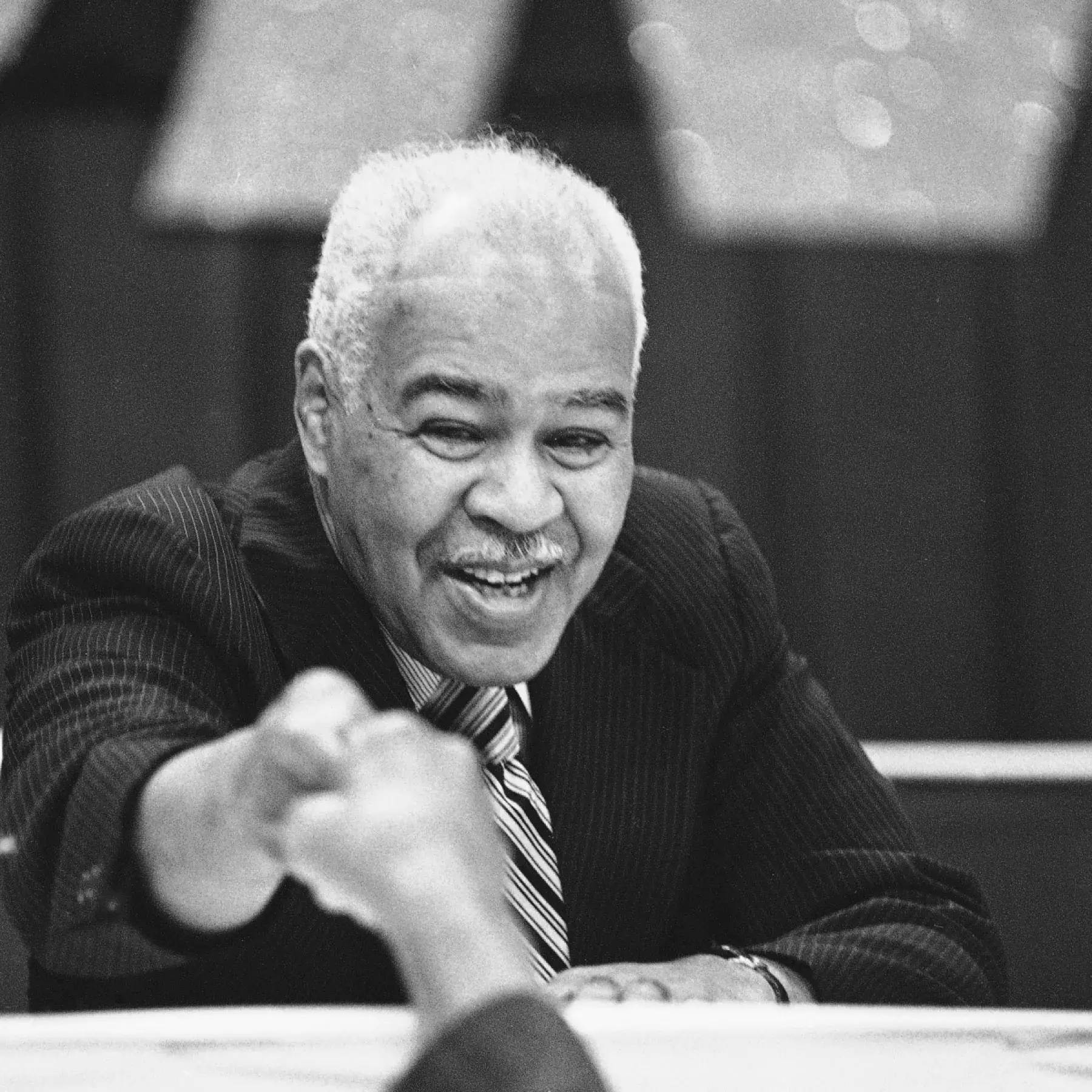
Roy Wilkins, NAACP executive director for twenty-two years — who maintained the organisation's legal and legislative strategy through the civil rights movement's most tumultuous period and was the movement's most important institutional anchor.
United States · Civil Rights Movement

Roy Wilkins

Roy Ottoway Wilkins was born on August 30, 1901, in St. Louis, Missouri, grew up in St. Paul, Minnesota, after his mother's death sent him to live with an aunt and uncle, attended the University of Minnesota where he edited the Minnesota Daily and joined the NAACP in response to a lynching in Missouri, and came to the NAACP's national staff in 1931 as assistant secretary under Walter White. He served as the NAACP's editor, as its administrator, and as its executive secretary before becoming executive director in 1955 — the position he would hold until 1977, making him the organisation's longest-serving executive in its most consequential period. He was, during those twenty-two years, the most important institutional figure in the American civil rights movement — not its most charismatic, not its most eloquent, not its most willing to be arrested, but the person responsible for the NAACP's institutional survival and effectiveness through the most turbulent period in the organisation's history, through the competition with the SCLC and SNCC for the movement's direction and resources, through the rise of Black Power politics that challenged the NAACP's integrationist premises, and through the legislative battles that produced the Civil Rights Act of 1964, the Voting Rights Act of 1965, and the Fair Housing Act of 1968. He was one of the March on Washington's Big Six. He negotiated with the Kennedy and Johnson administrations for the civil rights legislation that the movement needed. He maintained the NAACP's legal and lobbying infrastructure through the years when the movement's direct action campaigns were generating the national attention and political pressure that made the legislation politically possible. He was called too cautious by SNCC and too moderate by the Black Power movement, and he was — by the standards those movements set — both. He was also indispensable. The legal strategies, the lobbying infrastructure, the congressional relationships, the institutional credibility with the federal government that the NAACP maintained under his leadership were the mechanisms through which the movement's street-level pressure was converted into legislation. The civil rights movement needed its Thurgood Marshalls arguing in court and its Martin Luther Kings preaching in churches and its John Lewises marching across bridges; it also needed its Roy Wilkinses maintaining the institutions and the relationships and the legislative strategy that turned all of that into law. He resigned from the NAACP in 1977 and died on September 8, 1981, in New York City, at the age of seventy-nine.

United States NAACP Big Six Legislative Strategy Brown v. Board Civil Rights Act

Born: 30 August 1901, St. Louis, Missouri, USA  |  Died: 8 September 1981, New York City, New York, USA — aged seventy-nine

At a Glance

Full NameRoy Ottoway Wilkins; born 30 August 1901, St. Louis, Missouri; grew up in St. Paul, Minnesota; attended University of Minnesota, edited the Minnesota Daily; joined NAACP in response to Missouri lynching; joined NAACP national staff 1931 as assistant secretary under Walter White; edited The Crisis; became NAACP executive secretary 1955; executive director from 1963; Big Six member; was present at or instrumental in Brown v. Board strategy, March on Washington, Civil Rights Act, Voting Rights Act, Fair Housing Act; resigned 1977; died 8 September 1981, New York City, aged seventy-nine
Born30 August 1901, St. Louis, Missouri; his mother died when he was young and he went to live with his aunt and uncle Elizabeth and Sam Williams in St. Paul, Minnesota; the Williams household provided him with a stable and relatively privileged upbringing by the standards of Black America in the early twentieth century; he attended the University of Minnesota and edited the campus newspaper; his civil rights consciousness was crystallised by news of a lynching in Missouri — a specific act of racial violence that connected the abstract injustice to the concrete reality
Died8 September 1981, New York City; died at the age of seventy-nine, four years after resigning from the NAACP; had continued to be active in civil rights issues after his resignation and had published his autobiography "Standing Fast" in 1982 (the manuscript was complete before his death); his death received respectful but not enormous attention — characteristic of the pattern by which the institutional builders of the movement received less lasting recognition than its charismatic figures
Twenty-Two Years as NAACP ExecutiveServed as the NAACP's executive director for twenty-two years, from 1955 to 1977; his tenure spanned the Brown v. Board of Education decision, the Montgomery Bus Boycott, the rise of the SCLC, the sit-in movement and SNCC's founding, the Birmingham campaign, the March on Washington, the Civil Rights Act, the Voting Rights Act, the rise of Black Power, the Fair Housing Act, and the movement's transition from mass direct action to the consolidation of political gains; navigating the NAACP through this entire period without losing either the organisation's institutional effectiveness or its relevance required precisely the kind of patient, sustained, undramatic institutional leadership that the movement's standard narrative tends to undervalue
Big Six and the Legislative StrategyWas one of the movement's Big Six — the informal leadership group that also included King, Randolph, Young, Farmer, and Dorothy Height — who organised and appeared on the platform at the 1963 March on Washington; his contribution to the movement's legislative strategy was primary: the NAACP's lobbying infrastructure, its relationships with congressional leaders, its legal department's case preparation, and its public advocacy were the mechanisms through which the movement's direct action pressure was converted into the specific legislative language of the Civil Rights Act and the Voting Rights Act
The "Too Cautious" Critique and Its MeritWas consistently criticised by SNCC and by Black Power advocates as too moderate, too willing to work within the system, too respectful of the pace of legislative change, and too deferential to white liberal opinion; these criticisms had merit: Wilkins was more cautious than King, more willing to accept incremental progress, more uncomfortable with the confrontational tactics that SNCC practised; he was also more realistic than many of his critics about how legislation actually got passed and what institutional credibility required to be maintained; the critique and the defense are both accurate, and holding them simultaneously is required for an honest assessment of his record
The Crisis and the NAACP's VoiceServed as editor of The Crisis — the NAACP's magazine founded by W.E.B. Du Bois — and used the platform to maintain the NAACP's public voice on civil rights issues; his editorial work was part of his formation as an institutional communicator; the magazine's role in the movement's communications infrastructure was one of the NAACP's most important contributions to the broader movement's ability to reach and educate its constituency

St. Paul, the University of Minnesota, and the Institutional Path

Roy Wilkins grew up in St. Paul, Minnesota, in a household that was, by the standards of Black America in the early twentieth century, relatively stable and relatively privileged — his aunt and uncle Elizabeth and Sam Williams provided him with an education and an upbringing that placed him in the Black professional class rather than in the agricultural or domestic worker class that most Black Americans inhabited. The specific formation this produced — a young man with a university education, journalistic experience, and a familiarity with the institutional structures of American civic life — was precisely the formation that the NAACP's institutional work required.

His decision to join the NAACP was crystallised by a specific act of racial violence — a lynching in Missouri that made the abstract injustice of American racism concrete and immediate in a way that demanded response. This was not an unusual conversion experience; many of the civil rights movement's most important institutional figures came to the movement through a specific act of violence that they could not ignore. The difference between Wilkins and the figures who responded to such catalysts by becoming front-line organisers or protest leaders was not the depth of the commitment but the specific form it took: he responded by joining and eventually leading the organisation that was building the legal and institutional framework for challenging racial injustice systematically rather than through individual confrontation.

His twenty-two years at the NAACP — first as assistant secretary under Walter White, then as editor of The Crisis, then as executive secretary, then as executive director — were the specific institutional path that the movement's legislative victories required. He was not the person who marched into Bull Connor's fire hoses; he was the person who made sure that the legal arguments were in place before the marchers went in, that the congressional relationships were maintained so that the outrage the marchers generated could be converted into legislation, and that the institutional infrastructure remained functional through the years when the movement's direct action energy was at its peak and threatening to overwhelm the patient, sustained organisational work that direct action alone could never have accomplished.

Brown, the Civil Rights Act, and What the NAACP Built

The NAACP's most important contribution to the civil rights movement was the Brown v. Board of Education decision, and Wilkins's tenure at the NAACP encompassed and extended from that decision. He was not Thurgood Marshall; he did not argue the Brown cases; but the institutional infrastructure of the NAACP's Legal Defense Fund — the staff, the resources, the case selection strategy, the appeals pipeline that Marshall and Charles Hamilton Houston had built — was maintained and supported by the NAACP executive leadership of which Wilkins was a central part. Brown did not emerge from a vacuum; it emerged from the NAACP's twenty-year litigation strategy, and that strategy required the kind of institutional patience and sustained organisational commitment that Wilkins's leadership embodied.

His role in the Civil Rights Act of 1964 and the Voting Rights Act of 1965 was primarily legislative rather than dramatic: the NAACP's lobbying of Congress, its maintenance of relationships with sympathetic legislators, its provision of technical legal assistance to the drafters of the legislation, and its public advocacy for specific legislative provisions were the mechanisms through which the movement's direct action pressure was converted into specific statutory language. These contributions were essential and were almost never dramatic; they were the work of institutional politics rather than street-level confrontation, and they required the specific skills that Wilkins had spent his entire career developing.

The Cautious Institutionalist and the Movement That Needed Him

The critique of Wilkins as too cautious — from SNCC, from Black Power advocates, from the movement's more confrontational figures — was not wrong in its description of who he was. He was more cautious than the people who made the critique. He was more willing to accept incremental progress. He was more respectful of the pace of legislative change and more deferential to the white liberal alliances that the NAACP's Washington strategy depended on. He was uncomfortable with the confrontational tactics that SNCC practised and with the Black Power politics that challenged the NAACP's integrationist framework.

These characteristics were also, in the specific context of American politics in the 1950s and 1960s, precisely the characteristics that made the NAACP's legislative work effective. The Civil Rights Act did not pass because Congress was moved by moral argument alone; it passed because the NAACP had spent years building the congressional relationships and the legislative expertise that allowed it to convert the political pressure generated by Birmingham and Selma into specific statutory provisions that could survive the parliamentary process. The movement needed people who knew how to do this, and Wilkins knew how to do it.

The tension between the NAACP's institutional patience and the direct action movement's moral urgency was not a failure of either but a productive division of labor — a recognition that the movement needed both the dramatic confrontations that generated political pressure and the institutional machinery that converted political pressure into law. Wilkins was indispensable to the second part of this process, and the legislation that the movement produced was the product of both parts working together, however imperfectly and however much in tension.

The March on Washington's Big Six and the Movement's Consensus Figure

Wilkins's position as one of the movement's Big Six — appearing on the March on Washington platform alongside King, Randolph, Young, Farmer, and Dorothy Height — reflected the movement's recognition that the NAACP's institutional work was as necessary as the SCLC's direct action and SNCC's field organising. The March on Washington was itself a demonstration of the kind of coordinated action that the movement's different organisations could produce when they were working toward the same specific goal, and Wilkins's participation was the NAACP's contribution to that coordination.

His relationship with King was complex — marked by genuine mutual respect and genuine tension over the movement's direction and tactics. Wilkins was more comfortable with Kennedy than King was; Wilkins was more respectful of the pace of legislative change than King was; Wilkins was less willing to challenge the Johnson administration over Vietnam than King was. These differences were real and were expressed in the movement's internal debates. They did not prevent cooperation when cooperation was necessary, and the Civil Rights Act and the Voting Rights Act were both products of cooperation between the NAACP's legislative strategy and the SCLC's mass mobilisation.

He resigned from the NAACP in 1977, at seventy-six years old, after twenty-two years as executive director — having led the organisation through the entire arc of the civil rights movement's most consequential period. He died in 1981, in the city where the NAACP was headquartered, having spent his adult life building and maintaining the institution that the movement's most celebrated figures drew on. The celebration the movement received, and the relative obscurity in which Wilkins spent his final years, is the characteristic pattern of the movement's institutional builders versus its dramatic figures. Institutions are what movements need to survive; institutional builders are what movements tend to forget.

Other Civil Rights Movement Profiles

USA · Civil Rights Martin Luther King Jr. The SCLC leader whose direct action strategy generated the political pressure that Wilkins's NAACP converted into legislation USA · Civil Rights A. Philip Randolph Fellow Big Six member whose labour organising tradition complemented the NAACP's legal and legislative approach USA · Civil Rights James Farmer Fellow Big Six member whose CORE direct action approach represented the tactical alternative to the NAACP's institutional strategy USA · Civil Rights Dorothy Height Fellow Big Six member whose NCNW parallel institution to the NAACP addressed the specific needs of Black women USA · Civil Rights W.E.B. Du Bois NAACP co-founder and Crisis editor whose departure from the NAACP preceded Wilkins's rise — the intellectual tradition Wilkins inherited USA · Civil Rights Medgar Evers NAACP Mississippi field secretary working under Wilkins's national leadership — the grassroots face of the organisation Wilkins led nationally USA · Civil Rights Julian Bond Who later chaired the NAACP that Wilkins built — the institutional continuity from Wilkins's era through Bond's USA · Civil Rights Bayard Rustin Movement strategist who understood, like Wilkins, that legislative victories required institutional machinery as well as street-level pressure USA · Civil Rights Bob Moses SNCC director whose Mississippi voter registration work was the kind of grassroots confrontation that Wilkins's cautious approach and the SNCC's more radical approach debated
Share X Facebook WhatsApp LinkedIn