At a Glance
Marion, Perry County, and the Geography of Black Belt Disenfranchisement
Perry County, Alabama, sits in the middle of the state's Black Belt — the band of dark, rich agricultural soil whose fertility had made it the heartland of the plantation economy and whose large Black population was the legacy of the labour force that economy had required. By the 1960s, Perry County's agricultural economy had changed substantially but its racial order had not: Black residents constituted a significant portion of the county's population but were almost entirely excluded from political participation through the standard instruments of Alabama's disenfranchisement machinery.
Jackson grew up in this county in the ordinary material circumstances of a Black working-class family — woodcutting, church, community, the rhythms of rural Alabama life — and he came of political age at exactly the moment when the civil rights movement was beginning to build the organisational infrastructure in the Black Belt that would eventually produce the Selma campaign. He served in Vietnam, returned to Marion, and resumed both his church work as a deacon and his voter registration attempts. The five attempts he made before his death were not exceptional in their persistence — many Black Alabamians tried repeatedly — but they were representative of the sustained, quiet, unrewarded courage that the movement depended on and that rarely appeared in its celebrated narratives.
His grandfather Cager Lee, who was present in Mack's Cafe the night Jackson was shot, was approximately eighty-two years old — old enough to have been born before the Civil War, to have lived through slavery, emancipation, Reconstruction, and its destruction, and to be present when his grandson was killed trying to exercise the voting rights that three generations of legal and political struggle had nominally established. The continuity of this family's experience across the entire arc of Black American history — from slavery through Jim Crow to the civil rights era — was compressed into that single moment in a Marion cafe, and it is one of the reasons why Jackson's death carries the moral weight that it does.
February 26, 1965: The Night in Marion
The evening of February 26 began with a voting rights rally at Zion United Methodist Church — one of the regular meetings that the Perry County Civic League and the SCLC's local network had been organising as part of the sustained campaign building toward the larger demonstrations that would come in March. The specific trigger for the march that evening was the arrest of James Orange, a SCLC field worker who had been organising in Perry County and who had been taken to the county jail on charges that the movement regarded as pretextual.
State troopers and Marion city police were waiting when the approximately four hundred demonstrators attempted to march from the church to the jail. The troopers' first action was to turn off the streetlights — a deliberate tactical choice to prevent the press photographers who were present from documenting what followed. Then they charged into the crowd with clubs. Demonstrators scattered; some were beaten in the street; others ran to nearby buildings for shelter.
Jackson ran into Mack's Cafe with his mother Viola and his grandfather Cager Lee. The cafe's other customers included several reporters who had been covering the rally. State trooper James Bonard Fowler followed the Jacksons into the cafe and began hitting Viola with his club. Jackson stepped between Fowler and his mother — the instinct of a son protecting his parent — and Fowler shot him. The shots were at point-blank range, into his abdomen. Jackson fell. He was carried out of the cafe and eventually transported to Good Samaritan Hospital in Selma, approximately forty miles away, where surgeons operated. He lived for eight days. He died on February 28.
Eight Days, a Hospital Visit, and a Death Without Presidential Notice
Martin Luther King Jr. visited Jimmie Lee Jackson at Good Samaritan Hospital in Selma before he died — a visit that King described afterward as among the most painful of his civil rights experience. Jackson was conscious during part of his hospitalisation and was aware of what had happened to him and of the political context in which it had occurred. He died on February 28, eight days after being shot.
President Lyndon Johnson issued no personal statement at Jackson's death. The national press covered the story — Jackson's shooting had occurred in the presence of reporters — but the coverage was substantially less sustained and less prominent than the coverage that would follow James Reeb's beating in Selma on March 9. The differential was consistent with the pattern that had characterised the entire civil rights era: Black deaths in the movement generated less sustained national attention and less political response than the deaths of white people killed in the same cause.
This differential was not lost on the Black community in Alabama and across the South. SCLC leaders and local organisers who had been planning additional action in the wake of Jackson's death found that his murder, while deeply felt within the movement, had not produced the national political crisis that would force federal action. They needed to create that crisis by other means, and the march from Selma to Montgomery — proposed as a memorial march in Jackson's honour, to carry his name from the scene of his murder to the state capital — was the means they chose.
The March His Death Produced: From Marion to the Edmund Pettus Bridge
The decision to march from Selma to Montgomery was made in the days following Jackson's death, and it was explicitly connected to his murder: the march was described, in its early planning, as a procession to carry Jackson's body symbolically from Selma to the state capital, to place his death before the government that had allowed a state trooper to kill him and had done nothing about it. The specific proposal was made by James Bevel and adopted by the SCLC and the Dallas County Voters League as the march's organising premise.
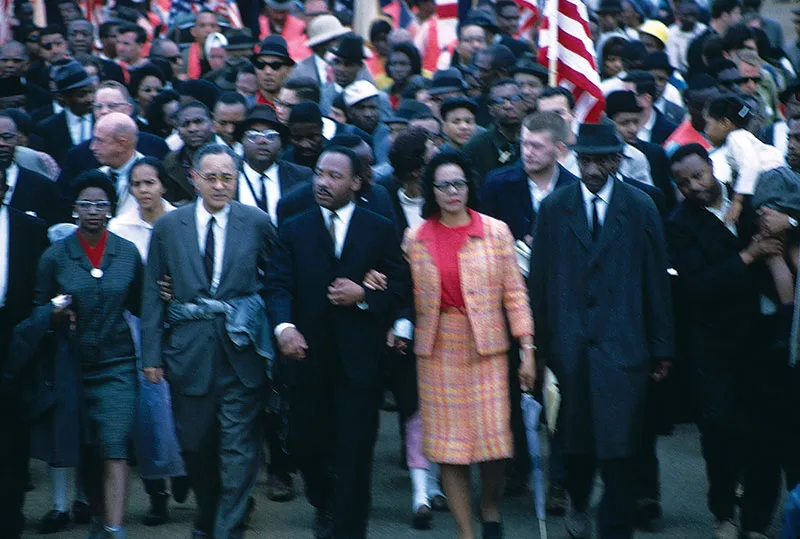
The march that set out from Brown Chapel AME Church in Selma on March 7, 1965 — with John Lewis and Hosea Williams at the head of the approximately six hundred people in the column — was a direct consequence of what had happened to Jimmie Lee Jackson in Marion nine days earlier. The people who were attacked by state troopers on the Edmund Pettus Bridge on Bloody Sunday were there because Jackson had been shot trying to protect his mother. The images of the attack that were broadcast nationally that evening were generated by a march that would not have happened without his death. The Voting Rights Act that the nationally broadcast violence made politically inevitable was, in this sense, built on the foundation of what James Bonard Fowler had done in Mack's Cafe.
Forty-Two Years Without Justice and the Guilty Plea That Acknowledged Nothing
James Bonard Fowler lived freely in Alabama from 1965 to 2007 — forty-two years during which no charge was brought against him for shooting Jimmie Lee Jackson at point-blank range in the abdomen in front of witnesses. He was not a hidden perpetrator; his identity was known. He had been a state trooper, acting under state authority, and the state of Alabama had chosen not to prosecute him. The choice was consistent with the state's approach to virtually every civil rights murder during the movement era.
The 2007 indictment came as part of the same wave of belated prosecutions that had produced convictions in other civil rights-era cases — Medgar Evers's murder, the Birmingham church bombing, the Neshoba County murders — as district attorneys and state attorneys general, working with the FBI's Cold Case Initiative, reopened investigations that had been closed without prosecution decades earlier. Fowler's case was complicated by the passage of time: witnesses had died, evidence had degraded, and the standard for proving murder beyond a reasonable doubt was difficult to meet forty-two years after the fact.
Fowler pleaded guilty in 2010 to misdemeanour manslaughter — not murder, not second-degree murder, but misdemeanour manslaughter for shooting a man twice in the abdomen at point-blank range while he was trying to protect his mother from a police beating. The sentence was six months. He did not serve it; he was sixty-seven years old and claimed health issues that the court accepted as grounds for not incarcerating him. He died in 2015. Jimmie Lee Jackson had been dead for fifty years when the man who shot him accepted a guilty plea to a misdemeanour and walked away from the courthouse.
The Forgotten Catalyst and What His Forgetting Means
Jimmie Lee Jackson is among the least well-remembered of the civil rights movement's martyrs, despite having triggered a chain of events that produced some of the movement's most celebrated and most consequential moments. His name does not appear with the frequency of Emmett Till's or the four girls killed in Birmingham, despite his murder being as unjust and as politically consequential as either. The reasons for this relative obscurity are multiple and none of them are flattering.
He was Black and the national political response to his death was proportionally smaller than the response to James Reeb's death two weeks later — a differential whose causes and consequences the movement documented painfully and which has affected historical memory as it affected political response. He died in Marion, not in a nationally broadcast dramatic confrontation but in a cafe where the state troopers had turned off the streetlights specifically to prevent the kind of photographic documentation that created lasting visual memory. And the movement that built on his death did so without always attributing to him the central role he had played in precipitating it.
His grandfather Cager Lee — who had been present when Jackson was shot and who lived to see the Voting Rights Act signed — was asked by a journalist what he thought of the legislation. His response was to say that he was glad it had come but that he wished his grandson had lived to see it. The Voting Rights Act was the political expression of what Jimmie Lee Jackson had died for. He did not get to vote under its protections. His killer did not go to prison for killing him. These are the facts of his story, and they resist the consolations of historical narrative.