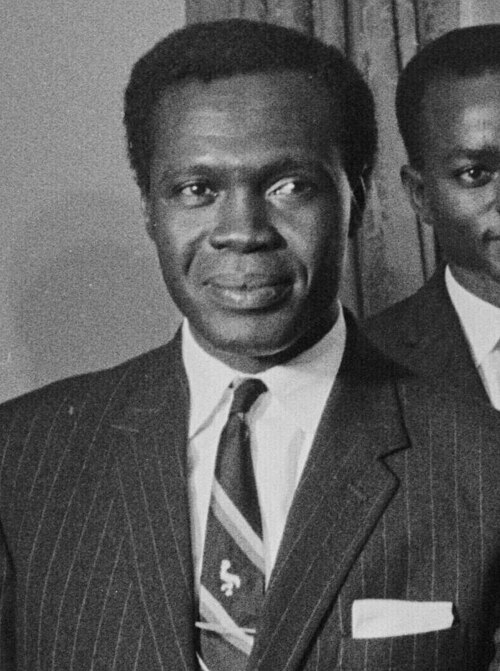
At a Glance
Lango, the North, and the Making of a National Politician
Milton Obote grew up in Akokoro in Lango district at a time when the colonial geography of Uganda was organised almost entirely around Buganda — when the Ganda administrative system, the Ganda language, and the Ganda political class were the instruments through which the British Protectorate governed the whole of what had become Uganda. The north — Lango, Acholi, the West Nile — was peripheral in this geography, administered more directly by British officers without the layer of Ganda intermediaries that applied elsewhere, and culturally distant from the Bantu-speaking, kingdom-organised south in ways that the colonial system had deepened rather than bridged.
Coming of age in that periphery gave Obote a political formation that was both motivated by and critical of Ganda dominance — motivated by it in the sense that the experience of marginalisation gave him the drive to break into the centre, critical of it in the sense that he understood that a genuinely national Ugandan politics could not simply be Ganda politics extended to a larger territory. The vision of Uganda as a nation belonging equally to its Lango, Acholi, Teso, Ankole, Toro, and Ganda populations — a vision that transcended the ethnic and regional hierarchies of the colonial system — was not merely rhetorical for Obote; it reflected a genuine political understanding of what was wrong with the existing political arrangements and what would be required to build something better.
He came to Kampala in the late 1940s and moved between the capital and Kenya, where he worked and encountered the East African nationalist politics of the Mau Mau era, before returning definitively to Uganda to engage in the nationalist movement that was developing in the early 1950s. The experience in Kenya gave him a broader frame for understanding colonial rule — an encounter with the more militant nationalism that the Kenyan situation was producing — and the comparison with Uganda's more moderate political climate sharpened his thinking about what kind of political strategy the Ugandan situation required.
Building the Uganda People's Congress
The founding of the Uganda People's Congress in 1960 was Obote's most significant organisational achievement — the creation of a political vehicle that was genuinely national in its ambitions and, over time, in its reach, capable of competing for support across Uganda's diverse regions and ethnic communities rather than being confined to the Ganda or any other single ethnic base. The UPC's founding reflected Obote's understanding that winning Uganda's independence elections required building a coalition that extended beyond any single community, and his organisational talent in doing the work — the travel, the meetings, the cultivation of local leaders across the country — that building such a coalition required.
The UPC's political programme was deliberately broad — nationalist in its commitment to Ugandan self-government, socialist in its economic rhetoric, inclusive in its appeal to Ugandans across regional and ethnic lines — in ways that sacrificed ideological precision for political breadth. This breadth was necessary for the coalition-building project, but it also meant that the UPC was an organisation held together more by its leader's political skill and by the shared objective of independence than by any deep programmatic commitment that would sustain it through the disagreements and tensions that governing Uganda would inevitably produce.
Prime Minister: The Independence Government and Its Contradictions
Obote's first government — from October 1962, when Uganda became independent — was simultaneously an achievement and a container of contradictions that it could not indefinitely manage. The achievement was real: Uganda had become independent under a government that represented, however imperfectly, the aspiration to national self-governance that the previous decade of nationalist politics had been working toward. The contradictions were equally real: the constitutional arrangements of independence were inherently unstable, binding together the UPC's national project and Buganda's autonomy in an alliance that required continuous management and that was fundamentally incompatible in its deeper logic.
The early years of independence saw Obote attempting to govern a genuinely complex political situation — managing the Buganda relationship, building the national state's administrative and economic capacity, positioning Uganda in the Cold War politics of the 1960s, and maintaining the political coalition that had brought him to power. His rhetorical commitment to African socialism — expressed in the Common Man's Charter of 1969 and the nationalisation programme that followed — reflected a genuine political orientation that was shared by other post-colonial African leaders of his generation, from Nyerere in Tanzania to Nkrumah in Ghana, and that was responding to real structural problems in the post-colonial economies that simple political independence had not resolved.
1966: The Destruction of the Constitutional Settlement
The events of 1966 — the arrest of the five cabinet ministers in February, the suspension of the constitution in April, the military assault on Mengo Palace in May — were the consequence of Obote's decision to resolve the political crisis triggered by Daudi Ocheng's gold scandal allegations by destroying the constitutional framework rather than by working within it. The decision was understandable in narrow tactical terms: the constitutional inquiry that the five ministers had called for would have exposed conduct that implicated both Amin and, quite possibly, Obote himself, and the political dynamics of the KY-UPC alliance were in any case creating structural tensions that were becoming increasingly difficult to manage.
But the decision was catastrophic in its larger consequences. By choosing to resolve the political crisis through executive force rather than constitutional process, Obote established that Uganda's constitutional arrangements were not binding on a government with sufficient military force to ignore them — that the rules of the political game could be changed by whoever controlled the army. This precedent was immediately applied against him: when Amin decided in 1971 that Obote was a threat to his own position, he applied exactly the same logic — that military force was the decisive factor in Ugandan political life, and that constitutional arrangements were irrelevant to a man who controlled the guns.
The abolition of the kingdoms — implemented alongside the constitutional coup and justified in the language of national unity and modernisation — was a profound cultural and political wound to the Ganda and other kingdom populations that has never fully healed. The kingdoms were not merely administrative conveniences; they were the repositories of deep cultural and historical identity for millions of Ugandans, and their abolition by executive decree was experienced as an act of cultural violence that reinforced the political violence of the constitutional coup. Museveni's restoration of the kingdoms in 1993 — as cultural rather than political institutions — was an acknowledgement of how deep that wound had been.
Exile, Return, and the Disputed Elections of 1980
The eight years of Tanzanian exile were years in which Obote maintained his political identity, cultivated his connections within the UPC's networks, and planned his return to Uganda. Julius Nyerere's Tanzania gave him sanctuary — Nyerere had been a close ally and remained one — and when the Tanzania-Uganda war of 1978–79 drove Amin from power, Obote was positioned to return and contest the elections that the post-Amin transition was supposed to produce.
The elections of December 1980 were the moment at which Uganda's attempt to restore democratic politics after the Amin catastrophe was most directly tested — and the moment at which it most clearly failed. The conduct of the elections — the ballot manipulation, the partisan role of the Military Commission that supervised the electoral process, the declaration of results that did not reflect the votes cast — was a demonstration that the political culture of executive manipulation that Obote's own 1966 coup had helped to create had become self-reinforcing. The UPC's victory was declared, Obote was returned to the presidency, and the conditions for the Bush War were established.
Luwero and the Final Moral Judgment
The Obote II government's counter-insurgency campaign in the Luwero Triangle — the area north of Kampala where Museveni's National Resistance Army was operating — was the most destructive period of Ugandan political violence since Amin, and the one for which Obote's second presidency is most definitively judged. The campaign involved the systematic targeting of the civilian population as a counter-insurgency strategy — the destruction of villages, the killing of civilians suspected of supporting the NRA, the use of methods that Human Rights Watch and Amnesty International documented in detail as constituting gross violations of human rights.
The skulls and bones that were found in the Luwero Triangle after the NRM's victory in 1986 — displayed as evidence of the Obote II government's atrocities — became the most visceral symbol of what the second Obote presidency had meant for the Ugandan civilians caught between his army and Museveni's guerrillas. The number of dead was contested — estimates ranged from tens of thousands to several hundred thousand — but the scale of the destruction was undeniable, and it constituted the final and most damning chapter in a political career that had begun with the genuine achievement of independence and ended with the abandonment of any serious commitment to the wellbeing of the Ugandan population.
The Complexity That Remains
Milton Obote died in Johannesburg in October 2005 — in exile, as he had been for most of the previous twenty years, having been driven from power by Museveni's NRA in July 1985 and having spent the last two decades of his life in Zambia, watching Uganda's political evolution from a distance. He was seventy-nine years old, and he had been at the centre of Ugandan political life for more than forty years — from the independence campaign of the late 1950s to the second presidency of the early 1980s.
The assessment of his legacy is genuinely complex in a way that the legacies of simpler political actors are not. He led Uganda to independence — that was a real achievement, requiring real political intelligence and real organisational capacity, and it is not diminished by what came after. His economic nationalism — the Common Man's Charter, the nationalisation programme — reflected genuine concerns about the structural problems of post-colonial economies that subsequent experience has largely validated, even if the specific policies he pursued did not resolve those problems. His pan-Africanist commitments were sincere, his solidarity with other African liberation movements real.
Against all of that must be set the 1966 constitutional coup, which destroyed the democratic foundations that independence had built; the Amin catastrophe, which his political choices had helped to make possible; the fraudulent 1980 elections, which gave his second government a legitimacy deficit it never overcame; and the Luwero atrocities, which established the moral terms on which his second presidency will always be judged. The complexity is real, and it reflects the genuine complexity of a political career that contained both the best and the worst that post-colonial African leadership has produced.