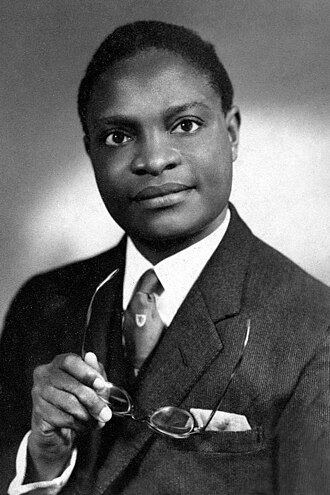
At a Glance
A Ganda Inheritance and Its Transformation
Abu Mayanja's formation in Buganda in the 1930s and 1940s meant formation in the most politically sophisticated of Uganda's kingdoms — a polity with its own parliament (the Lukiiko), its own bureaucratic hierarchy, its own relationship to the British Protectorate that combined cooperation and resistance in proportions that varied with circumstances and personalities. The Ganda political class into which Mayanja was born had been navigating the relationship with British power for decades, developing in the process a political sophistication that was at once deeply local — rooted in the specific history and culture of Buganda — and fully aware of the larger colonial and global context within which that local politics operated.
King's College Budo completed a certain kind of formation — the synthesis of Ganda political identity with British educational culture that the Church Missionary Society had designed the school to produce, though the synthesis produced results that the designers had not fully anticipated. The students who passed through Budo emerged with a command of the English language and the British educational tradition that gave them the tools to challenge British authority in its own terms, and with a sense of themselves as members of a political class with its own claims to governance that the colonial administration's own principles of eventual self-determination could not indefinitely refuse. Mayanja's particular development of that formation pointed toward law as the terrain on which the claims of Ugandan political authority could most effectively be pressed.
Cambridge, Constitutional Law, and the Colonial Paradox
The decision to study law at Cambridge was both a personal choice and a political one — an understanding that legal expertise was one of the most powerful tools available to the African politician who wanted to challenge colonial rule from within the system rather than simply against it. The colonial system was, in its own self-presentation, a legal system — governed by rules, procedures, and constitutional arrangements that claimed to derive their legitimacy from law rather than simply from force. The African lawyer who mastered those rules could use them as weapons against the system that had produced them, and the Cambridge-trained Ugandan lawyer who returned home with a thorough understanding of constitutional law was in a position to argue, in terms that the colonial administration could not easily dismiss, that Uganda's continued subjection to British rule was incompatible with the principles that the British claimed to uphold.
Mayanja absorbed that understanding at Cambridge and returned to Uganda in the late 1950s with it fully developed. What distinguished him from some contemporaries was that the commitment to constitutional method was not merely tactical — not simply a useful tool for achieving independence that could be discarded once independence was won — but a deep conviction about how political power should be organised and constrained. This distinction would matter enormously after 1962, when the question was no longer whether Uganda would be independent but what kind of political system an independent Uganda would have.
The Constitutional Negotiations and the Architecture of Independence
The design of independent Uganda's constitutional structure was a complex problem precisely because Uganda was not a simple political unit — it was a colonial creation that encompassed Buganda with its kingdom structure and special status, the other kingdoms of Ankole, Bunyoro, and Toro, and the non-kingdom territories of the north and east, all with different histories, different relationships to the colonial state, and different ideas about what independent Uganda should look like. The Lancaster House constitutional negotiations of the early 1960s were the arena in which these competing visions had to be reconciled into a constitutional settlement that could achieve independence without immediately collapsing into political crisis.
Mayanja brought to those negotiations a legal mind that could hold the constitutional complexities in view simultaneously — the federal arrangements for Buganda, the relationship between the central government and the kingdoms, the distribution of powers between the parliament and the executive, the rights protections that would constrain what any government could do to its citizens regardless of its parliamentary majority. His involvement in the negotiations was one dimension of a broader contribution to the constitutional moment of Ugandan independence — the moment when the political architecture of the new state was being designed, and when the choices made would shape what came after.
Ministry, Opposition, and the Coming Storm
The post-independence years brought Mayanja into the Obote government as a minister — a recognition of his political standing and his legal expertise that also positioned him within the governing structure whose trajectory he would eventually refuse to accept. The Uganda People's Congress governments of the early 1960s were operating under the constitutional arrangements of independence, with Buganda's autonomy protected, the kingdoms in place, and the formal structures of parliamentary democracy functioning. The tensions within that system — between the central government's desire for national authority and Buganda's insistence on its special status — were building throughout the first years of independence, and Mayanja could see where they were likely to lead.
The crisis came in stages. The 1966 political confrontation between Obote and Kabaka Mutesa II of Buganda — who was also the ceremonial President of Uganda — escalated to the point where Obote made his move: suspending the constitution in April 1966, issuing a new constitution that gave the executive overwhelming power, and then in May attacking the Kabaka's palace on Mengo Hill with army units, forcing Mutesa to flee into exile. Mayanja was among those who understood what had happened in constitutional terms: a government had used military force to destroy the constitutional settlement under which it had come to power, replacing law with the fact of armed control.
Imprisonment as the Price of Constitutional Principle
The imprisonment that followed Mayanja's refusal to accept Obote's constitutional coup was the most direct expression of the stakes involved in Ugandan constitutional politics. He was detained under the emergency powers that Obote's government used to suppress opposition to the constitutional transformation of 1966, joining a number of other politicians and public figures who had made clear their view that what Obote had done was not legitimate regardless of whether it was — in the tautological sense of the term — legal under the new constitutional arrangements that Obote had imposed by force.
The detention was an experience shared with members of the generation of Ugandan political actors who had built their careers on the assumption that constitutional politics was possible in Uganda — that the rules would be followed, that legal constraints on executive power would be respected, and that political disagreement could be resolved through parliamentary and legal means rather than through imprisonment and force. The shattering of that assumption in 1966 was one of the defining moments of post-colonial Ugandan political history, and Mayanja's response to it — maintaining his legal and constitutional position despite imprisonment — established the terms of his subsequent career: the man who refused to accept that force was a substitute for constitutional legitimacy.
Survival, Continuity, and the Amin Interregnum
Idi Amin's coup of January 1971, which overthrew Obote while Obote was abroad, produced a moment of complex and dangerous political possibility for the Ugandan political class. Amin initially released political prisoners from Obote's detentions and presented himself as a corrective to Obote's abuses — an opening that some of Uganda's political figures briefly attempted to use. Mayanja's navigation of the Amin years — a period during which thousands of Ugandans were killed by the regime, including many politicians, lawyers, academics, and intellectuals — required the kind of political intelligence and situational awareness that his career had been developing since the 1950s.
The fact that he survived the Amin years was not simply a matter of luck, though luck was inevitably a factor in survival during a period of such arbitrary and widespread political violence. It also reflected an ability to distinguish between the forms of accommodation that preserved the capacity for future engagement and those that compromised it irreparably — a distinction that was not always clear at the time and that became clearer only in retrospect. What mattered was that when Amin fell in April 1979, driven out by the combined Tanzanian and Ugandan exile force, Mayanja was alive and in a position to re-engage with Ugandan political life.
The Long Return: Law and Politics Across the Museveni Era
The post-Amin period — the complex sequence of transitional governments, the return of Obote in the fraudulent 1980 elections, the Bush War that Museveni's National Resistance Army fought from 1981 to 1986, and the NRM government that took power in January 1986 — was the context within which Mayanja spent the last two decades of his active political and legal life. He continued to practise law and to engage in public debate, bringing the same constitutional orientation that had shaped his career from the beginning to the questions that the Museveni government's political arrangements raised.
The NRM's initial "no-party" system — the argument that multiparty democracy was inappropriate for Uganda in its current stage of political development, and that a movement system was more suited to conditions of diversity and post-conflict reconstruction — was exactly the kind of constitutional argument that Mayanja was positioned to engage with critically and substantively. He did so, maintaining the position that constitutional governance required genuine accountability mechanisms and genuine political competition regardless of the specific form those mechanisms took.
The Legacy of Constitutional Persistence
Abu Mayanja died in 2005 having spent more than five decades in the public life of a country whose constitutional history had been one of the most turbulent in post-colonial Africa — a history of suspended constitutions, military coups, political detention, and the systematic destruction of the legal and institutional frameworks that each generation of political actors had attempted to construct. His persistence through all of that — his refusal to abandon the constitutional framework as the proper terrain of political argument even when the constitutions were being suspended and the political actors were being imprisoned — was both a personal achievement and a contribution to Ugandan political culture.
What he represented was the possibility of a specific kind of political actor: the lawyer-politician who understood that independence was not simply the transfer of power from British to Ugandan hands, but the construction of a new political order in which power was genuinely constrained by law, in which governments derived their legitimacy from constitutional processes rather than from military force, and in which the rights of citizens were protected against the state by legal frameworks that even the most powerful executive could not simply sweep aside. Uganda has not yet fully realised that vision, but the vision has been kept alive in part by the example of those who maintained it through circumstances that made maintenance difficult and costly.