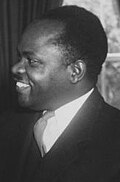
At a Glance
Buddu, Catholicism, and the Making of a Democratic Nationalist
The county of Buddu in western Buganda was the territorial heart of Ugandan Catholicism — the area where the White Fathers had established their missions in the aftermath of the religious wars of 1888–1892, where the Ganda Catholic community had been concentrated by the territorial settlement that ended those wars, and where the Catholic church had built its schools and its institutional presence across the first decades of the twentieth century. Growing up in Buddu in the 1920s and 1930s meant growing up in a community with a specific historical consciousness: the memory of the religious wars, the awareness of the systematic disadvantage that the Protestant establishment maintained through its control of the colonial state's patronage, and the sense of a community that had to be self-reliant and organised in order to advance in a system that was not designed to advance it.
Kiwanuka drew from that formation not the conclusion that Catholics should organise to take power from Protestants — though the DP's organisational base inevitably reflected its Catholic founding context — but the deeper conclusion that the whole structure of religious and communal political organisation was the problem, that Uganda's future had to be built on a different foundation. This was a harder political position to sustain than straightforward communal representation, because it required persuading people to identify with a national political project that transcended their immediate communal interests at a time when those interests were real and the structures that maintained them were powerful. Kiwanuka spent his career making that argument, and he was never entirely free of the tension between the universalist vision and the communal base that provided the resources to pursue it.
The Democratic Party and the Politics of National Inclusion
The founding of the Democratic Party in 1954 was a political act with immediate tactical dimensions and longer-term principled ones. Tactically, the DP gave Uganda's Catholic community an organisational vehicle for political participation at a moment when the nationalist politics of the period were being organised in ways that did not give Catholics a central role. Principally, the DP represented a claim that Ugandan political organisation should be structured around policy, around the practical question of what kind of country Uganda should be, rather than around the religious and ethnic identities that colonial rule had deepened and institutionalised.
The tension between these two dimensions never fully resolved itself during Kiwanuka's lifetime. The DP was, in practice, the party that Catholics voted for — not because Kiwanuka organised it that way but because the structural logic of communal politics meant that the party founded by a Catholic leader in opposition to the Protestant establishment attracted Catholic voters in the way that a party in a first-past-the-post system tends to consolidate the support of the community most motivated to support it. This structural reality both gave the DP its political base and complicated its claim to be a truly national, non-sectarian party.
What distinguished the DP from a simple communal organisation, and what made Kiwanuka a genuinely national figure rather than simply a spokesman for Catholic interests, was the consistency and seriousness with which he argued for the national vision. He was not using the language of national unity as a cover for communal advancement — he was genuinely committed to the idea that Uganda's political future had to be built on a foundation that transcended the religious and ethnic categories that colonial rule had created and deepened.
Prime Minister of Uganda: The 1961–62 Government
Kiwanuka's government of 1961 to 1962 — Uganda's first government under African leadership, the administration that moved the country from full colonial status to self-government in preparation for independence — was a demonstration that his vision of non-sectarian democratic politics could be translated into actual governance. The government was formed from DP members, operated under the constitutional arrangements of the new self-governing Uganda, and managed the practical business of government — education, health, economic development, the civil service — with the pragmatism and competence that the moment required.
The self-governing period was also the period during which the final constitutional negotiations for independence were taking place, and Kiwanuka's government was the Ugandan interlocutor in those negotiations — the administration that had to translate the competing demands of Buganda's monarchical constitutional claims, the other kingdoms' interests, the non-kingdom territories' desire for an undivided national state, and the nationalist parties' varying visions into a constitutional settlement that could be agreed and implemented. That Kiwanuka navigated this successfully — that Uganda reached independence in October 1962 with a functioning constitutional framework, however imperfect — was in part his achievement.
The 1962 Defeat and the Lessons of Electoral Politics
The defeat in the 1962 independence elections was a decisive moment in Ugandan political history — the moment when the question of what kind of political culture independent Uganda would have was answered, at least for the first decade, in favour of communal coalition arithmetic rather than programmatic national politics. The UPC-KY alliance that brought Obote to power at independence was not a conspiracy exactly — it was the rational calculation of two political organisations that both gained from cooperation — but its consequences for Ugandan political culture were profound.
What the alliance demonstrated was that, in Uganda's specific political geography, communal mobilisation was more electorally powerful than programmatic national politics. A politician who organised his or her community and then made deals with other communally organised politicians could win; a politician who tried to build genuinely cross-communal support on the basis of policy and principle would struggle against the arithmetic of communal blocs. Kiwanuka understood this lesson but refused to draw the conclusion that some would have drawn from it — that the principled national politics he had built was simply impractical and should be abandoned in favour of more effective communal strategies.
Opposition, Detention, and the Narrowing of Political Space
The years from 1962 to 1966 were years of political opposition for Kiwanuka — years in which he led the DP in the parliament as Leader of the Opposition, maintained the democratic critique of the Obote government's increasingly authoritarian tendencies, and continued to argue for the kind of constitutional politics that the 1966 crisis would eventually show Obote had abandoned. The opposition years were difficult — Uganda under Obote in the mid-1960s was not a state in which political opposition was entirely comfortable — but they were years in which a functioning parliamentary opposition could still operate, in which the argument could still be made in public, in which the democratic form was still being maintained even as its substance was being eroded.
The constitutional coup of 1966 ended that phase. Kiwanuka was among those detained after Obote's suspension of the constitution — caught up in the same exercise of emergency powers that imprisoned Abu Mayanja and others who had refused to accept the constitutional transformation as legitimate. He was held for a period and then released — one of the moments when Obote's regime exercised enough restraint to stop short of the systematic killing that Amin's regime would later practise as standard procedure.
Amin, Makindye, and the Final Reckoning
Idi Amin's coup of January 1971 created a moment of dangerous ambiguity for Uganda's political class. Amin's initial gestures — releasing political prisoners, presenting himself as restoring constitutional order, appealing to Uganda's religious communities with promises of even-handedness — gave some politicians reason to hope that the new regime might be less destructive than Obote's. The hope was quickly revealed as illusion. Amin's regime was not a temporary corrective to Obote's abuses but the wholesale destruction of the political, legal, and institutional framework that Ugandans had been trying to build since independence.
Kiwanuka's arrest in 1972 was the regime's move against one of the most significant surviving figures of Uganda's democratic politics — a man whose very existence was a reproach to a regime that organised itself on the opposite of every principle he had spent his career advancing. At Makindye, he was subjected to the violence that Amin's soldiers inflicted on political prisoners with the systematic brutality that the regime had normalised. He was murdered there, his body disposed of in the way that Amin's regime disposed of the bodies of those it killed — often without formal acknowledgement, without trial, without any of the legal forms that he had spent his career arguing were the foundation of legitimate political authority.
The Meaning of Kiwanuka's Life and Death
Benedicto Kiwanuka's murder in Makindye in 1972 was not the end of his political significance but in some ways the beginning of it. The manner of his death — taken by a military regime, held without trial, killed without legal process — was the ultimate demonstration of everything he had argued against. He had spent twenty years arguing that political power without legal constraint was not legitimate governance but organised violence, and Amin's regime proved him right in the most brutal possible way by killing him with the organised violence that it practised in place of legal governance.
The Democratic Party that he founded survived him — continuing to operate through the Amin years and afterward as one of Uganda's major political organisations, maintaining the tradition of non-sectarian democratic politics that Kiwanuka had built into its foundation. The vision of Uganda as a country that belonged to all its citizens regardless of religion or ethnicity — the vision that Kiwanuka had tried to translate into electoral politics and into government — remained available as a standard against which Ugandan political reality could be measured and found wanting.
In post-Amin Uganda, Kiwanuka's legacy became an important reference point for those who wanted to rebuild democratic politics on principled foundations — a reminder that Uganda had produced, before the descent into authoritarianism and violence, a political tradition that was worth recovering and worth defending. His biography is Uganda's democratic promise, stated most clearly and paid for most completely by the man who most consistently embodied it.