At a Glance
A City Child, a Performer's Education
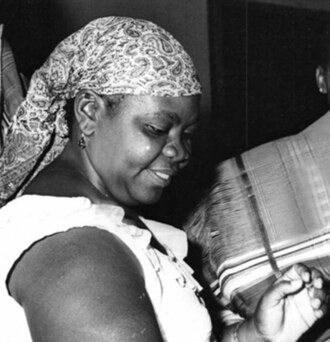
Bibi Titi Mohamed was born in Dar es Salaam in 1926 into a Muslim Swahili family. She received little formal schooling — the colonial education system was not designed to extend opportunity broadly — but she was educated in a different and arguably more important way by the culture of the city itself. Dar es Salaam in the 1930s and 1940s was a place where the Indian Ocean's trade and cultural currents converged: Arab merchants, Swahili artisans, Asian traders, African labourers, and a colonial administration sitting over all of it.
She became a taarab singer — a performer in the Swahili musical tradition that fused Arabic, Indian, and East African musical forms into something entirely its own. Taarab was the music of weddings and festivals, of longing and celebration, and it was also a form of social commentary. The best taarab singers were community figures: known, trusted, listened to. Bibi Titi became very good at it. She was known across Dar es Salaam's Swahili neighbourhoods before she ever set foot in a political meeting.
That reputation — the established performer, the woman whom ordinary people already knew and already trusted — was exactly what TANU needed when Julius Nyerere came looking for someone to mobilise Tanganyika's women. Nyerere was building a party in the mid-1950s that would have to reach beyond the educated urban elite if it was to be a genuine mass movement. The women of the coastal towns and the upcountry markets had not yet entered the political conversation. Bibi Titi Mohamed was going to bring them in.
Joining TANU and Discovering a Second Voice
Bibi Titi joined the Tanganyika African National Union in 1955, the year of its founding. She had been approached by a TANU organiser who recognised what her social standing and her gift for public address could mean for the party's reach. She was not immediately certain: politics, in the Dar es Salaam of the mid-1950s, was still largely a male domain, and a Muslim woman's participation in public life was not something universally encouraged. She joined anyway.
What followed was one of the most remarkable recruitment campaigns in African independence history. Working through the networks she already knew — the ngoma women's dance societies, the neighbourhood associations, the mosque communities, the market networks — Bibi Titi enrolled hundreds, then thousands, then tens of thousands of women into TANU membership. By some accounts, she personally recruited more members than any other individual in the party during the late 1950s.
She understood that the women she was speaking to were not apolitical: they had immediate, practical grievances about markets, taxes, land, the education of their children, and the arbitrary authority of colonial officers. Her method was neither ideological abstraction nor imported political theory. She spoke in Swahili, directly, about things people could see and feel. She was an extraordinarily effective communicator because she believed, without apparent self-consciousness, every word she said.
"Women are the backbone of any movement. Without the women of Tanzania, there would have been no TANU. Without TANU, there would have been no independence."
— Bibi Titi Mohamed
The TANU Women's Section and the Road to Independence
Bibi Titi became the leader of the TANU Women's Section — the Umoja wa Wanawake wa Tanganyika (UWT) as it was later formally constituted — and transformed it into the largest and most active wing of the party. In many parts of the country, the Women's Section was the primary vehicle through which TANU reached the population. It organised meetings, distributed membership cards, raised funds, and brought women into the political process at a moment when neither the colonial administration nor most African political parties had thought to prioritise them.
She travelled extensively — to upcountry towns and rural areas where TANU had not yet penetrated, speaking through interpreters where Swahili was not the first language, addressing crowds that had never been addressed by a woman on a political platform. The combination of her celebrity as a taarab performer, her obvious sincerity, and her oratorical skill created an effect that was, by contemporary accounts, genuinely electrifying.
By the time Tanganyika achieved independence on 9 December 1961, Bibi Titi Mohamed was one of the most recognisable political figures in the country. She had been elected to the Legislative Council and then to the National Assembly. She had travelled to the United Nations with Nyerere to present the case for independence. She was, in the full and unambiguous sense, a national leader.
Key Dates
Power, Marginalisation and Growing Discontent
Independence, as Bibi Titi Mohamed experienced it, was also the beginning of her marginalisation. The pattern is familiar in the history of liberation movements: the women who built the mass base during the struggle were thanked, honoured with ceremonies, given positions of secondary importance, and then systematically excluded from the centres of real power. The new Tanzanian state was dominated by men — the educated elite that Nyerere drew from, bureaucrats trained in colonial institutions, party apparatchiks who moved in circles where decisions were actually made.
Bibi Titi was appointed a Member of Parliament and given a role in the Women's Union, but her influence over actual policy was minimal. She had not been to university. She did not read English fluently. The networks that had made her the most effective organiser in Tanzania's independence movement — the ngoma societies, the market women, the mosque communities — were not the networks that mattered in post-independence Dar es Salaam.
Her frustration was real and articulate. She had mobilised the women of Tanzania for a revolution that, she increasingly felt, had not delivered what it promised — not to women, and not to the ordinary people who had trusted TANU's rhetoric about African socialism and genuine self-rule. By the late 1960s, she was being watched by the government's security services.
Treason Trial and Imprisonment
In 1969, Bibi Titi Mohamed was arrested along with a number of other prominent figures — including former cabinet minister Oscar Kambona, who had already fled the country — and charged with plotting to overthrow the government. The state alleged a conspiracy to replace Nyerere's administration. The defendants contested the charges.
Bibi Titi was convicted and sentenced to life imprisonment. Whether the conspiracy was genuine, fabricated, or something in between has been debated by historians ever since. What is not seriously disputed is that the government used the trial to eliminate a significant centre of internal dissent — and that among those swept up in its net was the woman who had done more than almost anyone else to bring that government into existence.
She served three years in prison before being pardoned by Nyerere in 1972. The pardon was presented as an act of presidential clemency rather than an admission that the conviction had been unjust. Her property was not returned. Her record was not cleared. She received no acknowledgement from the state of the wrong that had been done to her.
Later Life, Rehabilitation and Enduring Significance
Bibi Titi Mohamed spent much of the 1970s and 1980s in relative obscurity. She was not banned from public life, but she was not invited back into it either. The restoration of her reputation came gradually, and it came largely from outside official channels — from historians, particularly women historians working on the independence era, who began to document her contribution in detail. Oral history projects recorded her own account of the independence campaign and the years that followed.
Academic studies of TANU's organisation made clear that the Women's Section had been not a peripheral support structure but one of the party's primary engines of growth, and that Bibi Titi had built it almost single-handedly. By the 1990s, she was interviewed widely, celebrated at commemorative events, and recognised as one of the founding mothers of the Tanzanian state. The treason conviction was never formally overturned, but the historical record had been substantially corrected.
She died in Dar es Salaam in the year 2000, at approximately seventy-four years of age. Her legacy is, in some respects, the most instructive of all Tanzania's independence generation. She was not a theorist or a diplomat or a military strategist. She was an organiser — the finest the independence movement produced — and she understood something that the male leadership of TANU understood imperfectly at best: that a liberation movement is not a movement unless it moves people, and that moving people requires speaking to them in a language that connects with the texture of their actual lives.
She did that better than anyone. And for a time, the country she helped build rewarded her with a prison cell. That contradiction is not an anomaly in the history of liberation movements. It is one of the most important things the history of liberation movements teaches.
Related Profiles — Tanzania