At a Glance
The Mountain and the Mission School
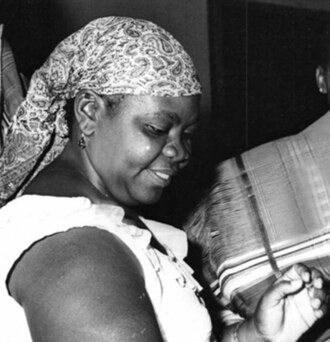
Lucy Selina Lameck was born in 1934 in Moshi, the principal town of the Kilimanjaro region in northeastern Tanganyika. The Kilimanjaro highlands had a character distinct from much of the rest of the territory: the Chagga people who dominated the region had engaged with Christian mission education earlier and more extensively than many other Tanganyikan communities, and the result by the 1930s was a relatively high density of literate, educated Africans who had developed a sophisticated understanding of how the colonial economy worked and what it would take to change it.
Lameck benefited from that educational tradition and went further with it than almost any other woman of her generation in Tanganyika. She completed her secondary education, entered teacher training, and then — in a step that required both institutional support and extraordinary personal determination — won a place at Ruskin College, Oxford, the institution founded specifically to provide university-level education to students from working-class and trade union backgrounds. She was one of very few African women to study in Britain in the 1950s, and the only Tanganyikan woman to do so in that decade.
Oxford gave her something beyond academic qualification: exposure to the trade union and labour movement networks of postwar Britain, to the broader debates of the international left, and to a community of African and Caribbean students who were simultaneously discovering, in the corridors of British institutions, the clearest possible view of the system they intended to dismantle. She returned to Tanganyika radicalised, organised, and ready.
Organising for TANU
Lameck joined TANU and immediately became one of its most active regional organisers in the Kilimanjaro area. Her education set her apart, but it was her political temperament that made her indispensable: she was direct, she was tireless, and she was constitutionally incapable of deferring to authority she considered unjust. In the Moshi area, where the coffee-growing cooperative movement had given African farmers a degree of economic organisation unusual in colonial Tanganyika, she worked the intersection of labour politics and nationalist politics with a sophistication that drew on both her Oxford experience and her deep familiarity with the local economy.
She was elected to the Tanganyika Legislative Council in 1960, one of the cohort of TANU women — alongside Bibi Titi Mohamed, who was building the party's women's base on the coast — who entered formal politics in the final years before independence. Where Bibi Titi's genius was in mass mobilisation, Lameck's was in the legislature: she understood parliamentary procedure, she could draft an argument and sustain it across a debate, and she used the platform she had been given with a purposefulness that distinguished her from many of her male contemporaries.
When Tanganyika became independent in December 1961, Lameck was among the new nation's founding parliamentarians — elected to the National Assembly for Moshi and recognised within TANU as one of its most capable legislators. The question was whether the party would have the political will to translate that recognition into executive power.
"We did not fight for independence so that women could be spectators in the nation we built. We fought so that everyone would be free — and freedom that does not include women is not freedom at all."
— Lucy Lameck, address to the National Assembly, Tanzania
First Through the Door: Cabinet Appointment
In 1962, Julius Nyerere appointed Lucy Lameck as a Junior Minister in the Ministry of Home Affairs — making her the first woman to hold cabinet office in Tanzania's post-independence government. The appointment was significant not merely symbolically. Lameck was not a ceremonial presence: she had the political experience, the parliamentary record, and the intellectual preparation to function as a working minister, and she did.
She subsequently served as Minister of State for Co-operatives — a portfolio that placed her at the centre of one of the independence government's most important economic projects. The cooperative movement in Tanzania was not simply an economic mechanism; it was, in Nyerere's Ujamaa framework, a model of the communal organisation that African socialism was meant to generalise. For a minister responsible for cooperatives to understand both the theoretical architecture and the practical mechanics of the cooperative form was essential. Lameck, with her Ruskin College background in labour economics and her hands-on experience of the Kilimanjaro coffee cooperatives, understood both.
Her tenure was marked by consistent advocacy for women's economic participation. The cooperative movement, she argued with documented persistence, would not achieve its goals if women — who performed the majority of agricultural labour in most of Tanzania's farming communities — were excluded from membership, management, and profit-sharing. This was not a peripheral concern: it was a structural question about whether Ujamaa's communal promise was genuinely universal or whether it reproduced, under socialist language, the same gender hierarchies that colonialism had entrenched.
Key Dates
Women's Rights as Political Argument
What distinguished Lameck from many of her contemporaries in the independence government was her refusal to treat women's rights as a separate, secondary concern to be addressed once the more urgent business of nation-building was complete. She understood — and argued, repeatedly, in parliament and in party forums — that the question of women's rights was a question about what kind of nation Tanzania was building.
Her arguments covered land rights, where customary law in many Tanzanian communities severely limited women's ability to own or inherit property; access to cooperative membership, where formal and informal barriers kept women from the economic organisations that were supposed to be the backbone of Ujamaa; and representation in government, where the number of women in elected and appointed positions remained, despite independence, a fraction of what the female majority of the population deserved.
She was not always successful. The independence government's record on women's rights was, by any honest assessment, mixed: better than the colonial system it replaced, worse than the rhetoric of Ujamaa promised. Lameck's persistence kept the gap between promise and practice visible in forums where it might otherwise have been politely ignored. That was not a glamorous form of political work. It was essential.
Legacy: The Pioneer Who Was Not Celebrated Enough
Lucy Lameck died in 1993. She did not receive, in life or in the years immediately following her death, the recognition that her record warranted. The narrative of Tanzanian independence had settled around a small number of canonical figures — Nyerere foremost, then Kawawa, then the Zanzibari revolutionaries — and the women who had made the independence movement what it was occupied a secondary position in that story, mentioned in passing when mentioned at all.
Historical recovery has been slow but real. Scholars of Tanzanian political history and gender studies have restored Lameck's place in the record with increasing thoroughness over the past two decades. Her role as the first woman in cabinet, her advocacy within the cooperative movement, and her parliamentary record are now better documented than they were during her lifetime. It is a pattern that repeats across the independence histories of virtually every African state: the women who built the movements were present at the founding, then gradually written out of the story that the founding told about itself.
Lucy Lameck's specific contribution — the combination of educational preparation, regional organisational work, parliamentary capability, and consistent advocacy for the half of Tanzania that the independence settlement consistently underserved — places her among the most significant figures of her generation. She was first through the door. She held it open. The fact that it took so long for history to record what she did there is its own kind of commentary on the problem she spent her political life trying to solve.
Related Profiles — Tanzania