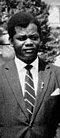
At a Glance
From Songea to the Centre of Power
Oscar Salathiel Kambona was born on 30 March 1928 in Songea, in the southern highlands of Tanganyika — a region whose colonial history carried a particular weight. The Ngoni people of Songea had mounted one of the most sustained armed resistances to German colonialism in the Maji Maji rebellion of 1905 to 1907, and the memory of that resistance — and of the brutal reprisals that followed — was not remote history in the community where Kambona grew up. It was living inheritance.
He was educated at mission schools and then at Makerere College in Uganda — the same institution that had trained Julius Nyerere. The two men met there and formed the political friendship that would shape both their careers for the better part of three decades. They understood each other's intellectual frameworks, shared a commitment to African nationalism that was Pan-African in ambition rather than merely territorial, and complemented each other temperamentally: Nyerere the theorist and orator, Kambona the organiser and political operator.
On returning to Tanganyika, Kambona worked as a teacher and immediately became active in the African Association that Nyerere was in the process of transforming into a proper political party. When TANU was formally constituted in July 1954, Kambona was appointed its first Secretary-General — the administrative and organisational anchor of the new movement, the man responsible for building the party infrastructure that would carry the independence campaign from Nyerere's initial vision into every corner of the territory.
Architect of TANU's National Structure
The Secretary-General's role in a nascent nationalist party is not glamorous, but it is foundational. Kambona had to build, largely from scratch, the bureaucratic and organisational apparatus through which TANU would function: the branch network, the membership systems, the communications between regional organisers and central leadership, the financial infrastructure that kept the party solvent during the years when the colonial administration was actively hostile to its activities.
He was exceptionally good at it. His energy was prodigious, his attention to organisational detail was meticulous, and his ability to manage the human complexities of a party that spanned more than 120 ethnic groups across a vast territory — keeping factions cooperative, managing personal rivalries, maintaining the discipline that non-violent constitutional nationalism required — was one of TANU's most important assets throughout the independence campaign.
He also served as the party's international envoy at critical moments. While Nyerere addressed the United Nations, Kambona worked the diplomatic circuits of London, New York, and the African capitals — cultivating relationships with other liberation movements, lobbying British politicians, and building the international network of support that gave the independence campaign its credibility beyond Tanganyika's borders. By the time independence was achieved in December 1961, Kambona had earned, by almost any measure, the second-highest place in the new government's hierarchy.
"A one-party state is not the African way. It is the way of those who are afraid of the people they claim to serve."
— Oscar Kambona, from exile in London, 1968
First Minister of Foreign Affairs, First Minister of Defence
In the first independent government of Tanganyika, Kambona was appointed Minister of Foreign Affairs — a portfolio that reflected both his international networks and his capacity to represent the new state with the combination of authority and diplomatic finesse that a young republic building its foreign relations from nothing required.
His tenure at Foreign Affairs coincided with some of the most turbulent moments in early post-independence East African history. The Congo crisis was reshaping the continent's understanding of what sovereignty meant in the Cold War context. The Zanzibar Revolution of January 1964 created an immediate foreign policy challenge — Kambona was among those who worked to ensure that the new Zanzibari government's alignment with Cuba and China did not provoke a Western intervention that would destabilise the whole region. The negotiation of the union between Tanganyika and Zanzibar, which Nyerere managed politically, required diplomatic scaffolding that Kambona helped erect.
He also served as Minister of Defence during the army mutinies of January 1964 — a crisis in which Tanganyikan soldiers revolted over pay and conditions, briefly seized the radio station and other installations, and required British military intervention to suppress. The mutinies were a profound embarrassment to the independence government and a demonstration of how fragile the state's institutional foundations still were three years after independence. Kambona's management of the political fallout — containing the damage, restructuring the military, and rebuilding governmental authority — was one of the less celebrated but more consequential achievements of his ministerial career.
Key Dates
The Break with Nyerere
The relationship between Kambona and Nyerere — which had been the central political partnership of Tanzania's independence movement — began to fracture in the mid-1960s over a set of disagreements that were both principled and personal. Kambona had reservations about the direction in which Nyerere was taking the country: toward a one-party state, toward an increasingly centralised economic model, and toward a foreign policy that Kambona felt was unnecessarily antagonistic to the Western powers on whose aid Tanzania depended.
The Arusha Declaration of February 1967, which committed Tanzania to Ujamaa socialism and introduced the leadership code requiring ministers to divest themselves of outside income and property, crystallised the break. Kambona was among several senior figures for whom the leadership code presented difficulties — he had investments and properties that the code required him to relinquish. Whether his opposition was primarily principled or primarily personal has been debated by historians ever since. The answer is probably that it was both, and that the two motivations reinforced each other in the way that they typically do in political breakdowns.
He resigned from the cabinet in 1967 and, facing what he believed was an imminent arrest, left Tanzania for London. He never held office again. From London he wrote, organised, and broadcast his criticism of the Nyerere government through the exile networks of African dissidents that the British capital hosted throughout the Cold War decades. The government in Dar es Salaam responded by including him in the 1969 treason trial — alongside Bibi Titi Mohamed and others — and securing a conviction in his absence.
Exile, Return and the Question of History
Kambona spent twenty-five years in London. He was not a forgotten figure — he was too well-connected, too articulate, and too willing to speak to journalists and opposition networks for that — but he was an exile, which meant that his influence on Tanzanian politics was real but indirect, filtered through the channels available to men who could not go home.
Tanzania's political liberalisation in the early 1990s under President Ali Hassan Mwinyi — the transition toward multiparty democracy that Nyerere had himself endorsed — created the conditions for Kambona's return. He came back in 1992, to a country he had not seen in twenty-five years, and to a political landscape that had changed enough that his critique of one-party rule was no longer seditious but mainstream. He did not, however, return to prominence. He was too old, too long absent, and too associated with an older generation of politics for the new Tanzania to find a central use for him.
He died in London on 21 July 1997, aged sixty-nine. His legacy is one of the most genuinely complex in Tanzanian history. He was, without question, one of the indispensable architects of independence — the man who built the party machine that made Nyerere's vision operational. He was also a man whose break with the government was sufficiently disruptive that the government chose to include him in a treason trial rather than manage the disagreement through political accommodation. Whether he was a principled democrat who refused to accept the suppression of political pluralism, or a politician who dressed personal interests in principled language, or — most likely — some honest combination of both, the record does not entirely resolve. What the record does establish, unambiguously, is that Oscar Kambona's contribution to the making of Tanzania was foundational, and that the country's official history was diminished by his absence from it for so long.
Related Profiles — Tanzania