At a Glance
Colonial French Somaliland and the Politics of Strategic Retention
The French Somaliland that Ali Aref Bourhan was born into in 1934 was unlike most French African territories in the specific intensity of France's strategic interest in retaining it. The port of Djibouti — the natural deep-water harbour at the southern entrance to the Red Sea — was the terminus of the Chemin de Fer Franco-Éthiopien, the railway that was Ethiopia's primary connection to the sea and that gave whoever controlled the port enormous leverage over Ethiopian trade and, by extension, over Ethiopia's relations with the wider world. France's determination to maintain this leverage made French Somaliland one of the last territories in French Africa to achieve independence, and the specific mechanisms through which France delayed that independence — the manipulation of referendums, the management of local political actors, the exploitation of ethnic divisions — were the mechanisms within which Ali Aref built his political career.
The territory's ethnic composition gave French divide-and-rule administration its specific instruments. The Afar — Cushitic-speaking pastoralists with traditional territories extending into Ethiopia and Eritrea — and the Issa Somali — one of the Dir clan groupings with connections to the broader Somali nationalist movement across the border — were communities with distinct linguistic, cultural, and political orientations whose cohabitation in the territory France governed was simultaneously a practical reality and a political resource. By positioning independence as an Issa Somali project that threatened Afar interests — by cultivating Afar political figures willing to present pro-French administration as Afar protection — France could split the independence movement along ethnic lines and prevent the unified front that might have forced earlier departure.
Rise Through the Colonial Apparatus
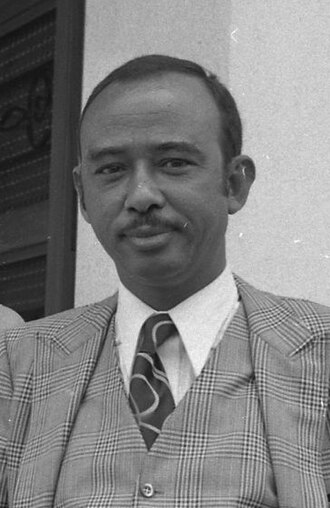
Ali Aref's rise through the French administrative apparatus followed the trajectory that French colonial governance made available to local political figures who demonstrated usefulness to the metropolitan power: representation in the French National Assembly, positions within the Territorial Assembly, and eventually the chief ministership that the 1967 constitutional arrangements created. His political career was built on the specific combination of clan and community networks that gave him credibility across the Afar-Issa divide, administrative competence within the French system, and the willingness to manage the territory's political life in France's interest rather than the territory's own.
The French investment in Ali Aref as a political actor was an investment in the specific kind of local authority figure that colonial governance required: a man with genuine local networks and credibility who was simultaneously committed to the continuation of French association. The colonial relationship was not purely coercive — it operated through the cultivation of local actors whose interests were aligned, at least partially, with the continuation of the colonial arrangement. Ali Aref's interests, as he understood them, were served by the French-backed position he occupied; the question of whether those interests reflected or distorted his community's broader interests was the question that the independence movement answered differently.
The 1967 Referendum: Democracy Managed
The March 1967 referendum — in which the territory's population was asked to choose between independence and continued association with France — was the pivotal event of Ali Aref's political career and the most visible demonstration of how French administration managed democratic processes to produce predetermined results. The registration of voters for the referendum was controlled by French administrative authorities, and in the weeks before the vote, a significant portion of the Issa Somali population was removed from the electoral rolls through reclassification as foreign residents — citizens of Somalia or Ethiopia rather than French Somaliland. The demographic effect of this reclassification was to reduce the proportion of the electorate likely to vote for independence, since Issa political organisations had been more consistently oriented toward Somali nationalism and independence than the Afar leadership that Ali Aref represented.
The result — a majority for continued association with France — produced a territorial reorganisation: French Somaliland was renamed the Territory of the Afars and Issas, explicitly acknowledging the two major communities while simultaneously renaming the territory in a way that removed the word "Somaliland" and its implications of connection to the broader Somali independence movement. Ali Aref was appointed chief minister of the newly named territory, the reward for the management services he had provided to the referendum process and the French expression of confidence in his continued usefulness as the territory's local political face.
Nine Years of Managed Governance: 1967–1976
Ali Aref's nine-year tenure as chief minister of the Territory of the Afars and Issas was a period of systematically managed politics in the service of French strategic retention. The independence movement was suppressed through a combination of legal restrictions on political organisation, administrative harassment of independence activists, and the use of the territory's patronage networks — government employment, infrastructure investment, access to French administrative favour — to reward communities and individuals who maintained pro-French orientation and to penalise those who did not.
The specific mechanics of his administration reflected the realities of governing a small territory entirely dependent on French financial and military support. The territory had no significant independent economic base beyond the port and railway operations, both of which were under French or French-associated control. The government's capacity to deliver services — schools, hospitals, infrastructure, public employment — depended entirely on French subventions, which gave France enormous leverage over any local government and made genuine independence of political action practically impossible even for a chief minister who might have wished to exercise it.
His management of the Afar community — the cultivation of traditional Afar leadership through patronage and the presentation of French association as Afar protection against Issa Somali political dominance — was the central pillar of his political strategy. The argument was not without substance: an independent Djibouti dominated by Issa political leadership, with its connections to the pan-Somali nationalist movement, might have meant Afar marginalisation as much as French protection had. The question was whether the alternative of continued French association was genuinely better for Afar interests or merely better for Ali Aref's personal political position. The independence movement, including its Afar wing led by Ahmed Dini Ahmed, answered that question one way; Ali Aref's administration answered it another.
The LPAI and the Unravelling of Pro-French Administration
The founding of the Ligue Populaire Africaine pour l'Indépendance in 1975 — the cross-community independence organisation jointly led by Ahmed Dini Ahmed as the Afar figure and Hassan Gouled Aptidon as the Issa figure — was the event that made Ali Aref's administration politically untenable. The LPAI's cross-community character directly undermined the argument on which his political position depended: that independence was an Issa Somali project against which Afar interests required French protection. When a prominent Afar political leader — Ahmed Dini — co-founded and co-led the independence movement, that argument collapsed.
France's response to the LPAI's emergence was to recalculate its position on Djiboutian independence. The strategic environment had also shifted: Somalia had moved closer to the Soviet Union, making the Cold War calculus around the port of Djibouti more complex; the regional decolonisation movement had accelerated with Mozambican and Angolan independence in 1975; and France's international diplomatic position was made more difficult by its continued resistance to independence for a territory whose population had clearly expressed independence preferences. France concluded that a negotiated independence — one that maintained French basing rights and economic privileges — was achievable and preferable to continued support for an increasingly isolated pro-French administration.
Ali Aref's removal from the chief ministership in July 1976 was the direct consequence of this recalculation. He was replaced by Abdallah Mohammed Kamil, a figure France believed could manage the transition to independence in a direction that preserved French interests, and the formal independence process moved rapidly to its conclusion in June 1977. Ali Aref had governed the territory for nine years with French backing; his removal took weeks once France decided it was necessary.
After Power: The Collaborator in the Independent State
Ali Aref's position in independent Djibouti after 1977 was the position of a political figure whose history made him both politically damaged and practically knowledgeable — a man whose networks, experience, and understanding of the territory's political structures retained value even after the legitimacy of his governmental role had been thoroughly discredited by independence. He did not face the comprehensive political exclusion or prosecution that a more aggressively decolonising political culture might have imposed; instead he occupied the specific space that post-independence African politics often created for the colonial-era political class: reduced influence, residual networks, continued presence.
His survival into independent Djibouti and his continued, if diminished, political engagement reflected the pragmatic accommodation between the independence movement leadership and the remaining colonial-era political figures that characterised many African post-independence transitions. The independence movement's priorities were governance and nation-building; the political energy required for a comprehensive reckoning with the colonial collaborationist past was energy that the new government's immediate challenges absorbed. Ali Aref lived and participated in Djiboutian political life until his death in 2006, a living reminder of the specific character of French colonial governance in the territory.
Legacy: The Uses and Limits of Collaboration
Ali Aref Bourhan's historical significance lies in what his career reveals about the structure of late French colonial governance rather than in any liberation achievement. He was the instrument through which France delayed Djiboutian independence for a decade beyond the point at which the independence movement might otherwise have achieved it, and the human cost of that delay — the continued suppression of political activity, the maintained dependence on French subventions, the delayed construction of Djiboutian national institutions — was real. That he operated within a French colonial system that gave local political actors limited genuine choices does not eliminate his agency; he was not coerced into collaboration but chose it, and he chose it in ways that advanced his own political career while serving French rather than Djiboutian interests.
He died in 2006 at seventy-two, having lived through the independence he had delayed, the construction of the state whose creation he had resisted, and the eventual Djiboutian political arrangements that bore no resemblance to the French-associated territory he had governed. The Djibouti he left behind was imperfectly democratic — the Gouled Aptidon and Omar Guelleh governments that followed independence had their own authoritarianisms — but it was an independent state that made its own political choices, however imperfectly. That it existed at all, rather than remaining a French territory into the 1980s or beyond, was partly a consequence of the independence movement's eventual triumph over the decade of delay that Ali Aref had administered.