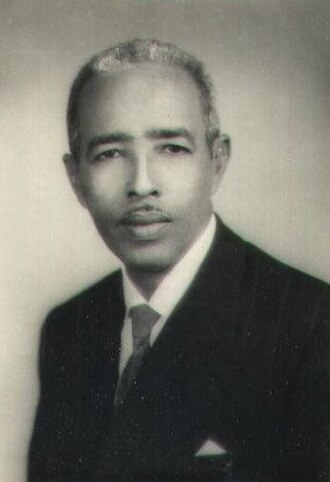
At a Glance
The Hiiraan Origins and the Formation of a National Leader
Aden Abdullah Osman Daar was born in 1908 in the Hiiraan region of what was then Italian Somaliland — the broad central riverine area between the Jubba and Shabelle rivers whose agricultural communities and trading networks formed a significant component of the Trust Territory's economic life. His birth year placed him at the very beginning of the generation that would come of age during the intensive period of Italian colonial consolidation in the 1920s and 1930s, experience the Italian imperial moment of the 1935–1941 East African campaign and occupation, and then find in the post-war moment of the United Nations Trust Territory the opening through which Somali political independence became possible.
His Abgaal Hawiye identity connected him to one of the most significant clan groupings of the southern Somali political world — a grouping whose traditional territories included both the Mogadishu hinterland and the Hiiraan region's riverine areas, and whose educated and commercial elites would play a central role in the Somali Youth League and the institutions of the Trust Territory period. That the Abgaal Hawiye would later become one of the primary faction-holders of the civil war period makes the contrast with Aden Adde's constitutional career all the more striking: his life demonstrated what the same clan identity could mean when channelled into democratic rather than factional politics.
The Somali Youth League and the Path to Statehood
The Somali Youth League's founding in 1943 — by young educated Somalis in Mogadishu who had concluded that the post-war moment offered the possibility of advancing Somali interests through organised political action — drew Aden Adde into the political movement that would shape his entire career. The SYL was distinctive among African nationalist organisations in its explicit pan-Somali dimension: it sought not merely the independence of the Trust Territory but the eventual unification of all Somali-inhabited territories, a vision that gave Somali nationalism its specific character and its specific complications.
Aden Adde's role within the SYL evolved from organiser and advocate to governmental figure as the Trust Territory's institutions developed through the 1950s. The Italian administration, under United Nations supervision, was required to prepare the Territory for independence by 1960 — a deadline that concentrated the political development process and accelerated the emergence of Somali political leadership. Aden Adde served as president of the SYL in the crucial period leading to independence and as speaker of the Legislative Assembly — the position from which he presided over the parliamentary institutions that the Trust Territory period created and that would become the foundation of the independent republic.
Presiding Over the First Republic: 1960–1967
Somalia's independence on July 1, 1960 — the union of the Italian-administered Trust Territory with the former British Somaliland Protectorate, which had achieved independence five days earlier — created a state whose constitutional framework was a parliamentary republic with a president elected by the National Assembly rather than by popular vote. Aden Adde was elected Somalia's first president by the combined National Assembly of the unified republic, a choice that reflected both his personal stature within the independence movement and his Hawiye identity, which balanced the Darod and Digil-Mirifle clan representatives who dominated the southern parliamentary majority.
His presidency was defined by the specific character of a parliamentary ceremonial head of state who understood that his constitutional role was to embody the rules of the game rather than to direct the game's outcome. The Prime Ministers of the First Republic — Abdirashid Ali Shermarke (1960–64), Abdirazak Haji Hussein (1964–67), and their successors — held the executive authority; Aden Adde held the constitutional dignity. He was re-elected in 1964, defeating a challenge from Abdirizak, in an election that tested whether the parliamentary process would function without manipulation and that produced a result — his re-election — that confirmed the constitutional framework's legitimacy.
The challenges of the First Republic — the irredentist tensions with Kenya and Ethiopia over Somali-inhabited territories, the Shifta War, the financial pressures of a state with limited resources and large security commitments, the intensifying clan competition for governmental patronage — were challenges that his presidency navigated within the constitutional framework. He did not seek emergency powers; he did not manipulate the parliamentary process to extend his authority; he did not use the prestige of the presidency to override the constitutional rules that limited its power. These are negative achievements — achievements defined by what was not done — but in the context of African independence-era governance, they are genuinely significant.
The Transfer of Power: Africa's Democratic Benchmark
The presidential election of June 1967 produced the result that defined Aden Adde's historical significance: the National Assembly voted 73 to 40 to elect Abdirashid Ali Shermarke as Somalia's second president, defeating the incumbent. The margin was decisive. The result was clear. And Aden Adde — who had led his country since independence, who had the prestige of the founding presidential generation behind him, who might have sought any number of procedural or political means to resist or delay the transfer — accepted it without resistance.
The act was simultaneously constitutionally required and politically remarkable. It was required because the constitution he had sworn to uphold specified that the president serve the term for which he was elected and step down when replaced — there was no constitutional ambiguity. But in 1967, in Africa, constitutional requirement and political reality were frequently disconnected: the continent was littered with heads of state who had found ways to extend their tenures, manipulate electoral processes, or simply refuse to leave. Aden Adde's compliance with the constitutional requirement transformed it from a formal rule into a genuine norm — demonstrated that the rule actually governed conduct rather than merely describing an aspiration.
The historiography of African independence consistently returns to this moment as one of the First Republic's most significant achievements, and justifiably so. Peaceful transfers of presidential power after electoral defeat were extraordinarily rare in the Africa of 1967. They remain rare. Aden Adde's act placed Somalia — briefly, before the 1969 coup ended the experiment — among the tiny minority of post-independence African states that had demonstrated genuine constitutional democracy at the level of presidential succession. That Somalia could not sustain this achievement does not diminish what was achieved.
Through Dictatorship, Collapse, and the Long Return
The two years between Aden Adde's transfer of power and the October 1969 coup were years in which the constitutional framework held — in which the Shermarke presidency and the Mohammed Haji Ibrahim Egal prime ministership continued the parliamentary governance that the First Republic had established. The coup's arrival was not, therefore, the inevitable consequence of the democratic period's failures; it was a specific historical event — the product of the specific decisions of specific military officers — that ended a democratic experiment that had been functioning. Aden Adde outlived the coup, outlived the Siad Barre dictatorship that followed it, outlived the state collapse of 1991, and survived into the reconstruction period after 2000.
His survival through these catastrophes — his refusal to collaborate with Siad Barre's regime, his maintenance of the democratic perspective through the long years of dictatorship, his physical presence in the ruins of Mogadishu as the reconstruction began — gave him a symbolic significance that went beyond his direct political activity. He was the living connection to the democratic founding moment, the embodiment of the constitutional standard against which all subsequent Somali governance had been measured and found wanting. When he died in Mogadishu in March 2007 at ninety-eight years old, Somalia lost its last direct link to the independence generation's leadership and its clearest embodiment of what constitutional democracy in Somalia had looked like.
Legacy: The Father and the Standard
Aden Abdullah Osman Daar's legacy is the legacy of the act that defined his career: the voluntary surrender of presidential power in accordance with a constitutional result that went against him. In a continent where such acts were rare, in a region where they would become rarer still, in a country that would spend decades attempting to reconstruct the institutions that were destroyed after he left office, this act remains the benchmark — the demonstration that Somali democratic governance was not merely theoretical but practically achievable, and that the constitutional values of the First Republic generation were not merely stated but genuinely held.
The tragedy of Aden Adde's legacy is that the standard he set was not maintained — that the institutions he helped to build were destroyed twenty-two years after independence and have not been fully reconstructed in the half-century since. But the standard itself remains, embodied in his career and his single most significant act: the proof that Somalia's democratic founding generation understood what constitutional governance required and was prepared to practise what it preached, even at personal cost. That proof matters, now as then, because it establishes that the failure was not inevitable — that a democratic Somalia was not merely imagined but briefly realised, and that its realisation, however incomplete and however temporary, was the work of real people making real choices to uphold real principles.