At a Glance
Salé, the Law, and the Formation of a Democratic Socialist
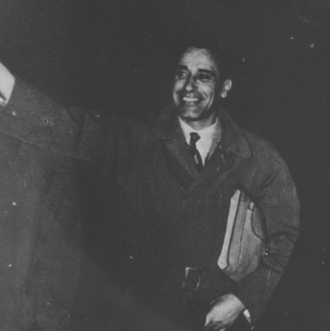
Abderrahim Bouabid was born in December 1922 in Salé — the city whose specific relationship to the adjacent capital Rabat gave it a particular political character. Salé had been in the early modern period the seat of the short-lived Republic of the Bou Regreg — a polity of Andalusian refugees and Moroccan corsairs that had maintained a form of urban self-governance in the seventeenth century — and its historical memory of autonomy and self-government gave the city a political culture that was more resistant to central authority than the capital across the river. Whether this historical memory directly shaped Bouabid's politics is impossible to say with certainty, but the city's specific character was part of the formation that produced him.
His legal training — at the Moroccan law school and then in France — gave him the professional formation that his subsequent career would draw on in multiple ways. The lawyer's specific skills — the analysis of evidence and argument, the public advocacy of contested positions, the defence of individuals against institutional power — were directly applicable to the kind of political work that democratic opposition in a semi-authoritarian state required. And the lawyer's professional identity — the specific claim to independence from the state that professional practice provided, the refusal to be merely an instrument of the political system — was a model for the political identity that Bouabid would maintain throughout his career.
Independence, Government, and the First Disillusionment
Bouabid's position as deputy prime minister in the first Moroccan governments after independence — the period between 1956 and 1958, when the transition from protectorate to independence was being managed and when the specific institutional arrangements of the post-independence state were being established — gave him a direct view of the process through which the promise of independence was being converted into the specific political order that the palace was determined to maintain. The experience was disillusioning in specific ways: he could see, from inside the government, how the palace was using its control of key ministries and its relationship with France to manage the transition in ways that preserved royal power at the expense of the constitutional democracy that the independence movement had promised.
The specific issues that drove his disillusionment — the palace's resistance to a genuinely constitutional monarchy with real parliamentary authority, the management of elections to ensure outcomes favourable to the palace's allies, the treatment of the trade union movement and the left as threats to be controlled rather than partners in governance — were the issues that would define the agenda of the UNFP and its successor the USFP for the following three decades. Bouabid did not leave the government in despair; he left with a clear political analysis of what was wrong and a commitment to building the opposition that would be needed to press for the democratic alternative.
The UNFP: Building Democratic Socialism in Difficult Conditions
The founding of the Union Nationale des Forces Populaires in 1959 was the organisational expression of the political analysis that Bouabid, Ben Barka, and the left wing of the Istiqlal had developed during and after the independence period. The UNFP's programme was explicitly democratic socialist — combining the commitment to social justice, economic redistribution, and workers' rights that socialism required with an equally explicit commitment to constitutional democracy, civil liberties, and the rule of law that distinguished it from both the authoritarian left and the palace's managed political system.
Building a genuine opposition party in the specific conditions of post-independence Morocco — with a palace that was consolidating its power, a political system that rewarded accommodation with royal authority, and a security apparatus that monitored political activity and was willing to use repression against credible threats — required a specific combination of organisational skill, personal courage, and political intelligence. The UNFP under Bouabid's leadership developed all three, building a party that was genuinely rooted in Moroccan civil society — in the trade union movement, in the student organisations, in the professional associations — rather than simply dependent on royal patronage or on the charisma of a single leader.
1963 and the Turn to Repression
The 1963 legislative elections — the first competitive elections of the independence period — were managed by the palace in ways that the UNFP and independent observers documented as fraudulent. The UNFP's electoral strength — which its organisational presence in the trade unions and the universities had built — was systematically undermined through the manipulation of the electoral process, and the party's parliamentary representation was significantly less than its actual popular support merited. The stolen elections were followed by the 1963 political trials in which UNFP leaders, including Ben Barka (who was outside the country) and others in Morocco, were accused of plotting against the monarchy — charges that the accused denied and that the available evidence did not substantiate but that the judicial system endorsed.
The 1963 trials established the pattern that would characterise the next two decades of Moroccan political life: the palace using the judicial system to suppress the opposition through prosecutions whose legal validity was contested but whose political purpose was clear, and the opposition maintaining its organisational existence through the imprisonment and the harassment rather than accepting the accommodation that would have ended the persecution. Bouabid was central to the UNFP's sustained maintenance of its position through this period — maintaining the party's internal coherence, defending its imprisoned members through legal channels, and keeping the international solidarity networks alive that provided some protection against the worst forms of repression.
The Years of Lead: Prison and the Integrity of Defeat
The Years of Lead — the period of the most intensive political repression of Hassan II's reign, running roughly from the early 1970s to the mid-1980s — were marked by the mass imprisonment of Moroccan leftists and unionists, the systematic torture of political prisoners, the disappearance of some activists, and the use of secret detention centres whose existence the government consistently denied. The specific targeting of the UNFP and USFP leadership during this period reflected the palace's assessment that the democratic left represented its most credible challenge — the political force whose programme and whose organisational base had the potential to genuinely constrain royal power if allowed to develop freely.
Bouabid was imprisoned during this period, subjected to the conditions that Morocco's political prisons imposed on their inmates, and emerged from imprisonment with his political analysis unchanged and his personal dignity intact. The specific quality of his survival — the refusal to recant, to collaborate, to accept the forms of capitulation that the regime offered as the price of release — was what gave his continued political activity its specific moral authority. A man who had been imprisoned for his convictions and who maintained those convictions in prison and after his release was a more credible advocate for democratic governance than any amount of intellectual argument could have produced on its own.
The Alternance That He Did Not Quite See
Bouabid died in January 1992, three years before the 1995 negotiations that would eventually produce the alternance — the agreement under which Hassan II accepted a government led by the USFP's Abderrahmane Youssoufi in 1998, the first time that the democratic left had been allowed to lead a Moroccan government. The alternance was imperfect — it was a managed political opening rather than a genuine democratic transition, and it required the USFP to accept enough accommodation with the palace's ultimate authority that some of its members regarded it as the co-optation that Bouabid had spent his career refusing. But it was also a genuine acknowledgement that the democratic left had built enough of a political base and enough of a moral authority that the palace could not simply continue to suppress it without political cost.
Bouabid did not live to see the alternance — he died in January 1992, seventy-nine years old, having spent four decades in principled democratic opposition that had cost him years of freedom and a lifetime of political marginalisation. The Morocco he left was not the democratic Morocco he had spent his career working toward, but it was a Morocco in which the democratic tradition he represented was alive, organised, and credible — in which the USFP had the organisational presence and the popular support to eventually reach the agreement that brought the left into government, however imperfectly. That the tradition survived was partly the product of his specific refusals: the refusal of exile, the refusal of co-optation, the refusal to accept that the authoritarian post-independence order was the inevitable outcome of Moroccan political development.
Legacy: Principled Opposition as a Political Achievement
Abderrahim Bouabid's specific contribution to Moroccan political history is the demonstration that principled democratic opposition is itself a political achievement — that maintaining the democratic tradition through decades of repression, building and sustaining an opposition party that is genuinely rooted in civil society, refusing the accommodations that would have made individual survival easier but collective progress impossible, is a form of political work that the historical record should take seriously alongside the more dramatic acts of revolution and martyrdom.
He was not Morocco's most dramatic figure — Ben Barka's assassination in Paris made a martyr that Bouabid's imprisonment could not match for international visibility. He was not Morocco's most intellectually brilliant figure — Allal al-Fassi's Islamic nationalist thought was more systematically developed. He was not Morocco's most electorally significant figure — the alternance that his work helped to make possible came after his death. But he was Morocco's most consistently principled democratic figure — the politician who could be relied upon, through the full range of pressures and temptations that four decades of opposition generated, to say what he believed, to do what he said, and to maintain the specific vision of democratic Morocco that the independence movement had promised and the post-independence order had not delivered. That consistency, sustained through imprisonment and harassment and marginalisation, is its own kind of political achievement, and Morocco's democratic tradition is poorer for the insufficient recognition it has received.