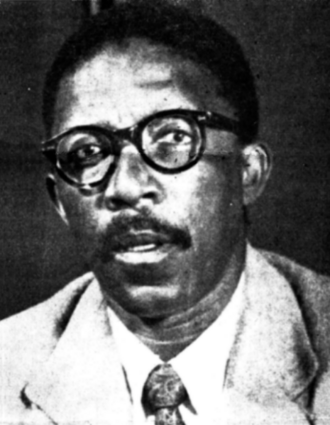
At a Glance
South Africa, Trade Unionism, and the Formation of a Radical
Philip Matante's political formation in South Africa placed him in the same tradition of cross-border political exchange that shaped so many of southern Africa's independence-era leaders. The movement of Batswana men and women to South Africa — for work in the mines, for education in the mission schools and universities, for exposure to the economic and political world that the Bechuanaland Protectorate's underdevelopment could not provide — was one of the defining features of twentieth-century Botswana society, and the political ideas that returned with these migrants were among the most important forces shaping Bechuanaland's emerging nationalism.
Matante encountered in South Africa the organised labour movement that was building working-class power in the industrial centres of the Rand, and the ANC's political culture that was developing the analysis and the organisational frameworks for challenging the racial capitalism that structured South African society. These two experiences — trade unionism and nationalist politics — came together in his formation in ways that gave his subsequent political work a distinctive character: the combination of the organiser's attention to the specific economic interests of working people and the nationalist's commitment to democratic self-determination and Pan-African solidarity.
The racial capitalism that Matante experienced in South Africa was not a system from which Bechuanaland was insulated. The migrant labour system that sent Batswana men to the South African mines and returned them to a homeland that had no alternative employment for their skills was itself a product of the regional economic order that apartheid South Africa dominated. The pass system, the compound system, the racial wage differential — all of these conditions that Matante experienced as a migrant worker in South Africa were conditions that his fellow Batswana also experienced, and that shaped the political consciousness he was bringing back to organise against.
The Bechuanaland People's Party: Urban Workers and Pan-African Vision
The Bechuanaland People's Party that Matante co-founded in 1962 was, from its inception, a party of the towns rather than the countryside — a distinction that reflected both the social character of its membership and the political vision that animated it. Bechuanaland's towns — particularly Francistown in the north and Lobatse and Gaborone in the south — were small by regional standards but were the centres of what wage employment, commercial activity, and educational institutions the territory possessed. Their populations included the teachers, nurses, clerks, traders, and workers who formed Bechuanaland's emerging African professional and working class, and who were the most politically conscious and organisationally experienced sections of Batswana society.
This urban base gave the BPP a distinctive political character. Its members were people who had direct experience of the modern economy — of wages, of employment conditions, of the racial differentials in pay and opportunity that structured Bechuanaland's economic life — and who had been exposed through education and through their South African experience to the political ideas and the organisational forms that the liberation movement offered. They were more directly connected to the ANC's networks and more influenced by the Pan-Africanist politics of the All-African People's Conference than the rural chieftaincy communities that formed the BDP's base.
Matante was the figure who could most effectively bridge the BPP's political vision and the lived experience of this urban constituency. His oratory — described by contemporaries as passionate, direct, and capable of moving audiences in ways that the more formal political styles of his rivals could not — was the instrument through which the BPP's analysis of Bechuanaland's political and economic situation was translated into the language that ordinary people could recognise as speaking to their conditions. This communication capacity was rare, and it was the primary reason that Matante was consistently the BPP's most successful electoral performer even in elections that the BDP dominated nationally.
Francistown: The Urban Stronghold
Matante's constituency of Francistown was the most important urban centre in northern Bechuanaland and the heart of his political base. Francistown had developed as a commercial and mining centre in the colonial period — it was connected to the railway line that ran through Bechuanaland between Rhodesia and South Africa, and it had attracted a more concentrated urban population than most of the territory. Its African population included a significant number of migrants from elsewhere in southern Africa as well as Batswana, and its economic character — more commercial, more connected to regional trading networks, more directly exposed to the modern capitalist economy — made it politically distinct from the rural constituency that the BDP dominated.
In this environment, Matante's combination of trade union background and Pan-Africanist politics resonated in ways it did not in the rural areas where the chiefs' influence, the BDP's patronage networks, and the conservative nationalism of the independence settlement had the most purchase. His consistent wins in Francistown were the BPP's most reliable electoral outcomes, and they gave the party its parliamentary foothold from which to challenge the BDP's dominance in the National Assembly.
The political debates that Matante conducted from his Francistown base — about the pace and character of economic development, about the relationship with South Africa, about the distribution of benefits from Botswana's mineral resources, about the representation of urban workers in a political system that remained heavily weighted toward rural and chieftaincy interests — were the debates that a functioning democracy required. His presence in parliament as the BPP's leading voice gave those debates a consistent and effective advocate, and his willingness to challenge the BDP on the substance of its policies rather than merely the style of its governance gave Botswana's parliamentary politics a critical edge that the governing majority could not ignore.
Pan-Africanism and the International Solidarity Dimension
Matante's Pan-Africanism connected his domestic political work to the broader project of African liberation in ways that the BDP's more domestically focused nationalism did not always engage with as directly. He was attentive to the politics of the OAU and to the developments in neighbouring countries — the liberation struggles in Zimbabwe, Namibia, South Africa, and Mozambique — in ways that reflected his conviction that Botswana's freedom was not separable from the freedom of its neighbours and that the solidarity of the independent African states with the liberation movements was not merely a diplomatic obligation but a moral necessity.
This internationalism gave his politics a dimension that was sometimes uncomfortable for the BDP government, which was navigating the pragmatic challenges of maintaining working relations with apartheid South Africa while formally endorsing the OAU's anti-apartheid consensus. Matante's insistence on the solidarity dimension — his arguments that Botswana should be doing more to support the ANC's struggle, should be taking stronger positions against South African economic dominance, should be aligning itself more decisively with the frontline states — put pressure on the government to maintain its anti-apartheid positions even when the pragmatic pressures toward accommodation were strong.
Legacy
Philip Matante died in 1979 at the age of approximately fifty-nine, still in opposition, still representing the BPP's radical nationalist alternative to the BDP's governing consensus. He had co-founded the BPP in 1962, had fought the independence election of 1965, had represented Francistown through the first decade of independence, and had maintained throughout this period the consistency of political commitment and the quality of democratic engagement that his background and his formation had produced.
The Botswana that he had challenged — the BDP's conservative, chieftaincy-aligned, South Africa-accommodating independence settlement — had proved more durable than his opposition could displace. The diamond economy that transformed Botswana's fiscal position from the early 1970s gave the BDP the resources to build a genuine development state, and the development record of the Khama and Masire governments made the BDP's political dominance more entrenched rather than less. Matante did not live to see the full transformation that the diamond revenues enabled, or to engage with the new political questions that the diamond economy's distribution raised.
What he left was the legacy of the democratic opposition — the consistent, principled challenge to the governing majority that democracy requires if it is to function as something more than the legitimation of existing power arrangements. Botswana's democracy in the independence era was better for having Philip Matante in it, and the questions he asked about economic distribution, working-class representation, and the meaning of African solidarity remain relevant to the political debates that Botswana's citizens continue to conduct.