At a Glance
Cloughjordan: A Household of Teachers and Music
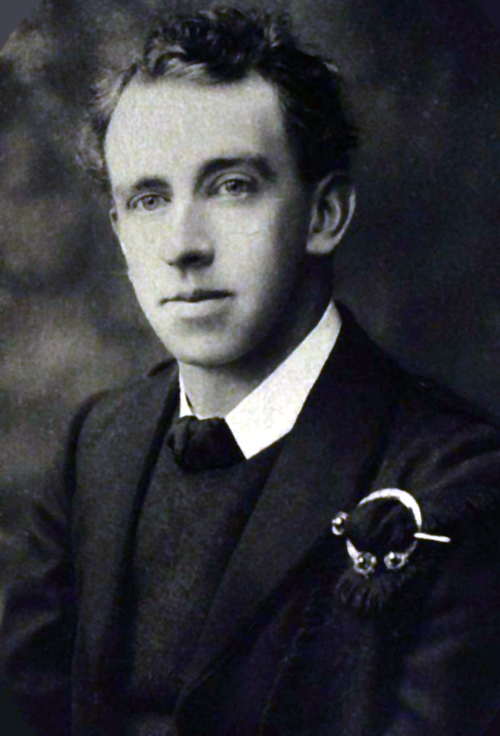
Thomas Stanislaus MacDonagh was born on 1 February 1878 in the village of Cloughjordan in County Tipperary, the son of Joseph MacDonagh and Mary Louise Parker — both schoolteachers, both people of wide culture and intellectual curiosity. The household MacDonagh grew up in was, by all accounts, filled with music, literature, and lively argument: his parents' professions and their interests shaped a boy who would spend his entire adult life as a teacher, writer, and intellectual, never entirely at ease with the transition to the military role that the final years of his life demanded of him.
He was educated at Rockwell College near Cashel — the school run by the Holy Ghost Congregation — and for a period considered entering the priesthood. He concluded that he had no genuine vocation and turned instead to teaching, taking a position at St Kieran's College in Kilkenny and subsequently at St Colman's College in Fermoy, County Cork, where he taught English, Latin, and French. It was during these years of provincial schoolmastering that two things happened which would determine the course of his life: he joined the Gaelic League in 1902, and he published his first book of poetry, Through the Ivory Gate, at his own expense.
The Gaelic League introduced MacDonagh to Irish nationalist cultural politics and, eventually, to the network of people — Pearse, Plunkett, MacNeill — who would draw him into the revolutionary movement. The poetry introduced him to himself as a writer and gave him the vocation that shaped everything else he did. He would publish further collections — April and May (1903), The Golden Joy (1905), and the work he considered his best, Lyrical Poems (1913) — and pursue a parallel career as a playwright, literary critic, and scholar that was genuinely distinguished, cut off at thirty-eight before it had reached its fullest expression.
St Enda's and Patrick Pearse: The Meeting That Changed Everything
The connection between Thomas MacDonagh and Patrick Pearse began in the Gaelic League, deepened in the Aran Islands where both went to improve their Irish, and became decisive in 1908 when Pearse invited MacDonagh to join the staff of his newly opened experimental school, St Enda's (Scoil Éanna), as assistant headmaster. St Enda's was one of the most ambitious educational projects of the Gaelic Revival: a bilingual school modelled partly on the ancient Irish system of the bardic school, committed to developing the whole child through Irish language, sport, drama, and a curriculum that placed Irish history and culture at its centre rather than at its margins.
MacDonagh threw himself into St Enda's with characteristic energy. He was an inspired teacher — warm, enthusiastic, intellectually generous — and the school's theatrical productions, which MacDonagh helped to direct, were a significant part of its reputation. His play When the Dawn is Come had been staged at the Abbey Theatre in 1908, under the direction of John Millington Synge himself, and was notably — for a play written before its author had any formal connection with revolutionary planning — about rebellion against a foreign occupier. The themes MacDonagh was drawn to as a writer were the themes he would enact as a revolutionary: the moral necessity of resistance, the price of freedom, the dignity of those who choose to fight rather than submit.
While teaching full-time at St Enda's, MacDonagh also studied part-time at University College Dublin, completing a BA in 1910 and an MA in English literature in 1911. His MA thesis — Thomas Campion and the Art of English Poetry — was a scholarly study of considerable quality, published in 1913, that established his reputation as a serious literary academic. In 1911 he was appointed as a lecturer in English at UCD, a position that gave him financial stability and brought him into contact with the full range of Dublin's intellectual life. He was, by the early 1910s, one of the most networked and warmly regarded figures in Dublin literary circles: a friend of Yeats, a regular contributor to literary journals, a presence at salons and readings and debating societies who was remembered by everyone who knew him for his charm, his genuine curiosity about other people, and his unfailing capacity for friendship.
Joseph Plunkett, the Irish Theatre, and the Drift Towards Militancy
Around 1910 MacDonagh took on a young man from the Gaelic League as a private Irish-language pupil. The pupil was Joseph Mary Plunkett — poet, mystic, son of a papal count, and one of the most romantic and impractical figures of his generation. MacDonagh and Plunkett became immediate friends over their shared love of poetry, language, and ideas, and Plunkett dedicated his first book of verse, The Circle and the Sword (1911), to MacDonagh. Both fell in love with sisters: MacDonagh married Muriel Gifford in January 1912, while Plunkett would marry Grace Gifford in the hours before his execution in 1916.
In 1914 MacDonagh and Plunkett co-founded the Irish Theatre, an avant-garde Dublin company that offered precisely the kind of experimental European drama — Chekhov's Uncle Vanya, Strindberg's Easter, Ibsen's An Enemy of the People — that the Abbey was not staging. The Irish Theatre was a significant cultural initiative and a testament to the seriousness of MacDonagh's theatrical ambitions; it also reflected the energetic, forward-looking quality of his mind, which was always interested in what was happening in European culture beyond Ireland's shores.
MacDonagh's political views were slow to harden. He had nationalist sympathies from the Gaelic League years, but he was fundamentally a constitutionalist who believed in peaceful change — an active supporter of the Irish Women's Franchise League and of the workers' cause during the Dublin Lockout of 1913. It was through his association with Pearse, Plunkett, and eventually Seán Mac Diarmada that his positions shifted in the years before 1916. The Ulster crisis, the outbreak of the European war, the split in the Irish Volunteers — each event moved him further from the constitutional position and closer to the conviction that rebellion was not only necessary but inevitable. He joined the IRB in April 1915, was co-opted to the Military Council in April 1916 just weeks before the Rising, and recruited Éamon de Valera into the conspiracy — telling the sceptical Éamonn Ceannt, when questioned about de Valera's reliability, that he always lands on his feet.
Easter Week: Jacob's Biscuit Factory
The Jacob's Biscuit Factory on Bishop Street was one of the largest and most strategically significant sites chosen for occupation by the Military Council. A massive Victorian industrial complex, it commanded the approaches to Dublin Castle from the south and provided strong defensive positions: high walls, multiple floors, narrow access points that could be held against superior forces. MacDonagh's 2nd Battalion was assigned to it, with Major John MacBride — the Boer War veteran and estranged husband of Maud Gonne — serving as second-in-command, and Michael O'Hanrahan as his other senior officer.
Jacob's saw little of the actual fighting of Easter Week. The British Army, occupied with the intense engagements around the GPO, the South Dublin Union, and the Four Courts, largely avoided the factory complex, concentrating instead on establishing positions that would allow them to isolate and reduce the other garrisons. MacDonagh's battalion was fully prepared to engage, but the engagements they had were limited. There is evidence that by mid-week MacDonagh, dishevelled and exhausted, had become something of a figurehead within the garrison, with effective tactical command increasingly exercised by the combat-hardened MacBride, who knew more about actually fighting the British than the professor and playwright who commanded him.
MacDonagh spent part of Easter Week writing propaganda — circulars and bulletins designed to maintain the morale of the garrison and spread news of the Rising's progress. He relayed reports of German landings and national uprisings that were not, in fact, occurring. When Pearse's surrender order arrived on Saturday afternoon, the garrison at Jacob's reacted with dismay and anger: men wept, some demanded to fight on, voices called out to hold the factory against all comers. MacBride steadied the soldiers while MacDonagh addressed them in terms that acknowledged the gravity of what was ending without dishonoring what had been attempted. MacDonagh met with General Lowe and facilitated the surrender of his garrison to the British Army at St Patrick's Park on the Sunday.
Court Martial, Death, and the Letter to Muriel
MacDonagh was court-martialled at Richmond Barracks on 2 May 1916. During the proceedings he made a statement that, on reflection, he worried might sound like an appeal for clemency: he had told the officers where the arms and ammunition were stored after the surrender was decided upon, a piece of cooperation intended to prevent unnecessary casualties. Writing to his wife Muriel in the hours before his execution, he addressed this point with characteristic directness: he was not seeking mercy, he was clarifying a factual point. The statement had sounded different written down than it had meant in the moment. He did not regret it and did not want it misunderstood.
The letters he wrote in his final hours — to Muriel, to his sister Sister Francesca who visited him in Kilmainham, to friends and colleagues — are among the most personally revealing documents of the Rising's aftermath. They portray a man at peace with what he had done, clear about its meaning, and deeply saddened by the personal losses: leaving his children Donagh (aged three) and Barbara (aged one), leaving Muriel, leaving a life that had been full and rich and which he had genuinely enjoyed. When Sister Francesca requested water for her brother before his execution, the guards refused; she was permitted to place her rosary around his neck. It was retrieved after his death.
He was executed at 3:30 in the morning of 3 May 1916, the third signatory to die. Witnesses reported that as he was led from his cell to the Stone Breakers' Yard he was whistling. Thomas MacDonagh went to his death as he had lived: with the outward composure of a man who had made his peace with a hard decision and found it, in the end, to have been the right one.
Yeats and the Legacy of the Unfulfilled Poet
W.B. Yeats was a friend of MacDonagh's, and his poem Easter 1916, written in the months after the Rising, contains what is perhaps the most precisely rendered portrait of any of the executed leaders. He wrote of MacDonagh as someone he had known in the comfortable world of literary Dublin — at one of the places where motley is worn — and described him as just coming into his force, a man of sensitive nature and daring thought who might have won fame in the end. The lines are elegiac in the literal sense: a lament for something that was beginning rather than completed.
MacDonagh's literary legacy is genuinely difficult to assess, precisely because his work was interrupted at a point when, by all indications, he was approaching his creative maturity. Literature in Ireland, his study of the Irish mode in English-language poetry, was published posthumously in 1916 and is a serious and original piece of literary criticism that had a direct influence on subsequent thinking about the relationship between the Irish language tradition and the literature written in English by Irish writers. It engages with questions that remain active in Irish literary studies a century later.
His son Donagh MacDonagh, born November 1912, became a Circuit Court judge, a celebrated poet in his own right, a Broadway playwright, and one of the central figures of the Irish literary revival of the 1940s and 1960s. The son carried something of the father's extraordinary range — law, literature, theatre — into the next generation. Muriel MacDonagh, who had been Muriel Gifford before her marriage, drowned at Skerries in County Dublin on 9 July 1917 while on a seaside holiday arranged for the widows and children of the 1916 leaders by Michael Collins, who was then administering the National Aid and Volunteer Dependents Fund. She had converted to Catholicism, received her First Holy Communion on the first anniversary of her husband's death, and was dead before the second.
Thomas MacDonagh is commemorated at Cloughjordan, where the Thomas MacDonagh Museum preserves his memory in the village that knew him as a child. MacDonagh Junction Shopping Centre in Kilkenny recalls the years he spent as a teacher in that city. His profile in Easter 1916 ensures that as long as Yeats is read, his name will be associated with the moment when the Republic was declared in poetry as well as in arms.