At a Glance
A Privileged but Fragile Beginning
Joseph Plunkett was born in November 1887 into one of the most prosperous Catholic families in Dublin. His father, George Noble Plunkett, was a papal count — the title bestowed by the Vatican on prominent Catholic laymen — a man of considerable wealth and cultural ambition who collected art, supported the Irish cultural revival, and moved in circles where money and aesthetics mingled with a kind of high-Catholic nationalist identity that was distinct from both the Protestant Anglo-Irish ascendancy and the Catholic working-class nationalism of the tenements. The family home on Fitzwilliam Street was full of books, art, and intellectual conversation, and Joseph grew up surrounded by the cultural resources that his family's wealth and his father's interests provided.
But his childhood was defined as much by illness as by privilege. He contracted tuberculosis as a young boy — the disease that was endemic in Ireland and that killed tens of thousands of Irish people every year — and the glandular form of the infection attacked the lymph nodes of his neck, requiring repeated surgeries that left him with the distinctive scarves and bandages he wore throughout his adult life and in the famous photographs that document his appearance at the time of the Rising. He was educated partly at Stonyhurst College in England and partly on the Continent, spending time in Algeria for his health — the warm dry climate of North Africa was one of the few reliably beneficial interventions available to tuberculosis patients in the pre-antibiotic era. Despite the illness, he read voraciously, wrote poetry from an early age, and developed the mystical-Catholic intellectual sensibility that infuses his verse.
Poetry, The Irish Review, and Cultural Nationalism
In the years before the Rising, Plunkett established himself as a significant figure in the cultural nationalist revival that was transforming Irish intellectual life. He co-founded The Irish Review in 1911 — a literary magazine that published poetry, fiction, drama, and cultural commentary, and that served as one of the principal forums of the literary and political ferment of the period. He contributed poetry and criticism, edited with care and seriousness, and used the magazine to advance a vision of Irish culture that was simultaneously Catholic, Gaelic, and artistically ambitious.
His poetry is the most distinctive literary production among the 1916 leaders. Where Pearse's verse is earnest and rhetorical, Connolly's writing is primarily analytical, and MacDonagh's is technically accomplished and academically engaged, Plunkett's poetry has a quality of mystical intensity that draws on the Metaphysical poets, the Catholic mystical tradition, and his own sustained contemplation of suffering and transcendence. The poem most associated with him — "I See His Blood Upon the Rose" — finds the presence of Christ in the natural world: in the rose, the sky, the stars, the snow. It is the poem of a man for whom religious faith and aesthetic perception were not separate faculties, and it has been widely reprinted and set to music in the century since his death.
He studied Irish and became a fluent speaker, connected with the Gaelic League, and gradually moved from the cultural nationalist sphere toward direct political and military involvement. He joined the Irish Volunteers on their foundation in November 1913 and brought to the organisation both his personal commitment and the resources — financial and organisational — that his family background could provide.
Military Planning: The Journey to Germany
Plunkett's most practically significant contribution to the Easter Rising was his role as Director of Military Operations — the man responsible for planning the actual military operations of the insurrection. He had no formal military training, but he was an intelligent and methodical planner who studied military history seriously and applied what he learned to the specific conditions of urban guerrilla warfare in Dublin. The plan he developed — with modifications contributed by Connolly and others — assigned specific positions and objectives to each garrison, created a defensive perimeter intended to hold the city centre, and provided for the use of the GPO as the Rising's headquarters and symbolic centre.
In April 1915, seriously ill, Plunkett travelled to Germany — via the United States and then via neutral ships — to meet with Roger Casement and to seek German support for the planned insurrection. The mission was part of the broader effort to secure the German arms shipment that the IRB Military Council hoped would transform the Rising's military prospects. The negotiations in Berlin produced promises that were ultimately not kept in the form hoped for: the arms shipment aboard the Aud, intercepted by the Royal Navy and scuttled off the Kerry coast on 21 April 1916, was real but insufficient, and the failure of the German support significantly reduced the Rising's capacity.
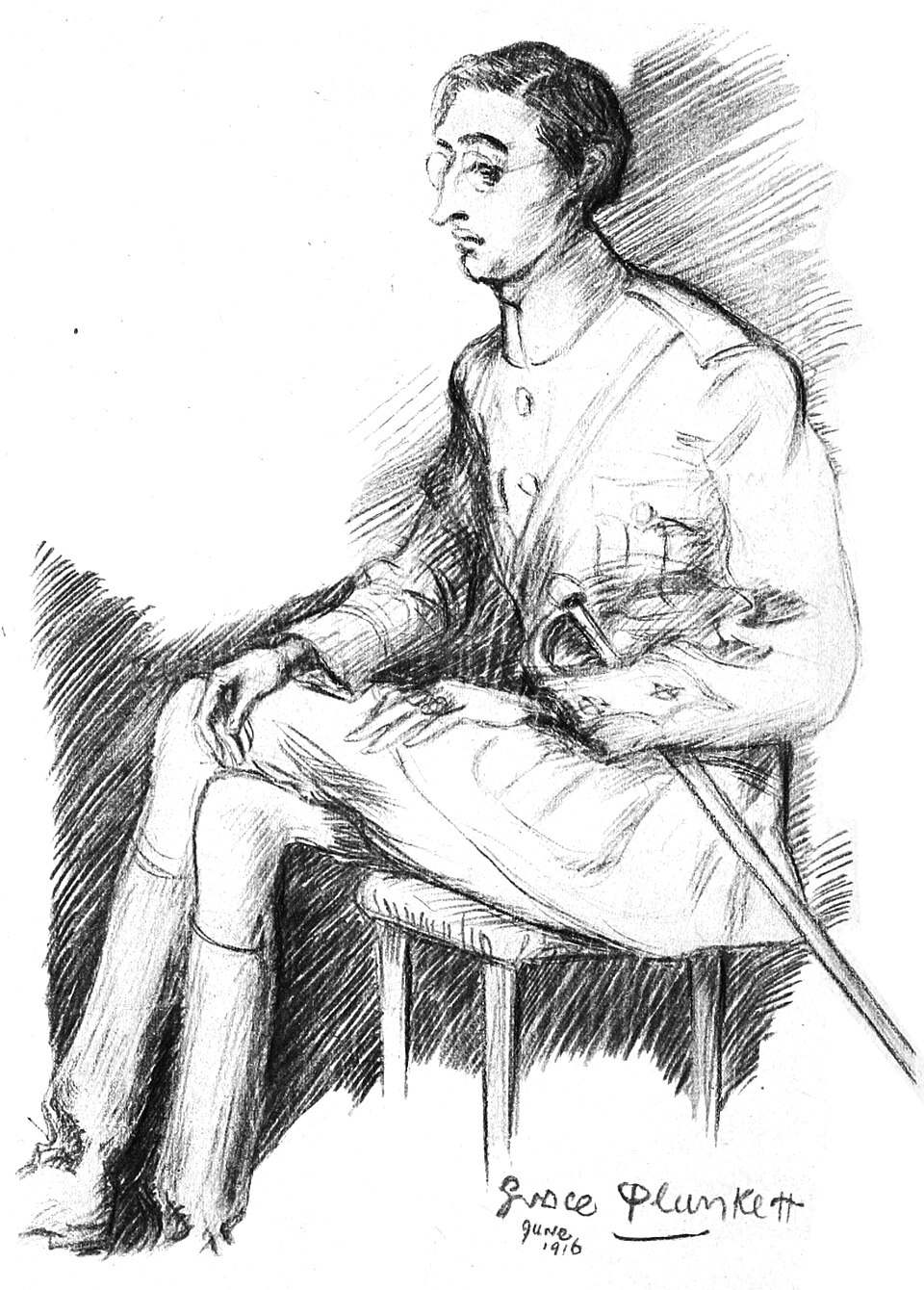
Plunkett was in a nursing home, recovering from operations on his neck and throat, in the weeks immediately before Easter 1916. He left his sickbed to participate in the Rising — a decision that was, in the most literal sense, an act of self-sacrifice, since his condition was such that continued exertion would certainly accelerate the progress of his illness. He arrived at the GPO on Easter Monday wearing the elaborate costume that photographs record: the rings, the bangles, the sword, the bandages visible beneath his collar — a figure who seemed to have stepped from a medieval romance into the twentieth century, an aesthetic Catholic knight entering the most significant engagement of his life.
Easter Week in the GPO
During Easter Week, Plunkett served as one of the senior officers of the GPO garrison, working alongside Pearse, Connolly, Tom Clarke, and Seán Mac Diarmada in the command structure of the Rising's central position. His physical condition was severe — the surgical wounds were not fully healed, the tuberculosis was advanced, and the physical demands of the week were extraordinary — but he remained active throughout, present at the planning sessions, contributing to the operational decisions that kept the garrison fighting.
The GPO was under artillery fire from Wednesday onwards, as British forces brought in eighteen-pound field guns to reduce the rebel positions. The fires that resulted were spectacular and ultimately uncontrollable: by Friday the building was ablaze, and the garrison had to evacuate through the burning building to a temporary headquarters in Moore Street, where Pearse issued the surrender order on Saturday afternoon. Plunkett was among those who emerged from the GPO through smoke and flames, and he was arrested with the other leaders after the surrender.
The Marriage in Kilmainham
The most celebrated episode of Plunkett's short life occurred in the hours before his execution. Grace Gifford — a Dublin artist who had converted to Catholicism and become engaged to Plunkett in December 1915 — had obtained a special licence and had come to Kilmainham on the evening of 3 May 1916 intending to marry him before he died. The authorities initially prevented the ceremony, but eventually permitted it to take place at midnight in the prison chapel, by candlelight, watched by a guard of soldiers who held their rifles throughout the brief ceremony.
The conditions of the wedding were deliberately humiliating — Grace Gifford has recorded that the soldiers' presence made the ceremony feel like a mockery — but the act itself was one of defiance and love that cut through the institutional brutality surrounding it. After the ceremony, Plunkett and his new wife were permitted approximately ten minutes together, with soldiers present throughout, before she was taken away. He was executed a few hours later, at dawn on 4 May 1916.
The image of the midnight wedding in Kilmainham — a dying man, a young woman, a prison chapel, candles, soldiers with rifles — became one of the most powerful symbols of the Easter Rising's romanticism and its cost. Grace Gifford Plunkett lived until 1955, an enduring presence in Irish cultural and political life, painting, writing, and keeping the memory of her husband and the Rising alive through four decades of independent Ireland.
Legacy: The Romantic Martyr
Among the seven signatories, Plunkett's legacy has a particular romantic and aesthetic quality that distinguishes it from the others. The combination of the poetry, the illness, the extravagant appearance, and the midnight wedding has made him a figure who appeals to the imagination in ways that the more austere or more politically complex figures do not always manage. The poem "I See His Blood Upon the Rose" is probably the single most widely known piece of writing by any of the seven signatories, and it captures the mystical-Catholic sensibility that made Plunkett unique among them.
His contribution to the Rising was real and substantial — the military planning that made the operation coherent, the connections with Germany that attempted to secure the arms that would have made it more formidable — but it is the personal dimensions of his story that have most powerfully entered the cultural memory. A young man of twenty-eight, already dying of tuberculosis, who left his sickbed to participate in an insurrection he knew was likely to fail, and who spent the last hours of his life in a candlelit prison chapel marrying the woman he loved: the story has the quality of legend, and it has been treated as such in song, in painting, and in the commemorative tradition of the republican movement.
Whether the legend does justice to the man — whose actual contributions were intellectual, literary, and strategic rather than primarily romantic — is a question worth asking. But the legend has its own truth: it captures something real about the spirit in which the 1916 leaders approached what they were doing, the degree to which their revolutionary politics was infused with a romantic Catholic nationalism that saw sacrifice and transcendence as inseparable, and that made the Easter Rising something more than a military operation — something closer to what Patrick Pearse called a "blood sacrifice," with all the theological resonance that phrase implied.