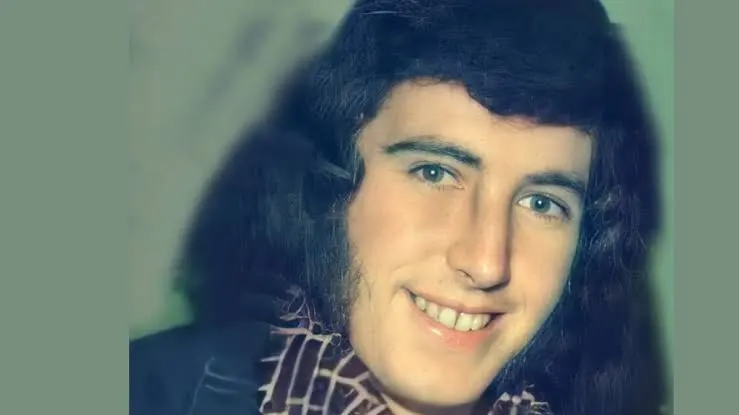
Cappagh: A Tyrone Townland in the Troubles
Edward Martin Hurson was born on 13 September 1956 in the townland of Aughnaskea, Cappagh, near Dungannon, County Tyrone. He was the eighth of nine children born to Johnny and Mary Ann Hurson — six girls and three boys — a large Catholic farming family typical of rural Tyrone. His mother died when he was still a boy, a loss that marked the family profoundly. His father Johnny was sixty-seven when Martin was arrested in 1976, a quiet, dignified man from the old rural world of County Tyrone who found himself navigating the impossible landscape of the Troubles and his son's imprisonment without any of the political preparation the generation would have wished for.
Martin grew up in the fields and lanes of Cappagh, playing Gaelic football for the Galbally club — a sport that in County Tyrone was inseparable from community, identity, and a certain robust sense of what it meant to be Catholic and Irish in a state that regarded those two things with official suspicion. He left school and started work as an apprentice fitter-welder at Findlay's engineering company, showing early the practical intelligence and physical capability that characterised him. After that he went to England for a period of about eighteen months, living in Manchester with his brother Francis and working for the construction company McAlpine's — the kind of labour migration that tens of thousands of young Irish men undertook in the decades before the Celtic Tiger, moving between building sites in Manchester, Birmingham, and London and the townlands of Tyrone, Donegal, and Mayo. He had an accident on one of the McAlpine sites — struck by a mechanical digger — and spent two weeks in hospital. He returned to Cappagh at the end of 1974, bought a car on hire purchase, and got a job at Powerscreen International in Dungannon.
Arrest, Torture and Conviction
In the early hours of Tuesday 9 November 1976, a series of RUC and British Army swoops in the Cappagh district of Dungannon led to the arrest of three young local men — Pat Joe O'Neill, Dermot Boyle, and Peter Kane — from their homes under Section 10 of the Emergency Provisions Act. Two days later, on 11 November, further dawn raids arrested four more men: James Joseph Rafferty, Peter Nugent, Kevin O'Brien, and Martin Hurson. All seven were taken to Omagh RUC barracks and held for interrogation about IRA operations in East Tyrone.
What happened at Omagh RUC barracks in those days in November 1976 was, by the accounts of the men involved and by the subsequent findings of the courts, torture. The men had their hair pulled, their ears slapped, were forced to stand for prolonged periods in the stress position against a wall, were kicked and punched, and were made to undergo sustained physical abuse intended to extract confessions. Two of the seven were released without charge. The remaining five were convicted entirely on the basis of statements extracted during those interrogations. Not a single piece of forensic evidence was submitted against any of them at trial. The depth of the irony was not lost on anyone: while Martin Hurson was dying on hunger strike in Long Kesh in July 1981, four of the RUC detectives who had interrogated him at Omagh were themselves awaiting trial on charges of assaulting one of the other prisoners, James Rafferty, during the same interrogations.
Martin was charged with membership of the IRA, possession of explosives in connection with a landmine at Galbally in November 1975, causing an explosion at Cappagh in September 1975, and possession of a landmine at Reclain in February 1976 that had detonated near a passing Ulster Defence Regiment land-rover. He was tried before Judge Rowland at the Diplock Court — a non-jury trial under the emergency legislation — in November 1977, after a year on remand. The judge admitted the statements extracted under torture as evidence and dismissed the medical evidence about the extent of Martin's injuries. He was sentenced to concurrent terms of twenty, fifteen, and five years — twenty years as the effective total. He was twenty-one years old.
The Blanket Protest and the H-Blocks
Martin Hurson, like hundreds of other republican prisoners convicted under the special courts, refused to wear prison uniform — the fundamental act of the blanket protest, by which prisoners asserted their claim to political status and their refusal to be treated as ordinary criminals. The conditions of the blanket protest were extreme: prisoners wore only a prison blanket, refused to wash, refused to clean their cells, and lived in isolation from the wider prison population in order to maintain the integrity of the protest. The no-wash protest — during which prisoners smeared the walls of their cells with excrement — was a response to the authorities' refusal to allow them to slop out; it was a last resort that the men themselves found physically and psychologically degrading, but which they maintained as the only weapon remaining to them.
Martin Hurson was beaten multiple times by prison guards during the blanket protest. In December 1978 he was badly beaten after being forcibly washed and spent a month in the prison hospital recovering from his injuries. He became engaged to his long-term girlfriend Bernadette Donnelly while in prison — a relationship maintained through prison visits across years of separation. He also appealed his conviction on several occasions, each time unsuccessfully. The appeal courts upheld the convictions based on the same statements the original judge had admitted.
When the first hunger strike of October–December 1980 ended without the agreement the prisoners had been led to expect, the bitterness and sense of betrayal within the H-Blocks was profound. Bobby Sands began the second hunger strike on 1 March 1981, with other prisoners joining at intervals. Martin Hurson joined the strike on 28 May 1981, replacing Brendan McLaughlin, who had been forced to withdraw from the hunger strike after developing a perforated stomach ulcer. He was twenty-four years old.
The Hunger Strike: An Unexpected Deterioration
At the 1981 Irish general election on 11 June — thirteen days into his hunger strike — Martin Hurson stood as an Anti H-Block candidate in the Longford–Westmeath constituency in the Irish Republic. He received 4,573 first-preference votes, representing 10.1 per cent of the total — a remarkable result for a prisoner standing from the H-Blocks, though not enough to win a seat. The contrast between his position — a man who could attract ten per cent of an Irish constituency while starving in a British prison — and the British government's insistence that he was simply a criminal was not lost on observers.
From early in his fast, Martin had difficulty keeping down the daily five pints of water that hunger strikers were required to drink in order to extend their survival for as long as possible. This difficulty — which his contemporaries on the strike did not share to the same degree — meant that his physical deterioration was far faster than that of the other men. He began to hallucinate. His speech became incoherent at times. His body was consuming itself at a rate that alarmed the prison authorities and that surprised the republican leadership, who had expected him to be alive long after other strikers who had joined before him.
The death of Joe McDonnell on 8 July, after sixty-one days, came only five days before Martin Hurson's death on 13 July — and Hurson had started his strike ten days after McDonnell, while Kieran Doherty and Kevin Lynch had both been on strike for longer and were still alive. The speed of his deterioration meant that his death was unexpected even by those closest to him. Near the end, his family discussed the possibility of intervening to save his life; but they were told that even if he were taken off the strike at that point, the neurological damage was probably irreversible and he would likely have sustained permanent brain damage. The decision was not made: Martin Hurson held to the strike, and died.
Death, Funeral, and the Cruelty of the Aftermath
Martin Hurson died on 13 July 1981, after forty-six days on hunger strike. His brother Francie had been refused entry to the prison when he arrived after 10 o'clock at night — the prison rules enforced to the letter even as the man inside was dying — and spent the night outside the gates of Long Kesh as his brother died within. The following morning, without consulting the family, the RUC removed Martin Hurson's body from the Maze Prison and transported it to Omagh Hospital. The intention was to deny mourners who would gather at roadsides the opportunity to pay their respects to the coffin as it passed. Despite this, more than a hundred cars followed the hearse from Omagh to the Hurson family home in Cappagh.
His fiancée Bernadette, his sisters Josephine and Rosaleen, and members of the community carried the Tricolour-draped coffin from the farmhouse down the country lane to the hearse. The funeral was held at Galbally church, and he was buried in the village of Galbally in County Tyrone, within sight of the GAA grounds where he had played football as a young man. A uniformed IRA guard of honour carried the coffin to the grave, and four armed Volunteers emerged from the mourners to fire volleys in honour of their comrade before standing for a minute's silence. The oration was given by Seán Lynch, who had been Hurson's election agent in Longford–Westmeath: he described Martin as a member of a large family whose mother had died while he was young, a GAA man, a lover of Irish things, a young man who had emigrated and returned and thrown in his lot with those who disputed British rule over Ireland.
Legacy: A Quiet Man from a Country Townland
Martin Hurson was twenty-four years old when he died. The judge who had sentenced him — and who was therefore presumably not among the most charitable interpreters of his actions — had reportedly said to him in the dock: "In another time, another place, you'd be a great man in your community." The remark was recalled by those who knew Martin as capturing something true about him: that the trajectory of his life, shaped entirely by the violence and injustice of the northern state, had taken a young man of evident ability and determination and converted his energy into resistance rather than into the farming, the football, the work, and the family life that he had been moving toward when the swoops came to Cappagh in November 1976.
His younger brother Seán, who was a child when Martin was imprisoned, grew up to become a Gaelic football referee — officiating at the 2024 All-Ireland final, one of the most prestigious appointments in the GAA. The arc of the Hurson family, from the agony of 1981 to a younger brother at the centre of Irish sporting life forty years later, is a compressed history of what happened to nationalist Tyrone in the decades that followed the hunger strike.
A play about Martin Hurson's life, written by Gerry Cunningham and performed at the Waterfront Hall in Belfast, brought his story to new audiences. Cunningham spent months interviewing former H-Block prisoners who had known Martin, and sat with Bernadette Donnelly — his fiancée from the prison years — for days going through the script. The play navigated the controversy that attaches to any dramatisation of the hunger strike: the accusation from unionist politicians that it glorified the IRA, against the counterclaim from republicans and historians that it was accurate testimony about what happened to young men in County Tyrone in the 1970s. Martin Hurson is buried in Galbally, and his grave is tended and visited. He remains, in the memory of his community, the quiet Tyrone man who died because his body failed faster than he intended, before the summer that took so many others was anywhere near its end.