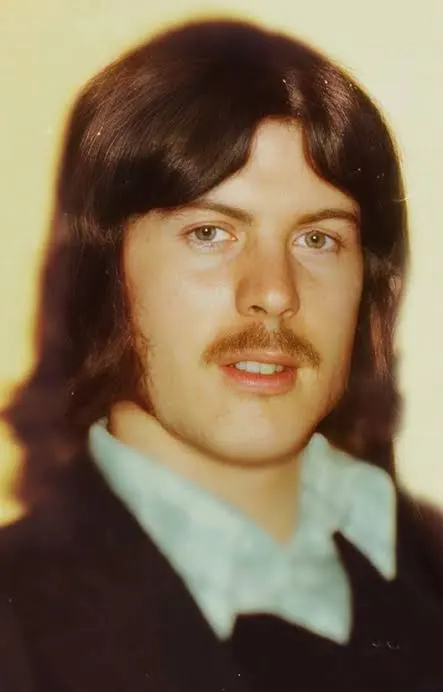
Andersonstown: A Family Shaped by Partition
Kieran Doherty was born on 16 October 1955, the third of six children of Alfred (Alfie) Doherty, a floor-tiler, and his wife Margaret, a Catholic convert from a Protestant background. The family lived in Andersonstown, the large Catholic housing estate in west Belfast that was, by the time Kieran came of age, among the most politically charged communities in the north of Ireland. The Dohertys were not casual bystanders to Irish republican history. Alfie's uncle Ned Maguire was an IRA man who had taken part in the famous rooftop escape from Crumlin Road jail in January 1943. Another uncle, Gerry Fox, also joined the IRA and escaped from Crumlin Road in 1972. The family had arrived in west Belfast after being driven from north Belfast during the loyalist pogroms that followed partition in the 1920s — a displacement that Kieran witnessed echoed around him during the violence of the early 1970s.
Kieran was educated at St Theresa's Primary School on the Glen Road and then at the local Christian Brothers' secondary school. He was a shy and somewhat reserved teenager — people who knew him recalled him as easily embarrassed, not given to grand speeches or declarations. His interests were ordinary: he liked football, enjoyed the company of his friends in the pubs of west Belfast, and admired fast cars, a hobby he shared with many young men in the area. He trained as an apprentice heating engineer, which gave him a practical trade. Nothing in his outward manner suggested the iron endurance he would later demonstrate.
His two older brothers, Michael and Terence, had been interned between 1972 and 1974 under the Special Powers Act — the British policy of detention without trial that was applied overwhelmingly in Catholic areas and that radicalised a generation of young men who might otherwise never have become involved in paramilitarism. Kieran himself joined the republican movement at around the age of fifteen. In February 1973, not yet eighteen, he was interned and held until November 1975. The experience of internment — the arbitrary arrest, the cages of Long Kesh, the daily humiliations — deepened his commitment rather than breaking it.
Arrest, Conviction and the Blanket Protest
After his release from internment in 1975, Kieran returned to west Belfast and resumed active involvement in the IRA's Belfast Brigade. In August 1976, while transporting explosives, the van he was travelling in was spotted and pursued by the Royal Ulster Constabulary. In the chase he managed to leave the vehicle and hijack a car, which he later abandoned. He was found a mile from the abandoned car and arrested. After spending seventeen months on remand, he was tried and sentenced in January 1978 to eighteen years for possession of firearms and explosives, with an additional four years for hijacking the vehicle — twenty-two years in total, for a man not yet twenty-three years old.
His girlfriend Geraldine Scheiss had not known of his IRA membership before his arrest. The relationship deepened during his imprisonment; though they never became formally engaged, they grew very close in the final period of his life, a detail that his contemporaries recorded with some tenderness. Prison was not the demoralising isolation the authorities intended. The republican prisoners in Long Kesh had built an extraordinarily resilient community of resistance, and Kieran became part of it fully. He joined the blanket protest — the refusal to wear prison uniform, which republican prisoners regarded as a claim of political status denied by the British — and took part in the associated no-wash protest, living in appalling physical conditions in deliberate assertion of the principle that he was a prisoner of war and not a criminal.
Within the prison he was known as a determined and patient man. A chess shield in the Long Kesh prison was dedicated to him for his skill at the game during the blanket protest — a detail that speaks to both the grimness of that existence and the humanity that sustained the men through it. When the first hunger strike of 1980 ended without agreement in December of that year, the prisoners had expected concessions that did not materialise, and the bitterness of that experience shaped what followed.
The 1981 Hunger Strike: Replacing Raymond McCreesh
Bobby Sands began the second hunger strike on 1 March 1981, followed at staggered intervals by other prisoners in order to ensure a prolonged campaign rather than a single mass collapse. The sequencing was deliberate: each man joined in turn, so that the deaths, if they came, would be spread across weeks and months, maintaining maximum political pressure. Sands died on 5 May 1981, Francis Hughes on 12 May, Raymond McCreesh and Patsy O'Hara on 21 May. When McCreesh died, Kieran Doherty was the prisoner chosen to take his place on the strike. He began refusing food on 22 May 1981.
He had put his name forward for the hunger strike long before it was his turn — a decision he had made deliberately and without apparent anguish, as an expression of what he understood his obligations to be. He was twenty-five years old. His comrades in the H-Blocks later described him as having entered the fast with the same quiet determination that characterised everything else he did — not theatrical, not declamatory, simply resolute. A member of the Irish Catholic Bishops' Commission for Justice and Peace who participated in the negotiations during the hunger strike later described Kieran Doherty as "a saint" — meaning, in context, a man of quite extraordinary moral seriousness and integrity.
Election to Dáil Éireann
On 11 June 1981, with Kieran Doherty twenty days into his hunger strike, Ireland held a general election. The republican movement had decided to contest the election with a number of prisoner candidates, following the extraordinary precedent set by Bobby Sands, who had been elected MP for Fermanagh–South Tyrone in April while on hunger strike and died three weeks later. Kieran Doherty stood as an Anti H-Block candidate in the Cavan–Monaghan constituency, a rural border constituency with a strong republican tradition on both sides of the partition line.
He received 9,121 first-preference votes — 15.1 per cent of the total — and was elected on the fourth count. The result was remarkable not only for Doherty personally but for its political consequences. Two Anti H-Block candidates were elected — Doherty and Paddy Agnew in Louth — and their presence in the Dáil denied Charles Haughey the majority he needed to form a Fianna Fáil government. The 22nd Dáil instead produced a Fine Gael–Labour coalition under Garret FitzGerald. Kieran Doherty, serving as a Teachta Dála while starving to death in a British prison, had helped determine who would govern the Irish state. He never took his seat. He is the shortest-serving TD in the history of Dáil Éireann, having served as a deputy for less than two months.
The Final Days
As the weeks of the hunger strike extended into July, negotiations between the British government and republican representatives intensified, but the fundamental question — whether the prisoners' five demands would be granted — was never resolved. The five demands were: the right to wear their own clothes; the right to refrain from prison work; the right of free association with other republican prisoners; the right to organise educational and recreational pursuits; and the restoration of the fifty per cent remission of sentences that had been lost. Margaret Thatcher's government maintained throughout that the prisoners were convicted criminals and that conceding political status was impossible.
A British government emissary, Michael Oatley, transmitted proposals in the final weeks that fell short of the five demands. When Kieran was told of the terms, his response was unambiguous. He reportedly said: "No one comes near me until we get the five demands. Thatcher can't break us. I'm not a criminal." His parents — who were with him frequently as his condition deteriorated — supported his determination to hold to the end. His girlfriend believed that the prisoners were being manipulated and that he should have been taken off the strike. The disagreement between them, around the bedside of a dying twenty-five-year-old, captures something of the impossible human cost of what was happening in Long Kesh that summer.
Kevin Lynch had died on 1 August 1981, the day before Kieran. Kieran died at 7:15 in the evening on Sunday 2 August 1981, after seventy-three days without food. He was the eighth of the ten men who would die in the 1981 hunger strike. His fast was the longest of any of them — one day short of the seventy-four days endured by Terence MacSwiney, who had died in Brixton Prison in October 1920 and whose record had stood as the benchmark of republican endurance for sixty years.
Funeral and Aftermath
Three IRA Volunteers fired a three-shot volley over his coffin outside the Doherty family home in Andersonstown to the cheers of the crowd gathered in the street. At the funeral Mass, a priest who had visited Kieran during the hunger strike told mourners what he had said: "Look, Father, I couldn't give it up. If I did, I'd go back to criminal status and I'm not a criminal and I never was and I'll not end up a criminal." The oration at the graveside was given by Caoimhghín Ó Caoláin, who had been his director of elections during the Cavan–Monaghan campaign. Ó Caoláin recalled the other Irish hunger strikers who had died as elected representatives: Terence MacSwiney, Bobby Sands, and now Kieran Doherty.
The 1981 hunger strike ended in October, when the families of the remaining prisoners authorised medical intervention to save their sons' lives once they lost consciousness, and the movement ultimately conceded that the original demands would not be met in full. In the aftermath, however, the British government quietly made concessions that addressed most of the practical issues the prisoners had fought for, without granting the political status label. More consequentially, the hunger strike transformed Sinn Féin's political strategy. The demonstration that republican prisoners could attract mass electoral support led directly to the dual strategy — the Armalite and the ballot box — that brought Sinn Féin into the constitutional politics of both the Irish Republic and Northern Ireland, culminating eventually in the peace process of the 1990s.
Legacy and Commemoration
Kieran Doherty is commemorated at Milltown Cemetery in Belfast, where he is buried. He is remembered on the Irish Martyrs Memorial at Waverley Cemetery in Sydney, Australia. In October 2016 — thirty-five years after his death, what would have been his sixty-first birthday — a painting of him was unveiled in Leinster House, the seat of Dáil Éireann, by Sinn Féin. The gesture was freighted with the irony that the parliament he had been elected to, while dying, finally acknowledged his presence in the building he never entered. Annual commemorations are held in Andersonstown and in Cavan–Monaghan by those who regard his sacrifice as foundational to the political path that led to the Good Friday Agreement and the subsequent growth of Sinn Féin as a major electoral force on both sides of the border.
The historical assessment of the 1981 hunger strike remains deeply contested. For Irish republicans, Kieran Doherty and his nine comrades are martyrs who died for a principle — that they were political prisoners, not criminals — and whose deaths were the catalyst for a political transformation that changed the landscape of Ireland north and south. For unionists and for the British government of the time, the strikers were convicted terrorists who manufactured their own deaths for political effect, and their commemoration amounts to a glorification of violence. Between these positions there is a vast contested middle ground of historical interpretation, and Kieran Doherty sits at its centre — a shy young man from west Belfast who endured seventy-three days without food and changed the politics of two countries.