At a Glance
Galway Origins and a Dublin Life
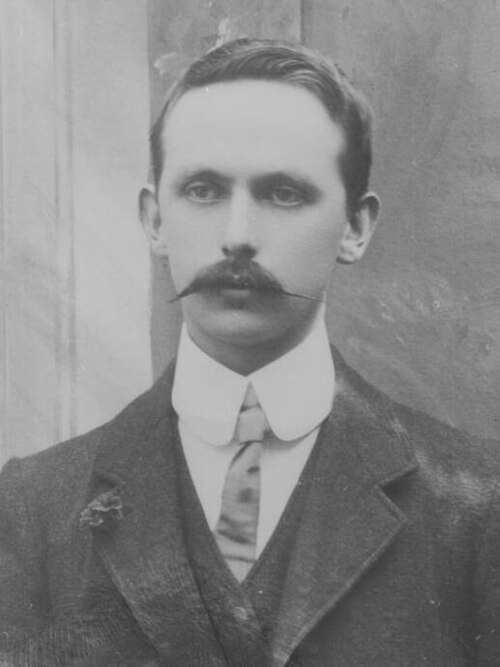
Éamonn Ceannt was born Edward Thomas Kent in Ballymoe on the Galway-Roscommon border on 21 September 1881, the son of a Royal Irish Constabulary sergeant — an irony that recurs throughout the biographies of the 1916 leaders, many of whom came from families with service connections to the colonial apparatus they would ultimately rise against. His father's postings took the family to Loughrea and then to Dublin, where Éamonn grew up and was educated at the O'Connell Schools in North Richmond Street, run by the Christian Brothers.
He took a clerical post with Dublin Corporation — the city council — where he worked as an accountant for the remainder of his civilian life. He was, by all accounts, a conscientious and competent employee: precise, methodical, reliable. The public servant and the revolutionary coexisted in the same man for years, the daytime work at Dublin Corporation giving no outward indication of the secret committees, the drilling sessions, and the planning meetings that filled his evenings and weekends.
His deepest passion, alongside republicanism, was the Irish language and the broader Gaelic cultural revival. He joined the Gaelic League in 1899, at the age of seventeen, and became a committed Irish speaker — Éamonn Ceannt was not a pen name but his Gaelic identity, the name he used in all nationalist contexts and eventually adopted entirely. The language revival, for him and for many of his generation, was inseparable from the political project: Ireland could not be genuinely independent while its people spoke the language of its coloniser, and reclaiming Irish was a form of national self-assertion that preceded and enabled the political.
The Uilleann Pipes and a Performance for the Pope
Ceannt was an accomplished uilleann piper — the Irish bagpipes, an instrument of considerable technical difficulty played with bellows worked by the elbow rather than the breath, producing a softer, more complex sound than the Highland pipes and deeply associated with the Gaelic musical tradition. He was good enough to be invited to play before Pope Pius X during a visit to Rome in 1908, an event that was widely reported in the Irish nationalist press and gave him a public profile that his otherwise quiet life would not have generated. The image is striking: the Dublin clerk in Rome, playing the ancient Irish instrument for the head of the Catholic Church, an act of cultural assertion in the heart of Christendom.
He was active in the Gaelic Athletic Association as well as the Gaelic League — the GAA having been founded in 1884 to promote Irish sports as part of the same cultural nationalist project. He was, in short, a man whose entire identity had been shaped by the cultural revival: a Gaelic speaker, an Irish musician, a Gaelic games enthusiast, a reader of Irish history who understood the political implications of every cultural choice. When the Irish Republican Brotherhood began recruiting among the cultural nationalist organisations in the years before the Rising, men like Ceannt were the obvious targets.
The IRB, the Volunteers, and the Road to 1916
He joined the Irish Republican Brotherhood in 1912, sworn into the secret oath-bound organisation that had been founded in 1858 with the explicit purpose of achieving Irish independence by physical force. The IRB was the hidden architecture beneath much of the nationalist movement, its members occupying key positions in various organisations while pursuing a long-term strategic objective that most of those organisations did not officially share. Ceannt's induction brought him into the inner circle of revolutionary planning at a moment when the IRB leadership was beginning to think seriously about the possibility of a rising during the European war that many expected was coming.
He was one of the founders of the Irish Volunteers in November 1913 — the paramilitary organisation established partly in response to the Ulster Volunteer Force, which had been raised to resist Home Rule. The Volunteers grew rapidly to over 180,000 men before the split of 1914, when Redmond's supporters followed his call to support the British war effort and the majority left. The rump that remained — some 10,000 to 15,000 men who rejected Redmond's position — became the instrument of the planned rising. Ceannt commanded the 4th Battalion, based in the south Dublin area.
He was co-opted onto the IRB Military Council in 1915 — the small group of men who actually planned the Rising and kept its date and scope secret even from most of the Volunteer leadership. The Council consisted of Ceannt, Patrick Pearse, Tom Clarke, Seán Mac Diarmada, Joseph Plunkett, Thomas MacDonagh, and James Connolly. These seven men signed the Proclamation and commanded the Rising's garrisons, and all seven were executed in the fortnight that followed its suppression. The secrecy of the Military Council meant that many senior Volunteers did not know the Rising was planned for Easter Sunday until days before it occurred — contributing to the confusion of countermanding orders that reduced the Rising's scale dramatically.
Easter Week 1916: The South Dublin Union
The South Dublin Union was one of the largest complexes in Dublin — a sprawling network of buildings housing the city's workhouse, the institution that provided the bare minimum of food and shelter for the destitute poor of Dublin. It covered some fifty acres between the South Circular Road and James's Street, a maze of wards, chapels, laundries, and administrative buildings that offered excellent defensive positions but was also home to hundreds of civilian patients and staff. Ceannt's 4th Battalion was assigned to occupy and defend it.
On Easter Monday, 24 April 1916, Ceannt led his men into the South Dublin Union and began establishing defensive positions. The garrison numbered around 120 men — substantially fewer than intended, owing to the confusion caused by the countermanding order issued by Eoin MacNeill on the Sunday — and they were defending a vast complex against British forces that would eventually bring substantial numbers of troops to bear against them. The fighting in and around the South Dublin Union was some of the most intense and intimate of Easter Week: close-quarters combat in the wards and corridors of a working institution, with the constant presence of civilian patients adding a dimension that made tactical decisions extraordinarily difficult.
Ceannt's second-in-command was Cathal Brugha, who was badly wounded in the fighting but survived — his recovery described as nearly miraculous by those who saw his injuries. The garrison held out for the full six days of the Rising, surrendering only after Pearse's general order on Saturday afternoon. The resistance offered by the South Dublin Union garrison was, by any military standard, remarkable: a small force, in a difficult defensive position, against significantly superior numbers, maintained for the duration of the engagement without breaking.
Kilmainham: Trial and Execution
Ceannt was arrested after the surrender, court-martialled, and sentenced to death. He was held in Kilmainham Gaol while the executions of the other leaders proceeded — Pearse, Clarke, and MacDonagh on 3 May; Willie Pearse, Edward Daly, Michael O'Hanrahan, and Joseph Plunkett on 4 May; John MacBride on 5 May. The staggered nature of the executions, stretched over nearly two weeks, transformed public opinion in Ireland from hostility or indifference toward the Rising into anger at the British response. By the time Ceannt was shot on the morning of 8 May 1916, alongside Seán Heuston, Michael Mallin, and Con Colbert, the executions had already done the political work of making the executed men into martyrs.
His final letters, written in Kilmainham in the hours before his execution, are among the most moving documents of the Rising. He wrote to his wife Áine with a composure and tenderness that testifies to the depth of his faith and the solidity of his character. He expressed no regret for what he had done — only sorrow at leaving her and their son Ronan, and a clear conviction that the sacrifice would ultimately bear fruit. He asked her to forgive any wrongs he had done her, expressed his pride in what the Rising had achieved, and left her with an account of a man at peace with his choices.
Legacy: The Quiet Revolutionary
Among the seven signatories of the Proclamation, Ceannt is the least immediately famous — less charismatic than Pearse, less strategically significant than Clarke, less dramatically martyred than Plunkett (who married his fiancée Grace Gifford in Kilmainham the night before his execution). He was not a man who sought the spotlight, and the thoroughness of his commitment to Irish-Ireland — the language, the music, the cultural project — meant that his revolution was as much cultural as military.
But the South Dublin Union garrison's resistance stands as one of the genuine military achievements of Easter Week, and Ceannt's leadership of it demonstrates the quality of man the IRB's recruitment among the cultural nationalist movements had produced: not a professional soldier, not a political ideologue, but a man of deep cultural conviction and personal integrity who had decided that the moment had come for the final assertion of Irish independence and who executed his part in that assertion with complete seriousness. The fact that he was a civil servant who played the pipes and spoke Irish is not incidental to understanding him — it is the explanation of him. His revolution was the revolution of the Gaelic revival made physical.
Ceannt Station, the railway terminus in Galway, was renamed in his honour in 1966, on the fiftieth anniversary of the Rising. He is commemorated alongside the other six signatories in the iconography of the Irish Republic — his face on stamps and posters, his name on streets and schools — as one of the men who signed their names to a document that declared a republic and then gave their lives to make that declaration something more than words on paper.