At a Glance
Holmes County, Mississippi, and the Geography of Disenfranchisement
Holmes County, Mississippi, sat in the middle of the Delta's richest agricultural land with one of the state's most heavily Black populations — and one of its most comprehensively disenfranchised ones. The county's Black majority had been effectively excluded from political participation since the end of Reconstruction through the standard instruments of the Mississippi disenfranchisement machinery: literacy tests, poll taxes, the threat of economic retaliation and physical violence, and the informal social understanding that attempting to register to vote was a transgression against the racial order whose consequences would be immediate and severe.
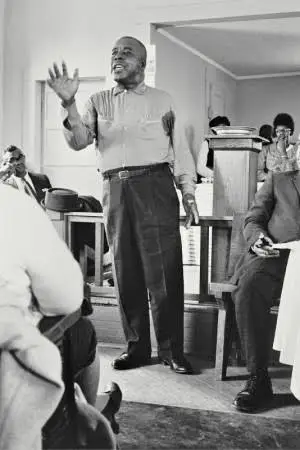
Turnbow's ownership of his own farm in the Mileston community — a piece of land that his labour had developed and that belonged to him rather than to a white landlord — was the economic foundation that made his political courage possible. The sharecropping system's genius, from the perspective of the white plantation economy, was that it created total economic dependency that functioned as a complete system of control: a sharecropper who challenged the racial order could be evicted from the land, fired from the job, blacklisted from future employment, and effectively destroyed economically without any physical violence at all. Turnbow was not subject to this leverage. He owned his land; no white employer could fire him; no white landlord could evict him. The consequence was that he could take political risks that sharecroppers could not, and when SNCC arrived in Holmes County in 1962 and 1963, he was among the first community members ready to move.
His position in the community — as a farmer who owned his land, as an older man with community standing, as someone whose economic independence was visible and admired — meant that his participation in the voter registration attempt carried weight that a younger or economically dependent person's participation would not have. When Hartman Turnbow walked to the Lexington courthouse in April 1963, he was not merely making a personal political statement; he was communicating to every other Black person in Holmes County who knew him that if Turnbow was willing to take this risk, the risk was one that could be taken.
The Night of the Firebombing: What Turnbow Said and Did
The sequence of events on the night following the registration attempt — the firebombing, Turnbow's response, the arrests — is one of the most extraordinary episodes in the civil rights movement's history, combining the Klan's standard intimidation tactic (arson of a civil rights activist's home), Turnbow's extraordinary response (shooting back), and the authorities' response (arresting Turnbow for arson of his own property) in a way that illuminated every dimension of Mississippi's racial order simultaneously.
Turnbow was asleep when the Molotov cocktails hit the porch. He woke up, assessed the situation, and did what a man who owned a rifle and had a burning house and a family inside it would do: he grabbed the rifle, helped his wife Sweets and their daughter get out of the burning building, and returned fire at the men who were shooting at his house. The attackers fled. Turnbow's wife and daughter were unhurt. The house burned. He stood outside with his rifle and called the authorities.
The authorities who arrived — local law enforcement and eventually the FBI — did not treat the situation as a violent attack on a Black farmer's home in connection with his voter registration attempt. They treated it as an arson investigation, and the investigation pointed in a direction that would have been farcical if the consequences were not so serious: they charged Hartman Turnbow with having set fire to his own home. They also charged Bob Moses, who had been nearby and had come to Turnbow's aid, and two other civil rights workers, with the same offense. The charges alleged, essentially, that these four men had conspired to burn Turnbow's house down for undisclosed reasons.
Bob Moses's response to the charges — in his subsequent writing and speaking about the case — captured something essential about what was happening. He was not surprised by the charges; he had seen enough of Mississippi's justice system to understand that it would be used against civil rights workers rather than for them. He was moved by Turnbow's courage, by the clarity of his self-defence, and by the way in which the absurdity of the charges made visible exactly what the Mississippi system was doing: using the law as an instrument of racial intimidation rather than as a framework for justice.
Self-Defence, SNCC's Nonviolence, and the Distinction Bob Moses Drew
Turnbow's shooting back at his attackers became one of the most discussed examples in the civil rights movement's internal debates about nonviolence and self-defence — debates that were more complex and more honest within the movement than the official commitment to Gandhian nonviolence sometimes suggested. SNCC's official position was nonviolent direct action; its field workers were trained in nonviolent discipline and conducted their demonstrations and voter registration work according to nonviolent principles. At the same time, many of the communities where SNCC worked were armed communities where self-defence was a deeply rooted tradition, and the SNCC workers who lived in those communities were often protected by armed community members whose rifles were not going to be surrendered in the name of a nonviolence principle that felt, to those community members, like a demand that they accept vulnerability to violence on behalf of a philosophy that their attackers did not share.
Moses drew a distinction that clarified the movement's actual position: organised demonstrations, voter registration lines, mass meetings — these were conducted nonviolently, as a matter of both principle and strategy; the nonviolence of these activities was what gave them their moral force and their ability to reveal the racial order's violence for what it was. But the personal right of individuals to defend their homes and families from violent attack was a different matter. Turnbow had not been in a demonstration or a voter registration line when his home was firebombed; he had been in his bed, with his wife and daughter. His response — grabbing his rifle and shooting back — was not a violation of the movement's nonviolence commitment but an exercise of the self-defence right that the movement had never claimed to deny.
This distinction was not merely theoretical but practically important for the movement's relationship with the communities it was organising. Communities like Holmes County's Mileston area were not going to be asked to disarm themselves in order to participate in the movement, and SNCC workers who lived in those communities were not going to pretend that the armed protections of local farmers were unwelcome. The movement's nonviolent direct action and the community's right to self-defence coexisted, as they had to in the conditions of Mississippi in the early 1960s, and Turnbow's case was the clearest possible example of how that coexistence worked in practice.
Holmes County's Transformation: From Turnbow's Attempt to Black Political Power
Turnbow's April 1963 registration attempt was the beginning of a transformation in Holmes County's political life that continued through the 1960s and beyond. SNCC's sustained voter registration campaign in the county, building on the foundation that Turnbow's attempt had established and drawing on the community networks that Turnbow and other landowners had maintained, gradually registered the Black majority that had been excluded from political participation for a century. By the late 1960s and 1970s, Holmes County had elected Black officials at various levels of local government — a transformation that Turnbow's walk to the courthouse in April 1963 had, in important respects, begun.
The Mileston community where Turnbow farmed became, during the SNCC years, one of the organisational centres of Holmes County's civil rights movement — a gathering place for meetings, a host location for SNCC workers, and a demonstration that the movement had roots in the county's own Black community rather than being imported from outside. Turnbow's farm was both a practical resource and a symbol: the land-owning Black farmer who had shot back at night riders and then continued to participate in the movement was evidence, visible to everyone in the county, that the movement was not merely for the young and the idealistic but for the community's established and respected members.
He continued to live and farm in Holmes County for the remaining twenty-five years of his life after the 1963 firebombing, watching the political transformation that the movement had produced and participating in the civic life of a county that was, by the 1970s and 1980s, substantially different from the one he had been born into in 1905. The difference was not complete — Holmes County's poverty, its economic inequality, its distance from the centres of political and economic power that determined Mississippi's future remained real — but the formal political exclusion that had been the foundation of every other form of exclusion had been broken, and Hartman Turnbow had been among the first people to break it.