The Making of a Black Radical: Jamaica and Early Formation
Marcus Mosiah Garvey was born on 17 August 1887 in Saint Ann's Bay, on Jamaica's north coast, the youngest of eleven children of Marcus Garvey Sr., a stonemason, and Sarah Jane Richards. The Jamaica into which he was born was a British colony deeply shaped by the legacies of slavery — formally abolished in 1834, but whose economic and social structures continued to define every aspect of life for the island's Black majority. The plantation system had given way to a peasant economy in which Black Jamaicans worked smallholdings and casual labour, excluded from political power and social advancement by a colonial hierarchy that placed white British officials and a light-skinned Creole elite at the top of every significant institution.
Garvey's father was unusual among his community in having a substantial personal library, and the young Marcus was an early and voracious reader. He left school at fourteen to become a printer's apprentice, a trade that brought him into contact with the world of print journalism and political publishing that would shape his life's work. He worked as a printer and then as a foreman at the printing firm P.A. Benjamin in Kingston, where he became involved in labour activism and participated in a printers' strike in 1907. The strike was defeated, Garvey was dismissed, and the experience taught him an early lesson about the vulnerability of Black workers when they confronted organised capital without independent economic power of their own.
Between 1910 and 1914 Garvey travelled extensively — to Central America, where he witnessed the brutal conditions in which West Indian workers laboured on United Fruit Company plantations in Costa Rica and Panama, and then to England, where he encountered the African and Caribbean intellectual diaspora concentrated in London. He read Booker T. Washington's Up from Slavery during this period, and the experience was transformative: Washington's argument for Black self-reliance and economic development — however differently Garvey would ultimately deploy it — provided the conceptual framework around which he began to build his own vision. By the time he returned to Jamaica in 1914 he had a project: to build an organisation that would unite people of African descent across the world in a movement for racial uplift, self-reliance, and eventually African redemption.
The UNIA and the Architecture of Black Internationalism
Garvey founded the Universal Negro Improvement Association and African Communities League in Jamaica on 1 August 1914 — the anniversary of emancipation in the British Caribbean — with the stated aim of uniting the African diaspora and establishing a self-governing nation in Africa. The initial Jamaican branch struggled to gain traction. Jamaica's light-skinned middle class, who dominated the island's civil society organisations, were suspicious of Garvey's overt Black nationalism, and the organisation remained small. In 1916 Garvey moved to New York, initially intending a brief tour to raise funds and return, but quickly recognising that Harlem — with its concentration of Black Americans who had migrated from the South, its intellectual ferment, and its mass media — was the ground on which a genuinely international movement could be built.
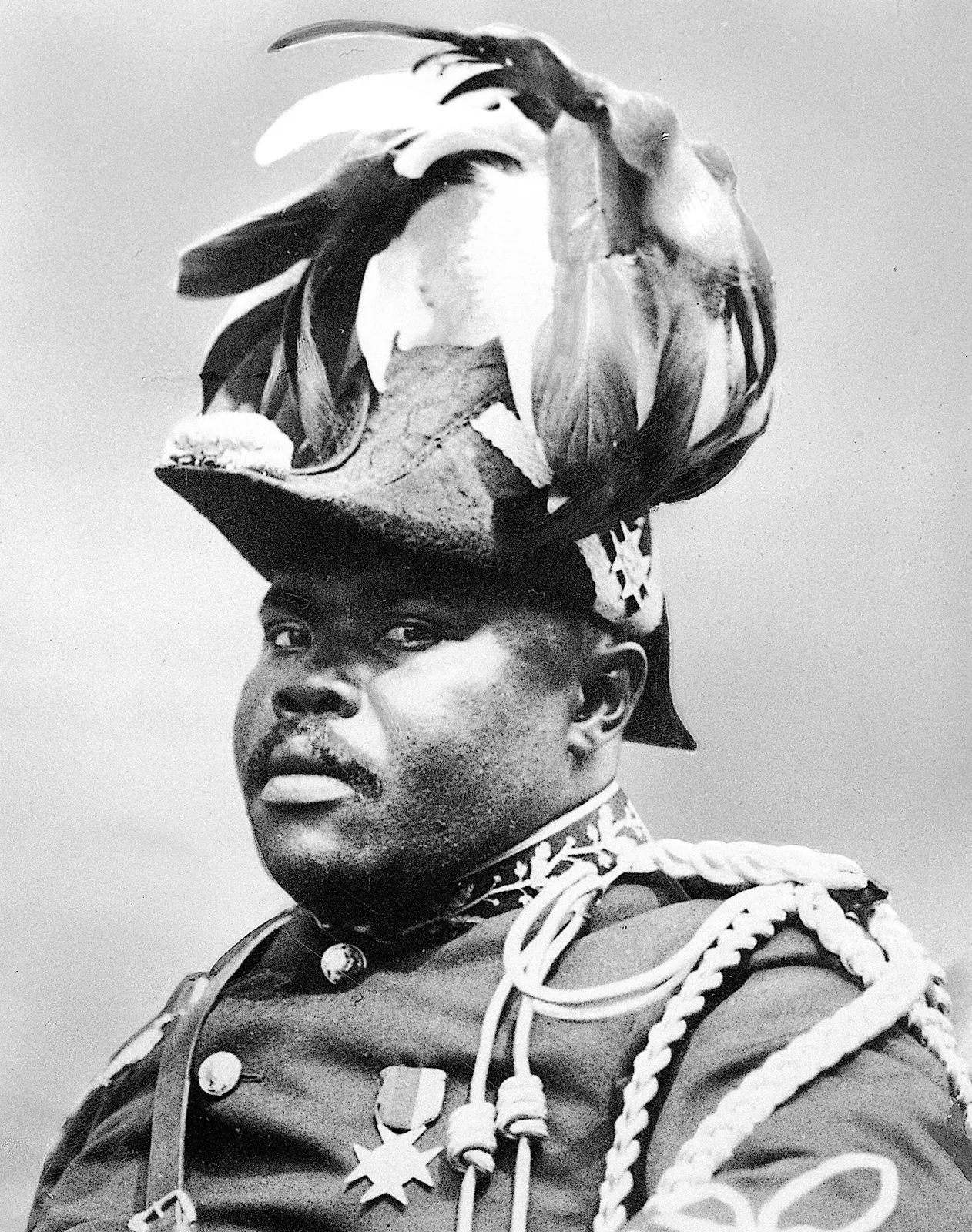
The New York branch of the UNIA grew with extraordinary speed. Garvey was a gifted orator whose theatrical style — parades, uniforms, titles, pageantry — created a sense of dignity and collective power that resonated deeply with communities accustomed to systematic humiliation. He launched The Negro World newspaper in 1918, which at its peak had a circulation of over 200,000 copies per week and was distributed across the United States, the Caribbean, Latin America, Africa, and Europe. The colonial authorities in British and French Africa were so alarmed by its content that they banned it outright. By 1920, when the UNIA held its First International Convention in New York, the organisation claimed over four million members across 40 countries, making it the largest organised movement of Black people in history up to that point.
"Up, you mighty race! You can accomplish what you will."
— Marcus Garvey, addressing UNIA conventions, 1920sThe 1920 convention was the movement's symbolic apex. It filled Madison Square Garden, adopted a Declaration of the Rights of the Negro Peoples of the World, and elected Garvey as Provisional President of Africa — a title that was symbolic rather than governmental but that captured the ambition of his project. The Declaration was a remarkable document: a systematic enumeration of the rights that people of African descent were asserting against the colonial powers and the racist states of the Americas, grounded in the same natural-rights language that had shaped American and French declarations but applied to a people who had been systematically excluded from those declarations' protections.
The Black Star Line and the Economics of Liberation
The most ambitious and ultimately most controversial element of Garvey's programme was the Black Star Line Steamship Corporation, founded in 1919 to provide Black-owned shipping connecting the Americas, the Caribbean, and Africa. The Black Star Line was not merely an economic venture — it was a political statement and a practical instrument. Garvey understood that Black economic independence required Black control of trade and transport; a shipping line owned by and serving the Black community would both demonstrate the capacity for Black economic organisation and provide the practical infrastructure for the back-to-Africa vision that animated the UNIA's most ambitious aspirations.
The company sold shares exclusively to Black investors at five dollars each, raising over $600,000 and demonstrating the remarkable capacity of the UNIA's network to mobilise collective economic resources. Three ships were purchased. The enterprise was plagued from the start by the inexperience of Garvey's management team, the deteriorated condition of the ships purchased, and — crucially — the active sabotage of federal authorities who had placed the UNIA under surveillance. J. Edgar Hoover at the Bureau of Investigation regarded Garvey as the most dangerous Black man in America, and federal agents worked to undermine the Black Star Line's operations and build a case against its leadership. The ships were poorly maintained, failed repeatedly, and the company eventually collapsed. Garvey was prosecuted for mail fraud in connection with the stock sales — a prosecution that his supporters regarded as politically motivated — convicted in 1923, imprisoned in 1925, and deported to Jamaica in 1927 when President Calvin Coolidge commuted his sentence.
Ideology, Controversy, and the Complexity of Garvey's Politics
Garvey's political thought was formidably original but also genuinely controversial, even within the Black liberation tradition. His emphasis on racial pride and Black identity was electrifying to millions who had been taught to regard their African heritage as a source of shame rather than honour. His insistence that Black people needed their own institutions — schools, businesses, newspapers, political organisations — rather than integration into white-controlled ones anticipated by decades the arguments that would be made in the 1960s by Black Power advocates. His vision of Africa as the spiritual and eventual political homeland of the diaspora provided a framework of meaning and dignity that resonated powerfully across the Black world.
But his politics were also marked by a racial essentialism that sat uncomfortably alongside other liberation traditions. His notorious meetings with Ku Klux Klan officials in 1922 — justified by Garvey as an exploration of whether the Klan's own racial separatism could be turned to Black advantage — alienated many allies, including W.E.B. Du Bois, who regarded Garvey's separatism as a capitulation to white racism rather than a challenge to it. The Du Bois-Garvey conflict became one of the great intellectual battles of 1920s Black America, with Du Bois's integrationist Pan-Africanism — premised on the eventual achievement of full citizenship rights within existing nations — set against Garvey's separatist nationalism premised on the building of a Black nation-state in Africa. Both were visionaries; neither fully prevailed in their own lifetime, and the tensions between their perspectives have animated Black political thought ever since.
Garvey's attitude toward class was similarly complex. He spoke the language of racial solidarity in ways that sometimes obscured class divisions within Black communities, and his relationship with Black labour movements was uneasy. He was suspicious of socialism — partly because many socialist organisations of his era were dominated by whites who did not take race seriously — and he emphasised Black capitalist development in ways that irritated socialist contemporaries like C.L.R. James, who regarded Garvey's racial nationalism as politically insufficient. Yet the communities that Garvey organised were overwhelmingly working class, and the UNIA's practical programme — cooperative enterprises, mutual aid, self-help institutions — had a character that was in important respects more solidaristic than individualist.
Deportation, Decline, and the Long Legacy
The years after deportation were difficult. Garvey rebuilt the UNIA from Kingston, but the movement had lost its mass base in the United States and never fully recovered. He moved to London in 1935, where he continued writing and speaking but reached smaller audiences than in his Harlem years. He suffered two strokes in 1940 and died in London on 10 June, aged 52, before the wave of African independence that his ideas had helped to inspire had fully broken. He never set foot on the African continent.
The legacy, however, was immense and far-reaching. Garvey's ideas provided the intellectual framework for the Rastafari movement that emerged in Jamaica in the 1930s — his prophecy that a great Black king would be crowned in Africa was interpreted by early Rastafarians as a reference to Haile Selassie's coronation in Ethiopia in 1930. His flag — red, black, and green — became the Pan-African flag, adopted by liberation movements across the continent. Kwame Nkrumah, who built Ghana's independence movement and became the first president of independent Ghana, credited Garvey as his primary political inspiration. Jomo Kenyatta, Kenneth Kaunda, and Julius Nyerere all acknowledged the formative influence of Garveyite ideas. Malcolm X's father was a Garveyite organiser; the Nation of Islam drew heavily on Garvey's emphasis on Black self-reliance and separate institutional development. The Black Power movement of the 1960s, with its insistence on Black pride, Black institutions, and Black political autonomy, was recognisably Garveyite in its fundamental assumptions. In 1964, the government of independent Jamaica declared Marcus Garvey the country's first National Hero.