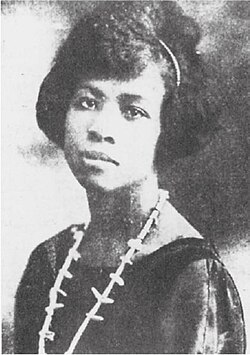
Jamaica, Education, and Entry into the Garveyite World
Amy Euphemia Jacques was born on 31 December 1895 in Blantyre, Saint Andrew Parish, Jamaica, into a family of the Black middle class — the layer of Jamaican society that occupied the uncomfortable space between the white colonial elite and the Black working poor, educated and professionally aspirant but consistently blocked from the highest levels of colonial society by the racial hierarchy that structured every institution. Her father, George Samuel Jacques, was a planter and businessman; her mother, Charlotte Henrietta South Jacques, came from a family with educational and professional attainments. Amy received an education that was genuinely excellent by the standards of colonial Jamaica, at a time when quality schooling was a privilege that many Black Jamaicans could not access.
She came to the Garvey movement as a young woman already engaged with the political and intellectual questions of her time. She had become acquainted with Marcus Garvey by around 1918 and joined the UNIA's Harlem operation, where she worked first as his personal secretary and then as a key figure in the organisation's administrative and communications infrastructure. The UNIA of the early 1920s was a vast enterprise — publishing a newspaper with a circulation of hundreds of thousands, managing chapters across multiple continents, operating the Black Star Line, planning conventions — and its day-to-day functioning required exactly the combination of organisational competence, political literacy, and editorial skill that Amy Jacques brought to it.
She married Marcus Garvey in July 1922, three months after his divorce from Amy Ashwood was finalised. The marriage was a partnership of a very specific kind: she was devoted to him and to the movement he represented, but she was also a person of independent intelligence and political judgment who did not simply subordinate her own views to his. The relationship required her to manage an extraordinary range of practical demands — his legal defence, the management of the organisation during his various crises, the care of their two sons — while also contributing substantively to the intellectual work of the movement.
Philosophy and Opinions: The Editorial Act That Preserved a Legacy
Amy Jacques Garvey's most immediately significant contribution to the Garveyite movement was editorial: the compilation and editing of Philosophy and Opinions of Marcus Garvey, published in two volumes in 1923 and 1925. The work collected speeches, editorials, essays, and manifestos produced by Marcus Garvey over the preceding decade, organised them thematically, and presented them in a form that made accessible the range and depth of his political thought. It was an act of intellectual curation as well as archival preservation, and its importance can hardly be overstated: without these volumes, much of Garvey's most important writing and speaking would have remained scattered across back issues of The Negro World and in reports of public meetings, inaccessible to the broader readership that needed to encounter it.
The editorial work was done during one of the most difficult periods of the movement's history, while Marcus Garvey was fighting his mail fraud prosecution. Amy Jacques was simultaneously managing his legal affairs, running correspondence for the UNIA, raising funds, and editing two volumes of political writing. The capacity this required — intellectual, organisational, and personal — was formidable, and it is characteristic of the way in which women's labour within political movements tends to be rendered invisible that the volumes are attributed entirely to Marcus Garvey rather than recognising Amy Jacques's constitutive editorial role.
"Women of all races and nations have been the silent, but active, builders of the race. We must now give them their rightful place in the struggle for liberation."
— Amy Jacques Garvey, writing in the Negro World, 1920sThe Philosophy and Opinions volumes became the foundational texts of Garveyism as a political tradition — the works to which subsequent generations of Pan-Africanists, Black nationalists, and anti-colonial thinkers would turn to understand what Garvey had actually argued and why it mattered. Kwame Nkrumah read them as a student. The founders of the Nation of Islam drew from them. The Black Power movement of the 1960s returned to them. Every subsequent engagement with Garveyite thought has passed through the editorial decisions Amy Jacques made in 1923 and 1925 — decisions about what to include, what to emphasise, how to organise and frame the material — and those decisions have shaped the Garveyite tradition as much as anything Marcus Garvey himself wrote or said.
The Negro World Column and the Women Question
Alongside her administrative and editorial work for the UNIA, Amy Jacques Garvey edited a regular column in The Negro World entitled "Our Women and What They Think" — a platform that was explicitly directed at Black women readers and that addressed the full range of issues relevant to their lives: politics, education, health, domestic life, cultural identity, and the specific challenges facing Black women in the racist and sexist society of 1920s America. The column gave women readers a voice in the UNIA's primary publication and placed questions about gender and women's liberation at the centre of Garveyite discourse in a way that the movement's male leadership had not consistently prioritised.
Her approach to the women's question was rooted in her Pan-Africanist framework: she argued that the liberation of Black people required the liberation of Black women, and that any movement that marginalised or subordinated women was ultimately weakening itself. She was not a feminist in the sense of prioritising gender over race — she consistently maintained that racial liberation was the primary political task — but she insisted that this task could not be accomplished without the full and equal participation of women, and she criticised the tendency of Black male leaders to reproduce within their organisations the gender hierarchies of the wider society they were challenging.
Prison, Deportation, and the Sustained Maintenance of the Movement
When Marcus Garvey was imprisoned in the Atlanta Federal Penitentiary from 1925 to 1927 — serving his sentence for mail fraud following a conviction that his supporters regarded as politically motivated — Amy Jacques became the de facto head of the UNIA's operations. She corresponded with chapters across the world, managed the organisation's finances, coordinated legal efforts on his behalf, advocated publicly for his release, raised their two young sons, and continued to write and edit. The movement would have collapsed without her, and in a real sense her management during this period was the condition of its survival into the years after Garvey's deportation.
When Garvey was deported to Jamaica in 1927, Amy Jacques followed with their sons and the couple rebuilt their life in Kingston. The Jamaican years were difficult — the UNIA's mass base had been in the United States, and rebuilding it from Jamaica, without access to the media concentration of Harlem, against the indifference of the Jamaican middle class and the hostility of the colonial authorities, proved ultimately impossible. Garvey moved to London in 1935, where he continued to write and speak to diminishing audiences. Amy Jacques remained in Jamaica with their sons, managing the family's limited finances and continuing her own political writing, while corresponding regularly with her husband in London until his death in 1940.
Widowhood and Four Decades of Independent Political Work
Marcus Garvey died in London in June 1940, and Amy Jacques Garvey spent the following thirty-three years — more than half again as long as their eighteen-year marriage — as his widow, keeper of his legacy, and an independent political figure in her own right. This final period of her life is in some respects the most interesting, because it is the period in which it is possible to see her political thought developing independently of her husband's shadow.
She wrote extensively and politically — contributing to Jamaican newspapers, to Caribbean publications, to international Pan-Africanist journals — on the progress of African independence, the situation of Black people in the diaspora, the Cold War's implications for the liberation struggle, and the continuing relevance of Garveyite principles to the changed world of the post-war era. She corresponded with African independence leaders, commented on the politics of independent African states, and engaged with the debates within Pan-Africanism about the relationship between racial solidarity and class struggle, between nationalism and socialism, between the diaspora and the continent.
Her book Garvey and Garveyism, published in 1963, was the most comprehensive account of the movement's history and philosophy produced by anyone who had lived through it. It drew on her own memories, on the papers and correspondence she had preserved, and on her own political analysis to present Garveyism as a living tradition relevant to the contemporary world rather than merely a historical episode. The book was reviewed seriously and cited widely by the generation of scholars who were beginning to give academic attention to the Pan-African tradition, and it remains an indispensable primary source for the history of the UNIA and of Garveyite thought.
Gender, Race, and the Demand for Recognition
One of the most distinctive aspects of Amy Jacques Garvey's political writing in her later years was her explicit insistence that Black women's contributions to the liberation struggle deserved recognition on their own terms rather than merely as extensions of the contributions of the men beside whom they worked. She was acutely aware of the ways in which the historiography of Pan-Africanism had systematically marginalised women — including herself — and she pushed back against this marginalisation in her writing with a directness and persistence that was unusual for a woman of her generation and social position.
She demanded, in particular, that the African independence movements that Marcus Garvey's ideas had helped to inspire should take seriously the advancement of African women rather than simply reproducing the gender hierarchies of colonial society in independent African states. She argued that independence which left women subordinated was not the liberation that the Pan-African tradition had promised, and she used her considerable moral authority — as the widow of the movement's founder, as the editor who had preserved its primary texts, as a veteran of forty years of political work — to press this argument on leaders who might otherwise have been inclined to defer to her on everything else but resist her on this.
Legacy: Beyond the Wife of a Great Man
Amy Jacques Garvey died on 25 July 1973 in Kingston, Jamaica, aged seventy-seven. She had outlived her husband by thirty-three years, and had spent every one of them in active political engagement with the Pan-African tradition she had helped to build and sustain. The recognition she received in Jamaica during her lifetime was belated and limited — the Musgrave Gold Medal from the Institute of Jamaica in 1971 was a significant honour but came very late in a life of sustained achievement. Internationally, her reputation remained largely that of Marcus Garvey's widow rather than a political figure in her own right.
The scholarly reassessment of her contributions began in the 1980s and has continued to develop. Feminist historians of the Black Atlantic world have placed her editorial work, her journalism, and her political writing within a tradition of Black feminist thought that deserves serious intellectual engagement rather than merely biographical acknowledgment. Her role in preserving the Garveyite texts through the Philosophy and Opinions volumes is now more widely understood as an act of intellectual labour with major consequences for the subsequent history of Pan-Africanism. And her own writing — the columns in The Negro World, the later journalism, Garvey and Garveyism itself — is read increasingly as evidence of a political thinker whose ideas deserve engagement on their own terms. She spent a lifetime in the shadow of a great man; she deserves to be remembered in her own light.