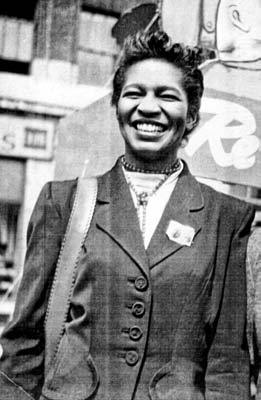
Trinidad, Migration, and the Making of a Radical in Harlem
Claudia Vera Cumberbatch was born on 21 February 1915 in Belmont, Port of Spain, Trinidad, the third of four children of Charles Cumberbatch and Sybilla Cumberbatch. The family emigrated to the United States in 1924, joining the wave of Caribbean migrants who were drawn to New York by the economic possibilities of the booming 1920s American economy and the concentrated cultural life of Harlem, which was in the midst of the cultural renaissance that would define a generation. The Cumberbatches settled in Harlem, where Claudia's mother died shortly after arrival — a loss that left a permanent mark on her sense of the brutal material conditions in which Black working-class families lived — and where her father struggled to maintain the family through the Depression years that followed the crash of 1929.
Growing up in Depression-era Harlem was a political education in itself. Claudia attended Harlem's schools and was a gifted student, but was forced to leave school early to help support her family. She worked in a laundry, as a hat checker, as a shop assistant — the kinds of service work that absorbed the labour of Black women in the segregated American economy, invisible to mainstream society but absolutely central to its functioning. She contracted tuberculosis as a young woman, a disease that would return throughout her life and that reflected the housing conditions and overwork that characterised the lives of Harlem's working poor. The tuberculosis damaged her heart, and the heart condition it left behind would ultimately kill her at forty-nine.
She joined the Young Communist League in 1936, at the age of twenty-one — drawn to the Communist Party USA's combination of socialist economic analysis and willingness to take racial equality seriously in a way that mainstream American politics entirely refused. The CPUSA of the 1930s, for all its subsequent reputation for Soviet subservience, was the only significant national political organisation that consistently argued for the full equality of Black Americans, that organised interracially in the South, that made anti-racism a central element of its programme. For a young Black woman from Trinidad living through the Depression and the continued daily violence of American racism, this was a powerful argument. She became a full member of the CPUSA in 1938 and quickly established herself as a capable organiser and journalist.
The Negro Woman and Triple Oppression: A Foundational Feminist Analysis
Claudia Jones's most important theoretical contribution was her 1949 essay "An End to the Neglect of the Problems of the Negro Woman!" — a short but remarkable work that systematically analysed the situation of Black women in the United States as the product of three interlocking systems of exploitation: racial oppression, class exploitation, and gender subordination. Published in the CPUSA journal Political Affairs, the essay argued that Black women occupied the most oppressed position in American society, facing discrimination from white employers because they were Black, from white workers because they were Black, and from Black men because they were women — a triple burden that existing progressive politics consistently failed to address because each strand of the left treated only one dimension of their oppression as real or important.
"The Negro woman, who combines in her person the worker, the Negro, and the woman, is the most exploited of all. She is the victim of the three-fold oppression of capitalism."
— Claudia Jones, "An End to the Neglect of the Problems of the Negro Woman!", 1949This analysis — developed decades before the academic concept of intersectionality was named and theorised by Kimberlé Crenshaw — was the most sophisticated account of the compound character of Black women's oppression produced by any thinker of the 1940s. Jones argued that the organisations of the left — including the Communist Party itself — consistently undervalued Black women's contributions, placed them in subordinate roles, and failed to take their specific situation seriously as a political problem requiring specific political solutions. The essay called for Black women to be placed at the centre of progressive politics rather than at its margins, and argued that the liberation of Black women was a condition for the liberation of all oppressed people.
The essay was also a critique of the American labour movement, which systematically excluded Black workers and especially Black women from its organisations and its benefits — a critique that placed Jones in a tradition of Black feminist labour analysis that ran from Ida B. Wells through Pauli Murray to the contemporary era. Her argument that racial capitalism required the super-exploitation of Black women specifically, as the labour force segment with the fewest legal protections and the weakest organisational position, anticipated the analysis that would be developed by Black Marxist feminist thinkers in subsequent decades.
McCarthyism, Imprisonment, and Deportation
Claudia Jones paid an enormous personal price for her political commitments. The Cold War brought the full machinery of the American state to bear on the Communist Party, and Jones — as one of its most prominent Black members and a non-citizen — was particularly vulnerable. She was first arrested in 1948 and charged under the Smith Act, which made it a criminal offence to advocate the overthrow of the government or to be a member of an organisation that did so. She was convicted, appealed, convicted again, and ultimately served time in the Federal Reformatory for Women at Alderson, West Virginia — the same institution that imprisoned Ethel Rosenberg.
Prison further damaged the heart disease she had suffered since her tuberculosis in the 1930s, and she was hospitalised repeatedly during her periods of incarceration. She was imprisoned three times in total. The conditions of her imprisonment — the denial of adequate medical care for a woman with a known heart condition, the psychological pressure of repeated prosecution, the isolation from her political community — amounted to what her supporters regarded as a slow and deliberate destruction of her health. The American authorities' awareness of her medical vulnerability did not soften their prosecution; if anything, the evidence suggests they regarded her deteriorating health as a reason for urgency rather than mercy.
She was deported to England in December 1955, under the provisions of the McCarran-Walter Immigration Act, which allowed the deportation of non-citizens for Communist Party membership. The deportation was a political victory for the McCarthy-era right but also an act of characteristic short-sightedness: it removed from American soil a brilliant organiser whose political influence then spread to Britain, the Caribbean, and the wider Black Atlantic world in ways the American authorities neither anticipated nor desired.
London, the West Indian Gazette, and the Black British Community
Jones arrived in London in January 1956 to a Black British community that was in the early stages of its post-war formation. The Windrush generation — the West Indian migrants who had come to Britain from 1948 onward in response to active recruitment to fill Britain's post-war labour shortages — had established communities in Brixton, Notting Hill, Wolverhampton, Nottingham, and other cities, but these communities lacked the organisational infrastructure, the press, and the political voice that their counterparts in American cities had developed over generations. Jones threw herself into the work of building that infrastructure with the energy and organisational skill that had characterised her American career.
She founded the West Indian Gazette and Afro-Asian Caribbean News in 1958 — the first major Black newspaper in Britain — which quickly established itself as the voice of the Caribbean community and a platform for anti-colonial politics, civil rights advocacy, and the cultural life of Black Britain. The paper was editorially independent and politically radical, covering the independence movements in Africa and the Caribbean alongside the struggles of West Indian migrants against workplace discrimination and the casual racism of British housing, employment, and public life. It gave the Black British community a voice in public debate at a moment when they were systematically excluded from the mainstream press and from political representation.
Jones was simultaneously organising politically — working through the Committee of Afro-Asian-Caribbean Organisations and other bodies to build coalitions between Caribbean, African, and Asian communities — and building cultural institutions. She was among the key figures in the creation of the Caribbean Artists Movement and was deeply involved in the cultural life of Black London. Her political vision was international: she maintained her connections with socialist and anti-colonial movements across the world, corresponded with liberation leaders in Africa and Asia, and understood the Black British experience as one element of a global struggle against imperialism and racial capitalism.
The Birth of Carnival: Culture as Anti-Racist Politics
The event that cemented Claudia Jones's place in British cultural history occurred in 1958. The Notting Hill race riots of August and September 1958 — in which white mobs attacked Caribbean homes and individuals for several days while the police largely stood by — demonstrated with brutal clarity the degree of racist hostility that West Indian migrants faced in Britain. The riots were a traumatic shock to the Caribbean community, which had been encouraged to believe that Britain, the mother country to which they had come at the invitation of the British government, would offer a more welcoming reception than the American South.
Jones's response to the riots was characteristically political and creative. In January 1959, she organised an indoor Caribbean Carnival at St Pancras Town Hall — deliberately scheduling it to reclaim the streets, in symbolic form at least, that the riots had made threatening. The event brought together Caribbean music, dance, food, and community, providing a moment of collective affirmation and joy in the aftermath of organised racist violence. It was simultaneously a cultural celebration and a political demonstration: a assertion that the Caribbean community belonged in Britain, would not be intimidated into retreat, and would express its culture publicly and proudly. This event is now recognised as the direct ancestor of the Notting Hill Carnival, which has grown into the largest street festival in Europe and remains one of the most significant expressions of Black British culture and identity.
The significance of this act of cultural politics cannot be overstated. Jones understood — in a way that reflected both her theoretical sophistication and her practical organising experience — that cultural affirmation was not separate from political struggle but an essential element of it. A community that had been told, through violence and through daily discrimination, that it did not belong, needed to assert its belonging through joyful public presence as well as through political organisation. The Carnival was an answer to the riots — not a retreat into culture as compensation for political defeat, but a specifically cultural form of political resistance.
The Final Years and the Weight of Sacrifice
Claudia Jones worked at a pace that her health could not sustain. The tuberculosis of her youth, the heart disease it had left, the repeated imprisonments, and the relentless demands of political organising and journalism combined to wear down a constitution that had never been robust. She suffered heart attacks and was hospitalised repeatedly in her London years, but continued working through illness with the same determination that had characterised her entire political life. She continued to edit the West Indian Gazette, to organise politically, and to write until she was physically unable to do so.
She died on 24 December 1964, alone in her flat in Shepherds Bush, found dead of a heart attack at the age of forty-nine. She was buried in Highgate Cemetery, to the left of Karl Marx — a placement that reflected her own explicit wish, and that situated her, in death as in life, within the international communist tradition while insisting on the specific location from which she had engaged with it: Black, Caribbean, female, a woman who had been triply exploited and who had made the liberation of the triply exploited the central project of her political life.
Legacy and Recognition
The recognition of Claudia Jones as a significant historical figure came slowly and unevenly, as tends to happen with Black women whose intellectual and political contributions have been obscured by the multiple forms of marginalisation they faced in life. Her theoretical work on triple oppression was rediscovered by Black feminist scholars in the 1980s and recognised as a foundational contribution to the intellectual tradition that would produce intersectionality theory. Her organisational contributions — the West Indian Gazette, the Caribbean community organisations, the Carnival — were reclaimed by Black British historians and community activists as central to the history of Black Britain. A blue plaque on her former home in Notting Hill was eventually installed, and she is now increasingly recognised as one of the most important figures in the history of both Black feminism and the Black British experience.
The Notting Hill Carnival — which Jones founded as a direct political response to racist violence — now draws two million people annually and is one of the most visible expressions of Black British culture in the world. Every August bank holiday weekend, the streets of Notting Hill fill with the music, colour, and celebration that Jones began as an act of collective defiance. She would have understood it perfectly, and she would have been organising a political meeting in the same week.