An English Birth and a Father's Death
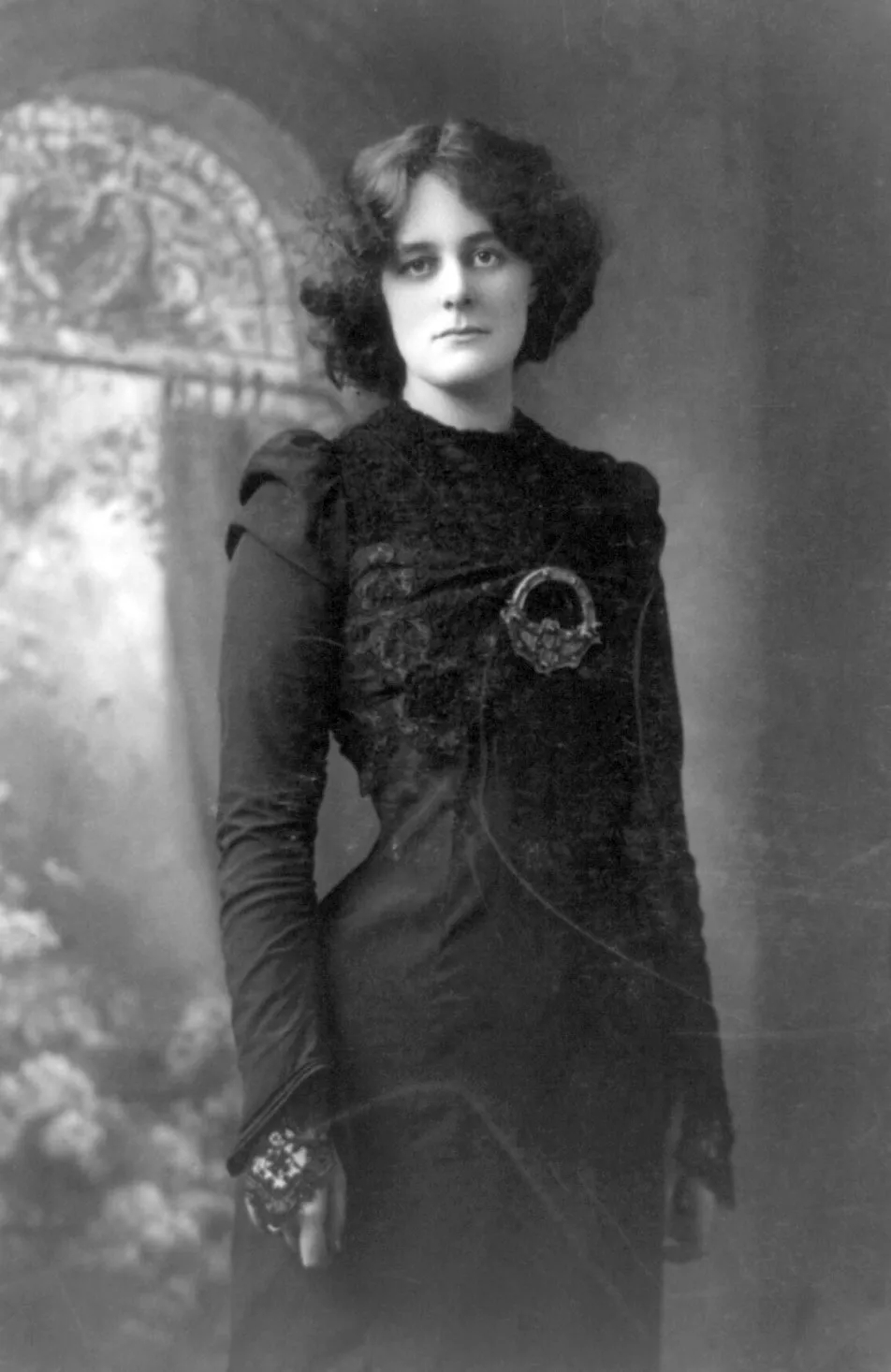
Edith Maud Gonne was born on 21 December 1866 at Tongham Manor, near Farnham, Surrey, the eldest daughter of Captain Thomas Gonne of the 17th Lancers and his wife Edith Frith Gonne, born Cook — both from solidly established English families with no Irish connection whatever. The future icon of Irish republicanism was, as the historian Margaret Ward put it, English on both sides and on all counts. Her claims later in life to Anglo-Irish ancestry were not well-founded; she was English, the daughter of an English officer in the British Army, and she was won over to Irish nationalism not by birth or blood but by what she saw with her own eyes during the Land Wars of the 1880s.
Her mother died of tuberculosis when Maud was still a young child — around the age of six — and she and her sister were sent to Paris to be educated in a boarding school for girls. She grew up between France and England, acquiring fluency in French and a cosmopolitan ease with European political life that would serve her well in the decades of agitation ahead. In 1882, her father was posted to Dublin as an assistant adjutant-general, and she accompanied him and served as his hostess at social functions, getting her first sustained exposure to Irish life at the upper reaches of the colonial establishment. When Captain Thomas Gonne died in 1886, Maud was nineteen years old and suddenly financially independent — a position of unusual freedom for a young woman of her class and era.
Conversion to Republicanism
The conversion came through direct experience rather than ideology. In 1887, visiting County Donegal, she witnessed the forced eviction of a family from their home by bailiffs acting on behalf of a landlord — an image of suffering and dispossession that she carried for the rest of her life as the foundation of her politics. She had by this point met Lucien Millevoye, a French journalist with strongly anti-British, nationalist sympathies who became her lover and political mentor. Through him she encountered the world of European radical politics and began to understand the Irish question within the framework of anti-colonial struggle rather than as merely a domestic British constitutional matter.
She began speaking at Land League meetings in Donegal and Mayo, organising relief for evicted families, building shelters for the homeless, and writing articles for nationalist publications. The combination of her extraordinary physical presence — she was tall, striking, widely described as the most beautiful woman in Ireland — and her gift for oratory made her immediately effective in the most immediate sense: she drew audiences, she moved them, and she directed their energy toward practical outcomes. She was threatened with arrest in connection with her Donegal activities and briefly returned to France. She became a founding and early figure in the amnesty movement for Irish political prisoners held in British jails, a cause she pursued through the 1890s with characteristic energy.
In 1889 she met William Butler Yeats at a party in London. He was twenty-three, an unknown young poet with large ambitions. She was twenty-two and already famous, or notorious, in certain circles. He fell in love with her instantly and completely, and the love was genuine enough to survive forty years of refusal. Yeats proposed to her at least four times — in 1891, 1894, 1899, and 1901 — and she declined every time. Her explanations varied: he was insufficiently committed to Irish republicanism; he was unwilling to convert to Catholicism; and, most revealingly, she told him that he would always be a better poet for being unhappy in love than a merely contented married man. The world should be grateful for her firmness, because the poetry Yeats wrote about Maud Gonne — "No Second Troy," "When You Are Old," "He Wishes for the Cloths of Heaven" — is among the greatest in the English language.
Inghinidhe na hÉireann: Ireland's Daughters
In April 1900, on the occasion of a planned visit to Ireland by Queen Victoria, Maud Gonne founded Inghinidhe na hÉireann — the Daughters of Ireland — as a direct counter to the British authorities' attempt to cultivate Irish loyalty through a children's patriotic party and free food distribution in the Phoenix Park. Gonne organised a rival patriotic children's picnic for the same day, distributing nationalist materials and Gaelic cultural resources rather than imperial goodwill. The founding meeting of Inghinidhe na hÉireann drew twenty-nine women, and the organisation rapidly became the most important women-led nationalist body in Ireland.
Inghinidhe na hÉireann was not merely a protest organisation. It offered educational classes in the Irish language, Gaelic history, music, and dance. It distributed free meals to poor children in Dublin, addressing the grinding poverty of the city's working class in practical terms rather than purely political ones. It published Bean na hÉireann — Woman of Ireland — from 1908 onwards, a nationalist feminist journal that gave a platform to women's political writing. It organised cultural events, theatrical performances, and public lectures. Gonne insisted that the organisation be exclusively for women, at a time when the main nationalist bodies were almost entirely male; she was not separating women from the struggle but insisting that women had an autonomous role within it that did not depend on the permission or direction of men.
In 1902, she played the title role in the first performance of Yeats's play Cathleen Ní Houlihan at the Abbey Theatre — the figure of the old woman of Ireland who calls young men to die for her freedom. The role was felt by the audience to be essentially autobiographical. Yeats later wrote that he wondered if the play had sent men out to die, and the question carried the implicit recognition that Maud Gonne's performance had been part of the political mobilisation that produced the Easter Rising fourteen years later.
John MacBride and the Boer War
In the winter of 1900, Maud Gonne met Major John MacBride at the Gare de Lyon in Paris. MacBride had led the Irish Transvaal Brigade — a unit of Irish and Irish-American volunteers who fought on the side of the Boer republics against the British Army in South Africa — and arrived in Paris with the reputation of a genuine soldier-hero of the anti-imperial cause. Gonne and MacBride were drawn together by shared politics and by the excitement of the transnational republican networks in Paris of which they were both part. They toured the United States together in 1901 and 1902, speaking at nationalist gatherings.
In February 1903, after declining Yeats's proposals for the last time, Maud Gonne married John MacBride in Paris. She converted to Catholicism before the marriage. Their son Seán MacBride was born in 1904. The marriage was disastrous. Gonne later accused MacBride of serious domestic violence and of the sexual molestation of her daughter Iseult from her relationship with Millevoye. The subsequent separation — not a legal divorce, given the Catholic context — was scandalous in nationalist circles and effectively marginalised Gonne from the centre of advanced politics for the next decade; she was hissed in the Abbey Theatre in 1906, four years after being rapturously received there. MacBride went on to take part in the Easter Rising of 1916, was captured, and was executed by firing squad in Kilmainham Gaol in May 1916, which transformed him into a martyr and gave Gonne a reflected political legitimacy she immediately deployed.
The Rising, Imprisonment, and Opposition to the Treaty
Maud Gonne was in France when the Easter Rising took place in April 1916. The execution of the Rising's leaders — including her estranged husband John MacBride — produced the wave of revulsion in nationalist Ireland that transformed a militarily unsuccessful revolt into a political watershed. Gonne returned to Dublin and threw herself back into the movement. In May 1918, in the wave of arrests that followed the so-called "German Plot" — a British intelligence operation of dubious substance that was used to justify detaining large numbers of nationalist activists — she was arrested and imprisoned in England for six months. Her health, always fragile, deteriorated severely in prison; she contracted a form of lung illness and was released when the British authorities judged that having Maud Gonne die in Holloway Prison would be more politically damaging than releasing her.
She returned to Ireland immediately, despite being forbidden from doing so. She was by 1918 deeply embedded in the human consequences of the conflict — working with the Irish White Cross to distribute funds to the victims of Black and Tan violence, advocating for republican prisoners, writing for nationalist publications. When the Anglo-Irish Treaty of 1921 produced the great split in the republican movement, Gonne sided firmly with the anti-Treaty position, consistent with her absolute republicanism and her rejection of anything that fell short of complete separation from Britain. She spent the Civil War years of 1922–1923 in Dublin, working with organisations that attempted to document and protest the conditions of anti-Treaty prisoners in the Free State's jails — a cause not unlike the one for which she had campaigned on behalf of British prisoners in the 1890s.
Later Life: The Long Witness
Maud Gonne lived for thirty years after the Civil War, and they were not quiet years. She remained vocal on the conditions of political prisoners, on the rights of women, and on what she regarded as the failures of the Free State — and subsequently the Republic — to live up to the ideals of 1916. She was a founding member of the Women's Peace Committee. She established lending libraries in remote rural areas. She continued to write journalism. She campaigned against capital punishment. She opposed what she saw as the Catholic Church's excessive influence over the Irish state, even though she remained a practicing Catholic herself. She was present at the formal establishment of the Republic of Ireland on Easter Monday 1949, one of the great nationalists invited to the ceremonies in Dublin — an eighty-two-year-old woman who had been fighting for that moment since before most of the dignitaries in the room were born.
Her son Seán MacBride became a distinguished international lawyer, a founder of Amnesty International, a Nobel Peace Prize laureate (1974), and a significant figure in Irish politics as leader of Clann na Poblachta and as a minister in the first inter-party government of 1948–1951. The son of the woman who refused to marry Yeats and the man executed after the Easter Rising became one of the most honoured humanitarians of the twentieth century — a trajectory that neither parent could have predicted from the ruins of their catastrophic marriage.
Maud Gonne died at Roebuck House, Dublin, on 27 April 1953, surrounded by her daughter Iseult, her son Seán, and Seán's wife. She was eighty-six years old. She was buried at Glasnevin Cemetery in Dublin, the burial ground of so many of the men and women whose cause she had served for sixty years.
Legacy: More Than a Muse
The standard way of introducing Maud Gonne in accounts of the Irish literary revival and the independence movement has been as Yeats's muse — as if her significance were derivative, located in the poetry she inspired rather than in the political work she did. This framing is both historically inaccurate and deeply unfair. She founded Ireland's first women-led nationalist organisation. She organised relief for the victims of eviction and famine across Connacht when the Land League was at its most embattled. She brought the Irish republican cause to European audiences through her work in Paris and her journalism in French. She was imprisoned for the republic. She opposed the Treaty. She spent thirty years in the independent Irish state criticising it for falling short of the ideals it claimed to represent.
The Yeats connection is, to be fair, genuinely extraordinary as a biographical fact. The love was real, it lasted decades, and the poetry it produced is among the finest in the English language. Gonne understood this better than her critics: she told Yeats that marriage would have been a dull affair and the world should thank her for refusing him. She was right that the unrequited love was more generative than the settled domestic life would have been. But she was also right, in the harder political sense, that she had a vocation that did not accommodate what Yeats wanted — which was, ultimately, a beautiful woman to love and be loved by, rather than a comrade in a cause that was indifferent to poetry. Maud Gonne chose the cause. She chose it every time he asked her, and she chose it for sixty years after the last time she said no. That is her real legacy: not the muse of a poet, but the architect of a women's nationalism, the voice of the evicted and the imprisoned, and the most formidable woman in the history of the Irish republican movement.