At a Glance
From the Print Shop to the Underground
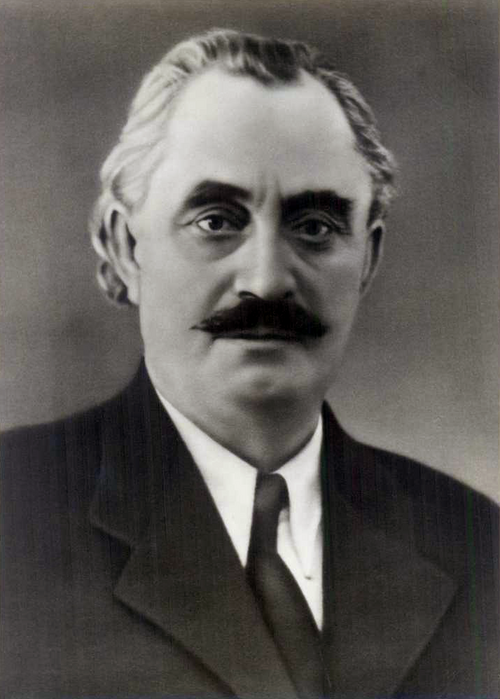
Georgi Dimitrov was born in 1882 in Kovachevtsi, a small town in western Bulgaria, the fourth of eight children of a craftsman family. His father was a fireman and part-time preacher; his mother a devout woman whose character — stubborn, dignified, unwilling to bend — her son would inherit and deploy in circumstances she could not have imagined. The family was not politically radical, but it was poor enough that the young Georgi entered the labour force early, becoming a typographer's apprentice and then a qualified printer — a trade that brought him, as it brought so many workers of his generation across Europe, into contact with the world of socialist ideas that were circulating in the print shops and workers' clubs of the period.
He joined the Bulgarian Workers' Social Democratic Party in 1902, at the age of twenty, and quickly demonstrated the qualities that would define his career: absolute personal fearlessness, an exceptional capacity for organisation, and an instinct for the dramatic gesture that could shift public opinion in ways that patient organisation alone could not. He was arrested repeatedly in the years before the First World War for labour agitation, surviving imprisonment and exile with a composure that became legendary among his comrades. He was elected to the Bulgarian National Assembly in 1913 — part of the socialist bloc that opposed the Balkan Wars and their human costs — and used his parliamentary platform as an organising tool rather than as an end in itself.
After the war, as the Bulgarian Communist Party (BCP) — the successor to the left wing of the Social Democrats — navigated the tumultuous aftermath of defeat and revolution, Dimitrov was among the most militant voices within it. He was involved in the preparation of the September 1923 uprising that the BCP launched in response to the coup against Stamboliyski — an uprising that was crushed with considerable bloodshed, sending Dimitrov into exile and underground work across Europe for the next decade.
Underground Europe and the Road to Leipzig
The years between 1923 and 1933 were a decade of clandestine political work — the kind of life that requires constant movement, false identities, safe houses, and the ability to read a room quickly enough to know when to talk and when to disappear. Dimitrov operated across Central Europe on behalf of the Comintern, the Moscow-based organisation that coordinated communist parties internationally. He was based in Vienna for a period, then in Berlin, working under cover in the increasingly dangerous political environment of the late Weimar Republic as the Nazi movement gathered force and the German left fractured in the face of it.
He was in Berlin when the Reichstag — the German parliament — burned on the night of 27 February 1933, four weeks after Hitler's appointment as Chancellor. The fire was immediately seized upon by the Nazi government as evidence of a communist conspiracy, and used to justify emergency decrees that effectively suspended civil liberties in Germany and enabled mass arrests of communists, socialists, and political opponents. Dimitrov, along with three other Bulgarian communists and a young Dutch communist named Marinus van der Lubbe — who almost certainly set the fire alone, on his own initiative — was arrested and charged with arson and treason.
The charges against Dimitrov were transparently political. He had no credible connection to the fire, and the Nazi government's case against him rested on assertions rather than evidence. But the trial, which opened in Leipzig in September 1933, was not a forum where the quality of the evidence was expected to matter — it was intended as a political show that would justify the regime's actions and destroy its opponents. What happened instead was something that shook the world.
The Leipzig Trial: A Prisoner Who Prosecuted His Prosecutors
Dimitrov chose to defend himself — a decision that transformed the proceedings entirely. Speaking in German that was learned but fluent and completely confident, he cross-examined witnesses, challenged the prosecution's evidence point by point, and repeatedly forced the presiding judges to intervene to prevent him from making arguments that were simply too effective to allow. His manner in the dock was the opposite of what the Nazis had expected: not cringing, not defensive, not broken by weeks of imprisonment, but combative, dignified, and capable of a mordant wit that made the court proceedings occasionally read like political satire.
The confrontation with Hermann Göring — the President of the Reichstag and one of the most powerful men in Germany — was the centrepiece of the trial's drama. Göring had been summoned as a witness, expecting to deliver a prepared statement that would settle the matter. Instead he found himself being cross-examined by his own prisoner, who calmly dissected his testimony, exposed its contradictions, and refused to be intimidated by threats. When Göring finally lost his temper and shouted that he would have Dimitrov taken out and beaten, the moment was recorded and reported around the world. The prisoner had made the minister look ridiculous.
"I am defending myself, a Communist, before this Fascist Court. But I am defending my Communist honour, my dignity, my Communist convictions, and my Communist ideology. I am defending the substance and content of my whole life."
The court acquitted Dimitrov and the other Bulgarian defendants on 23 December 1933 — it had no choice, given the complete absence of credible evidence against them. Van der Lubbe was convicted and executed. Dimitrov, now the most famous communist in the world, was taken from the court, granted Soviet citizenship by Stalin's government, and flew to Moscow — where he was received as a hero of anti-fascism at a moment when the left desperately needed such figures.
The Comintern and the Popular Front
In Moscow, Dimitrov's political authority was enormous — the Leipzig trial had given him a moral credibility that no amount of party-political maneuvering could manufacture. Stalin, who was not in the habit of sharing power, recognised that Dimitrov's international stature made him useful in ways that a more conventional apparatchik would not be, and appointed him head of the Communist International in 1934, a position he formally assumed after the Seventh World Congress of the Comintern in 1935.
It was at that Congress that Dimitrov delivered the report that became the theoretical foundation of the Popular Front strategy — the decisive shift in Comintern policy away from the sectarianism that had characterised the early 1930s (when socialists had been denounced as "social fascists" worse than actual fascists) and toward a broad coalition of all forces willing to resist fascism, regardless of their other political differences. The Popular Front approach was adopted across Europe: in France it brought the left to power in 1936; in Spain it created the government that the Franco coup attempted to overthrow. It was arguably the most significant strategic contribution that any communist leader of the period made to the left's response to fascism — and it came from the man who had learned firsthand, in a Leipzig courtroom, what fascism was capable of.
He led the Comintern through the most difficult years of the Stalin era — a period in which the organisation was simultaneously the primary vehicle of anti-fascist coordination internationally and the instrument of Soviet foreign policy, with all the tensions and contradictions that entailed. He navigated the purges that decimated the Comintern's membership in the late 1930s, when thousands of communist emigres in Moscow — many of them Bulgarians — were arrested, shot, or sent to the camps. How much he could have done to protect them, and how much he was complicit in the system that destroyed them, are questions that Bulgarian historians continue to debate.
Return to Bulgaria and the Final Years
When the Red Army entered Bulgaria in September 1944 and the Fatherland Front — the communist-led coalition — took power in Sofia, Dimitrov was still in Moscow, weakened by the tuberculosis that would eventually kill him. He returned to Bulgaria in November 1945, to scenes of mass celebration, and took formal control of the Bulgarian Communist Party's government. He served as Prime Minister from 1946 until shortly before his death in 1949, overseeing the consolidation of communist power — the elimination of political opposition, the collectivisation of agriculture, the nationalisation of industry — with the combination of ideological conviction and ruthless pragmatism that had characterised his career.
His most interesting political initiative in the final years was also his most dangerous one: the proposal for a Balkan federation that would have united Bulgaria and Yugoslavia in a single political entity, potentially serving as the nucleus of a broader regional federation. The idea had deep roots in the Balkan left, and both Dimitrov and Yugoslav leader Tito discussed it enthusiastically. Stalin killed it — firmly and without appeal — in early 1948, recognising that a strong, unified Balkan communist state would be harder to control than two separate ones. The episode illustrated both the genuine vision that Dimitrov retained beneath his Stalinist exterior and the absolute limits that Moscow placed on satellite state autonomy.
He died in a Soviet sanatorium on 2 July 1949, officially of liver failure — though his death, like that of several Eastern European communist leaders of the period, occurred in circumstances that subsequent historians have found suspicious. He was 67 years old. His embalmed body was placed in a mausoleum in Sofia — Bulgaria's equivalent of Lenin's tomb — where it remained until 1990, when the post-communist government had it buried in the normal way, a gesture of de-Stalinisation that also quietly acknowledged how much of his legacy had been built on terror as well as heroism.
The heroism, however, was real. The man who had stood in a Leipzig courtroom in 1933, with no resources but his intelligence and his nerve, and had refused to be broken by the most powerful fascist state in Europe — that man existed, and what he did mattered. In the darkest period of the European twentieth century, he demonstrated that individuals could resist totalitarian power through courage and wit, and that sometimes — not always, but sometimes — they could win.