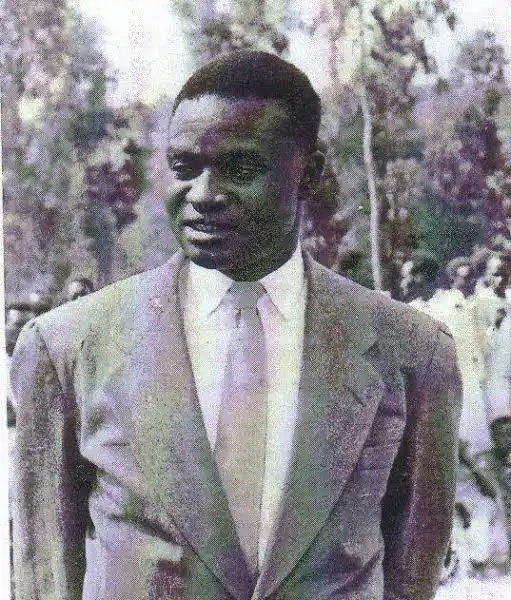
The Man at the Hinge of Rwandan History
On 1 November 1959 — All Saints' Day — a rumour tore through the hills of Gitarama with the speed and force of fire in dry season grass: Dominique Mbonyumutwa, a Hutu sub-chief and leading organiser of the newly formed MDR-Parmehutu movement, had been beaten to death by Tutsi youths loyal to the royalist UNAR party. The rumour was false. Mbonyumutwa had been attacked and injured — genuinely assaulted by a group of UNAR militants who had stopped his vehicle on a rural road — but he was alive. He would recover.
What did not recover was the old Rwanda. Within hours of the rumour spreading, Hutu communities were attacking Tutsi homes, burning the compounds that had symbolised pastoral wealth and social hierarchy for generations, and driving Tutsi notables from the administrative positions they had occupied under Belgian patronage. By the time Belgian colonial troops restored a semblance of order, the political landscape of Rwanda had been transformed permanently. The events of November 1959 — known in Rwandan as the muyaga, the wind — ended the Tutsi monarchy and made Hutu majority rule the political fact that independence, when it came in 1962, would simply formalise.
Dominique Mbonyumutwa did not plan the revolution. He was its catalyst, not its architect — the specific body whose reported fate became the spark that lit a society already primed to burn. But in the years that followed, he navigated the transition from colonial sub-chief to independence politician with the pragmatism of a man who understood that historical moments, once they arrive, must be seized or they pass forever. He seized his.
Colonial Formation: A Hutu Who Climbed
Mbonyumutwa was born around 1927 in Ndiza, in the Gitarama prefecture of central Rwanda — a region that would become the heartland of Hutu political organisation and that produced, in the same generation, the writers and organisers of the Bahutu Manifesto. He was born Hutu in a society where that word, as the Belgian colonial administration had institutionalised it by the 1930s, meant cultivator, subject, inferior. The Tutsi held cattle, held administrative appointments, and held power. The Hutu tilled the soil and obeyed. The identity card made this permanent and legible to anyone who needed to know which category a person occupied.
His intelligence and application won him a foothold in the colonial system that most Hutu could not reach: appointment as a sub-chief. This placed him within the administrative hierarchy — a position of genuine local authority — while simultaneously making clear the ceiling that ethnicity imposed. He observed, at close range and with the particular clarity of someone just below the line, how the colonial system operated: how Tutsi chiefs maintained power with Belgian backing, how the mechanisms of extraction and obedience were organised, and what it would take to change them.
By the late 1950s, change was in the air across sub-Saharan Africa. Ghana had achieved independence under Nkrumah in 1957. The Belgian Congo was moving toward independence that would arrive in 1960. In Rwanda, the Bahutu Manifesto of 1957 had articulated for the first time in systematic political language the demand for Hutu majority rights and an end to the racial caste system. MDR-Parmehutu was founded in 1958 with Grégoire Kayibanda as its intellectual leader. Mbonyumutwa was among its primary organisers in the Gitarama area — the man who built the local networks that would transform political consciousness into mass action.
November 1959: The Attack, the Rumour, the Revolution
The attack on Mbonyumutwa on 1 November 1959 was real. A group of UNAR-affiliated Tutsi youths stopped his vehicle on a rural road in Gitarama, pulled him out, and beat him. He required medical attention. He was shaken but not mortally injured. The rumour of his death that spread from this incident — whether deliberately fabricated by MDR-Parmehutu organisers seeking a pretext for action, spontaneously distorted in transmission through a society with no reliable communications infrastructure, or some combination of both — spread faster than any correction could follow it.
By nightfall, the hills were burning. Hutu communities across central Rwanda attacked Tutsi homes and compounds. The violence was not random — it followed the precise geography of resentment that the colonial caste system had built: who had cattle, who had administrative positions, who had demanded labour without payment, who had enforced the uburetwa system of obligatory service. The Belgian colonial administration, its soldiers outnumbered and its political analysis in tatters, eventually restored order — but drew the only conclusion the events permitted: the revolution was irreversible.
The Belgians systematically replaced Tutsi chiefs with Hutu counterparts across the country. UNAR, the royalist party, was sidelined. The Tutsi monarchy — the mwami Kigeli V — found itself politically isolated. The path to a Hutu-dominated independence was opened by what happened on those November hills, and the body at the centre of it was Dominique Mbonyumutwa's.
The Gitarama Coup: First Head of State
In January 1961, the revolution produced its most audacious single act. At a gathering of communal councillors at Gitarama — Mbonyumutwa's home territory — local leaders from across Rwanda assembled, declared the monarchy abolished, proclaimed Rwanda a republic, and named Dominique Mbonyumutwa as head of the provisional government. The whole thing was illegal by colonial law. The Belgians had not authorised it. The United Nations had not been consulted.
It was also effective. Belgium, facing international pressure to decolonise and confronted with the political reality that the monarchist alternative to MDR-Parmehutu had collapsed, accepted the fait accompli. Mbonyumutwa served as Rwanda's first transitional head of state — the man who occupied the position between the old monarchical order and the fully independent republic that would be proclaimed on 1 July 1962. He was not the most intellectual figure of the Hutu nationalist movement — that was Kayibanda, who was elected Rwanda's first permanent president in 1962 — but he was the most politically symbolic: the man in whose name, literally, the revolution had erupted.
He served subsequently in the National Assembly and in various governmental capacities through the Kayibanda years and into the Habyarimana period, a respected but secondary figure, the founding catalyst who had found his moment and occupied it fully without ever pretending to be more than he was.
Legacy: What the Revolution Cost
Mbonyumutwa lived long enough to see the full arc of what November 1959 set in motion — and that arc, seen whole, is one of the most tragic in modern African history. The Social Revolution he catalysed was, from one perspective, genuine liberation: the overturning of a feudal-colonial order that had denied the Hutu majority political existence for generations. The Bahutu Manifesto's demand that the majority govern itself was not unreasonable; it was, in the language of the United Nations and of democratic theory generally, straightforwardly just.
From another perspective — and this perspective cannot be avoided — the revolution produced and entrenched a politics of ethnic exclusion that drove between 150,000 and 200,000 Tutsi into exile in the early 1960s, killed thousands in the pogroms of 1963–64, and created the exile community whose children — returning as the Rwandan Patriotic Front in 1990 — would trigger the four-year civil war that culminated in the genocide of 1994. The genocide of April–July 1994 killed between 500,000 and 800,000 people in one hundred days. It was the catastrophic terminus of a political logic that the 1959 revolution began.
Mbonyumutwa died in 2003. He had survived the Kayibanda years, the Habyarimana coup, the genocide itself, and nine years of post-genocide Rwanda. He was the last man standing from the core of the 1959 generation. He died having seen what the rumour of his death had ultimately produced — and carrying, presumably, the full and impossible weight of that knowledge.
Further Reading
- Mahmood Mamdani, When Victims Become Killers: Colonialism, Nativism, and the Genocide in Rwanda (2001)
- René Lemarchand, Rwanda and Burundi (1970)
- Alison Des Forges, Leave None to Tell the Story, Human Rights Watch (1999)
- Philip Gourevitch, We Wish to Inform You That Tomorrow We Will Be Killed with Our Families (1998)
- Gérard Prunier, The Rwanda Crisis: History of a Genocide (1995)