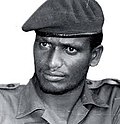
The General Who Gave Everything Before the War Was a Day Old
On 1 October 1990, Major General Fred Rwigyema led approximately four thousand Rwandan exile fighters across the border from Uganda into the Kagitumba sector of northern Rwanda. It was the beginning of the military campaign the Rwandan Patriotic Front had been preparing for years — the armed attempt to end the exile of the hundreds of thousands of Tutsi expelled from Rwanda since the Social Revolution of 1959 and the subsequent waves of organised violence that had driven them out in successive surges across three decades.
Fred Rwigyema had spent those years building this force. He had recruited, trained, and commanded its core within the Ugandan army, simultaneously preparing it — in secrecy, in patience, in the absolute conviction that the moment of return would come — for the day he led it home. He was the reason the RPF existed as a functioning military organisation capable of sustained operations. He was the reason it crossed the border with coherence and purpose rather than as a ragged exile army running on grievance alone.
He was killed on 2 October 1990. The second day of the campaign. He was thirty-two or thirty-three years old. The liberation he had spent his adult life preparing did not end with his death — it continued for four more years, under Paul Kagame's command, until the RPF's military victory in July 1994 ended the genocide and placed the organisation in power. But that victory was prosecuted in his name and with the military foundation he had built. Fred Rwigyema is the man the RPF's success rested on. He did not live to see a single day of it.
Exile and the Making of a Soldier
Rwigyema was born in 1957 in Rwanda. His family fled to Uganda as the violence of the 1959 revolution and the early 1960s displacement swept through the country, making them part of the first great wave of Rwandan Tutsi refugees who settled in the camps and margins of southern Uganda — people who had lost everything and who maintained, across a generation, the conviction that return was not merely desirable but obligatory.
Growing up in Ugandan refugee camps formed him in the way that only genuine dispossession can form a person: with a clarity about what matters, an absence of illusions about the goodwill of states toward those they have expelled, and a practical intelligence sharpened by the daily necessity of surviving in circumstances that were not designed for survival. He was educationally capable — those who knew him consistently described a sharp, quick mind — but the education that defined him was political and military rather than academic.
When Yoweri Museveni launched his National Resistance Army bush war against the Obote government in 1981, Rwigyema was among the Banyarwanda — Rwandan Tutsi exiles — who joined it. The reasons were several: genuine commitment to Museveni's liberation politics, gratitude to Uganda as a host country, and the entirely clear-eyed understanding that military training and combat experience were the tools that would eventually enable a return to Rwanda. He joined a liberation army because he intended to lead one.
He rose within the NRA with exceptional speed. He was among Museveni's most trusted battlefield commanders during the bush war — brave, tactically adept, and possessed of the personal authority that makes soldiers follow without needing to be ordered. When the NRA captured Kampala in January 1986 and Museveni became president, Rwigyema's reward was commensurate with his contribution: he was appointed Deputy Commander of the Uganda People's Defence Force, the national army, and later Deputy Minister of Defence. These were not honorary positions. He held real military authority over a national armed force while simultaneously, and in careful parallel, building the Rwandan Patriotic Front toward the day it would cross the border he had been denied all his life.
Building the RPF: A Decade of Preparation
The Rwandan Patriotic Front was founded in 1987, with Rwigyema as its dominant military figure and Paul Kagame — his closest comrade from the NRA years — alongside him. The organisation drew its membership primarily from the Banyarwanda exile community in Uganda: men who had served in the NRA and whose military training was now to be redirected toward Rwanda, and educated exiles in Uganda, Europe, and North America who provided political and financial support.
The preparation was patient and meticulous. Rwigyema's years as Uganda's deputy military commander gave him access to weapons, logistics, training facilities, and the command experience that a guerrilla force needs to operate as something more than an irregular band. He developed the RPF's military doctrine — built around mobility, political consciousness among fighters, strict discipline regarding civilian populations, and the strategic clarity that distinguished the RPF from the exile armies that had previously attempted incursions into Rwanda and been routed.
His soldiers loved him with a personal intensity that is rare even among charismatic military leaders. Those who served under him described a man who shared the hardships of the field without complaint, who knew the names and situations of fighters far below his rank, who communicated the purpose of what they were doing with a directness that made abstract political goals feel immediately personal. Paul Kagame, who would lead the RPF after his death, has spoken of Rwigyema with a reverence that places him in a category apart from any other figure in the movement's history.
1 October 1990: The Invasion
The decision to launch in October 1990 was made against multiple pressures. Uganda, facing donor pressure to reduce its Banyarwanda military presence, was signalling that the window for RPF use of Ugandan territory as a staging ground was closing. Habyarimana's Rwanda, simultaneously under international pressure to democratise, appeared momentarily vulnerable. The RPF had reached a level of military readiness that Rwigyema judged sufficient. He gave the order.
The RPF crossed the border at Kagitumba in the northeast on 1 October. The initial engagements went well — better than Rwandan government forces had anticipated. The RPF fighters moved south with purpose and discipline, demonstrating in the first hours of combat the training and cohesion that years of preparation had produced. Rwigyema commanded from the front, as had always been his practice — the practice of a man who had learned his soldiering in the NRA's culture where commanders led by visible presence rather than from behind the line.
On 2 October he was dead. The precise circumstances — whether he was struck by Rwandan government fire in a conventional engagement, by a stray round, or in circumstances more deliberately arranged — have never been conclusively established. Multiple accounts exist; none has achieved the authority of a definitive historical record. He was buried in Rwanda, on the ground he had fought forty-eight hours to reach, by the soldiers who had followed him across the border two days before.
The RPF regrouped under Peter Bayingana — who was also killed within days — and then under Paul Kagame, who cut short his military training at Fort Leavenworth to return and take command. The war that Rwigyema launched continued for four years. It ended, in July 1994, with the RPF's capture of Kigali and the termination of the genocide that had killed between half a million and a million people in the hundred days preceding it.
Legacy: The Hero Rwanda Built Its State Around
Post-genocide Rwanda has elevated Fred Rwigyema to national hero status with an intensity that reflects both genuine reverence and the political utility of a martyr who died before any of the complexities of governance attached to him. His image appears on Rwandan currency. October 1st is Umuganura — Heroes' Day — honouring him specifically. The Rwigyema Military College trains Rwanda's officer corps. Streets, schools, and public buildings bear his name across the country.
The political use of his memory has occasionally complicated the historical record — in a Rwanda where the RPF's narrative is the official narrative, and where questioning that narrative carries legal risk, the full circumstances of his death and the internal politics of the RPF's early years cannot be freely examined within the country. But the essential facts of his achievement are not in dispute and do not require the protection of censorship.
He built a coherent fighting force from an exile community with no state, no territory, and no resources beyond the military experience its members had accumulated in someone else's army. He did it over a decade, with patience and precision, while simultaneously holding a senior position in the Ugandan armed forces that required its own full attention. He led that force into battle on the day he had planned for, and he died on its second day.
In the tradition of the African liberation commanders who died before their movements prevailed — Amílcar Cabral of Guinea-Bissau, assassinated in 1973 before independence; Eduardo Mondlane of Mozambique, killed in 1969 before FRELIMO's victory — Rwigyema occupies the particular tragic position of the founder who built the instrument but never played it. The Rwanda that exists today — whatever its contradictions and its ongoing political contests — was made possible by what he created. He belongs among the defining liberation figures of twentieth-century Africa, and his absence from that canon in most international tellings of the story reflects little more than the world's habitual indifference to everything that happens in the Great Lakes region until it becomes impossible to ignore.
Further Reading
- Gérard Prunier, The Rwanda Crisis: History of a Genocide (1995)
- Roméo Dallaire, Shake Hands with the Devil: The Failure of Humanity in Rwanda (2003)
- Philip Gourevitch, We Wish to Inform You That Tomorrow We Will Be Killed with Our Families (1998)
- Mahmood Mamdani, When Victims Become Killers: Colonialism, Nativism, and the Genocide in Rwanda (2001)
- Michela Wrong, Do Not Disturb: The Story of a Political Murder and an African Regime Gone Bad (2021)