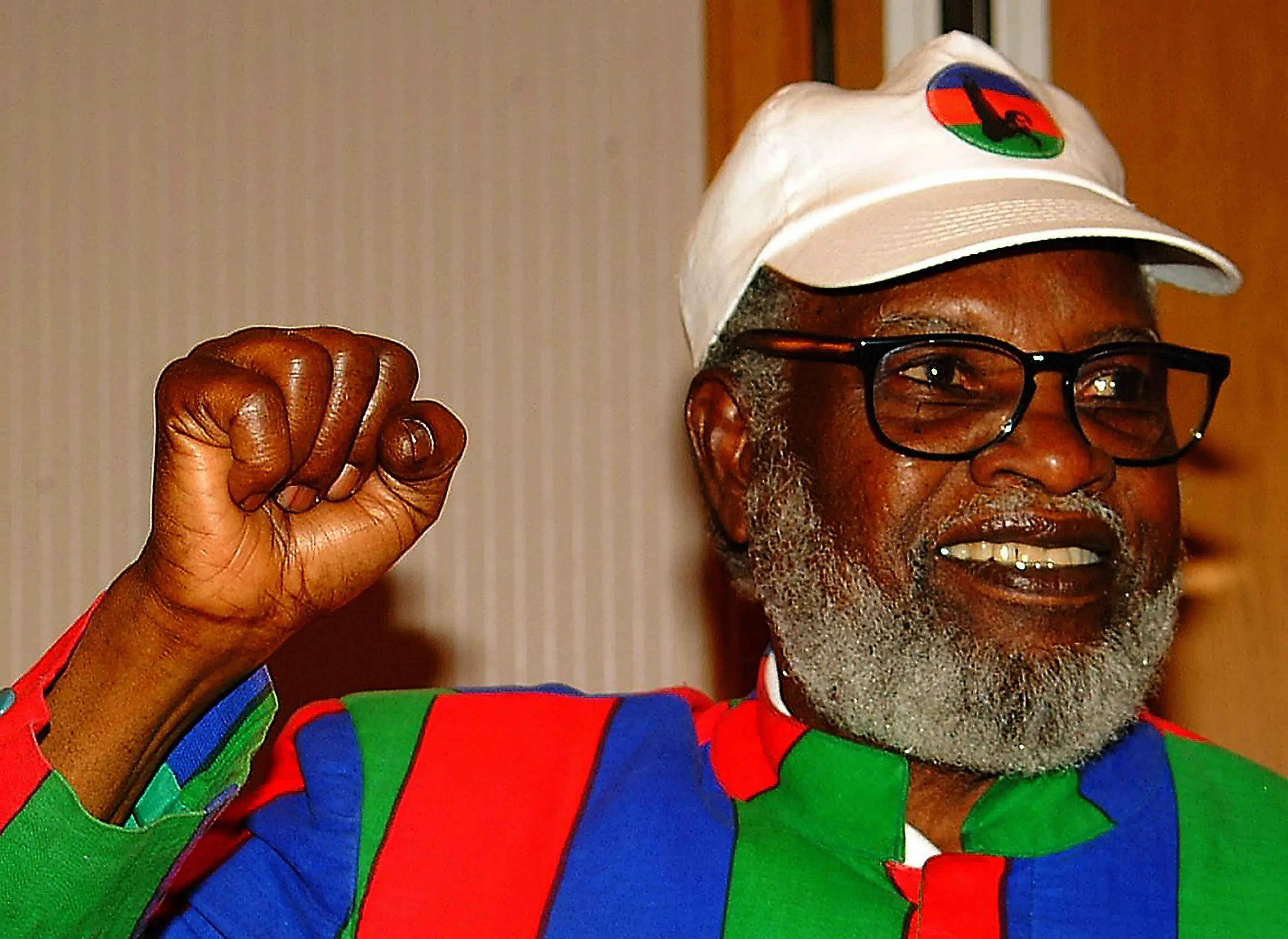
Ongandjera: A Childhood Under Colonial Rule
Samuel Daniel Shafiishuna Nujoma was born on 12 May 1929 in Ongandjera, in the Omusati region of Ovamboland — the same broad territory that had produced Peter Nanyemba, the future PLAN commander, and that would furnish the overwhelming majority of SWAPO's founding generation. His father was a subsistence farmer; his early years were shaped by the rhythms of Ovambo agricultural life and by the institutions — the Finnish Lutheran Mission school, the community structures of the Kwanyama — that mediated between traditional life and the impositions of colonial administration.
Nujoma attended Oshigambo Mission School, acquiring the literacy and basic education that the colonial system permitted to Black Namibian children at the lowest levels while systematically denying them access to anything more ambitious. He left school in his early teens — the education system offered nothing further to a Black Ovambo boy in 1940s South West Africa — and entered the colonial labour economy, eventually finding work with the South African Railways in Windhoek. It was in Windhoek, working as a railway clerk, that Nujoma's political consciousness crystallised into something beyond private grievance — into the conviction that the colonial system was not a natural condition but a constructed one, and that constructed conditions can be dismantled by the people they were constructed to contain.
Windhoek in the 1950s was a city of stark racial division — apartheid legislation was being extended from South Africa to the territory with increasing rigour, and its effects were visible and daily in everything from park benches to job categories. Nujoma was not the only railway worker who was politically radicalising in this environment, but he was among those who moved most decisively from radicalisation to organisation.
The Ovamboland People's Organisation
In 1958, Nujoma co-founded the Ovamboland People's Organisation (OPO) — a body that initially addressed the specific grievances of Ovambo contract workers in Windhoek, particularly around the contract labour system that was the most direct instrument of their economic subjugation. The OPO was the organisational embryo from which SWAPO would be born, and its founding reflected both the practical experience of the contract labour system's victims and the broader political awareness that Nujoma and his co-founders had been developing.
Nujoma travelled to New York in 1959 to petition the United Nations on behalf of Namibian workers and communities — the first time he appeared on the international stage that would define so much of his subsequent career. The petition process introduced him to the mechanics of international diplomacy: the protocols, the relationships, the patient cultivation of allies in delegations from dozens of countries, and the specific rhetorical registers that made arguments effective in multilateral forums. He was a quick study. His subsequent thirty years of exile diplomacy rested on a foundation of competence in this arena that he began building in his first UN visit.
In 1960, he helped transform the OPO into the South West Africa People's Organisation — SWAPO — broadening its claimed constituency from Ovambo workers to all Namibians and broadening its political goal from labour reform to full independence. He was elected its first president. He was thirty-one years old. He would hold that position for the next sixty years.
"Namibia is not a political slogan. It is the name of our country, and we will take it back — by every means available to us, for as long as it takes, with whatever we have."
— Sam Nujoma, SWAPO founding address, 1960Three Decades in Exile: The Long Revolution
Nujoma went into exile in 1960 — forced out of Namibia by the South African authorities who could see clearly enough that the organisation he had founded posed a threat to the colonial order they administered. He would not return to Namibia as a free man for thirty years. The exile that began in 1960 took him across the African continent and beyond: Tanzania, Zambia, Egypt, Ethiopia, and eventually to Lusaka and Luanda as SWAPO's operational centres shifted with the political geography of the liberation struggle.
The three decades of exile were not a single experience but a succession of distinct phases. The early 1960s were years of organisation-building and diplomatic cultivation — establishing SWAPO's presence in the growing network of newly independent African states, seeking recognition from the Organisation of African Unity and from sympathetic governments, and beginning to argue the Namibian case in the United Nations with the credibility that came from representing a real organisation with real members inside the territory.
The mid-1960s brought the decision for armed struggle. Nujoma was part of the leadership that authorised PLAN's first military operation in 1966, and he remained the political authority behind the armed campaign for the next two decades. He was not a guerrilla commander in the field — his role was political leadership and external diplomacy — but the military campaign was conducted in his name and under his overall political direction, and the decision to sustain it through years of setback and sacrifice was ultimately his to make and keep making.
The 1970s saw SWAPO's international standing increase dramatically. The UN General Assembly recognised SWAPO as the sole and authentic representative of the Namibian people in 1973 — a recognition that gave the movement a diplomatic standing it had been building toward for over a decade. The collapse of Portuguese colonialism in 1974–75 and the independence of Angola and Mozambique transformed the regional strategic environment: SWAPO now had a sympathetic government in Angola willing to host its military headquarters and support its operations. The combination of PLAN's military campaign and SWAPO's diplomatic isolation of South Africa at the UN created the two-front pressure that would eventually produce the 1988 settlement.
The International Campaign: Every Capital, Every Forum
No account of Sam Nujoma's liberation career can do justice to the sheer volume of diplomatic work it required. He appeared before the UN General Assembly on multiple occasions. He cultivated relationships with heads of state across the African continent, the Non-Aligned Movement, the Soviet bloc, the Nordic countries, and eventually with sympathetic voices in the Western democracies that were simultaneously Namibia's most important potential allies and South Africa's most important trade and investment partners. He sat in the waiting rooms of foreign ministries in capitals across four continents, made arguments that were sometimes heard and often ignored, built relationships through years of patient engagement that would yield results only decades later.
The Nordic relationship was particularly important. Sweden, Norway, Finland, and Denmark provided not only diplomatic support — voting consistently with SWAPO in international forums — but substantial material support: funding for SWAPO's educational and welfare programmes, scholarships for Namibian students, and the kind of sustained civil society solidarity that complemented the official governmental support. Nujoma was a regular presence in Stockholm and Oslo, and the relationship he built with Nordic social democratic governments and with the international solidarity organisations they supported was one of the more durable and productive of the exile period.
He also cultivated relationships with Cuba, the Soviet Union, and China — accepting weapons, training, and logistical support from all three while maintaining, to the extent possible, SWAPO's formal non-alignment. The Cold War context made this balancing act inherently unstable: Western governments tended to view SWAPO's Soviet and Cuban connections as evidence of communist orientation, and South Africa exploited this perception relentlessly in its lobbying of Washington, London, and Bonn. Nujoma's consistent answer was that SWAPO accepted support from wherever it was offered because the cause demanded it, and that the political destination — democratic, non-racial, independent Namibia — was clear and not dependent on any external sponsor.
The Kassinga Massacre and the Cost of Occupation
On 4 May 1978, South African paratroopers attacked Kassinga — a SWAPO refugee settlement in southern Angola that housed hundreds of Namibian civilians, predominantly women, children, and elderly people who had fled the territory. The attack killed more than 600 people and wounded hundreds more. South Africa described it as a strike on a PLAN military base. Survivors and independent investigators documented it as a massacre of a refugee community. Kassinga became the defining atrocity of the South African occupation in SWAPO's collective memory, and Nujoma used it relentlessly and effectively in the international argument: this was the face of the colonialism that the world was being asked to tolerate.
The massacre did not break SWAPO. Nujoma's response was what it had always been in the face of South African violence: to continue. To rebuild. To restate the case with greater urgency and to press the international community to translate its formal positions — the UN resolutions declaring South Africa's presence in Namibia illegal, the sanctions regime, the diplomatic isolation — into the actual pressure that would produce change.
"They killed our children at Kassinga to frighten us into silence. They did not understand what we had already decided: that silence was the one thing we would never give them."
— Sam Nujoma, address to the UN General Assembly, 1978The Settlement and the Return
The 1988 New York Accords — signed by South Africa, Angola, and Cuba, with the United States and Soviet Union as mediators — finally set in motion the implementation of UN Security Council Resolution 435. South Africa would withdraw from Angola, Cuban troops would leave, and Namibia would move to internationally supervised elections under a UN transitional authority. The process was slow and fraught — South Africa exploited every procedural mechanism available to delay and complicate it — but it was irreversible.
On 12 September 1989, Sam Nujoma returned to Namibia after twenty-nine years in exile. The scenes at Windhoek airport — tens of thousands of people gathered to receive the man who had given three decades of his life to making this moment possible — were among the most charged of the entire southern African liberation era. He had left as a wanted man; he returned as the presumptive president of a nation on the threshold of its birth.
SWAPO won the November 1989 elections with 57 percent of the vote — a decisive majority that fell just short of the two-thirds required to write the constitution alone, which meant that the founding document of independent Namibia was negotiated rather than dictated. The constitution that emerged was widely praised as one of the most progressive in Africa: a Bill of Rights, an independent judiciary, term limits on the presidency, and explicit protections for gender equality and freedom of expression.
Fifteen Years as President: 1990–2005
Sam Nujoma was inaugurated as Namibia's first president on 21 March 1990. He governed for fifteen years across three terms — the third term made possible by a constitutional amendment that his critics argued was inconsistent with the democratic spirit of the document he had presided over creating. The amendment was legal; its wisdom was debated fiercely.
His presidency oversaw the consolidation of Namibian democracy and the construction of state institutions from the ground up. The civil service had to be Namibianised — gradually replacing the apartheid-era white bureaucracy with Namibian citizens, most of them returning from exile, who had the political commitment but often lacked the administrative experience that effective government requires. The economy had to be restructured away from its colonial configuration — centred on mineral extraction for South African capital — toward something that served the whole population.
Land reform was the most politically explosive domestic issue. Namibia's land ownership patterns at independence were among the most unequal in Africa — a consequence of German and South African colonial dispossession. Nujoma favoured land redistribution and pursued it through a willing-seller, willing-buyer model that critics from both left and right found unsatisfying: too slow and too respectful of colonial title for those who demanded radical redistribution, too radical and too threatening to property rights for those invested in the colonial settlement's economic outcomes.
His foreign policy reflected the liberation movement's solidarities. He was a committed supporter of Robert Mugabe's Zimbabwe even as the land seizures there produced economic catastrophe — a loyalty to a liberation-era comrade that critics argued placed ideological solidarity above pragmatic assessment. He supported the DRC intervention in 1998, deploying Namibian troops to support Laurent-Désiré Kabila's government against rebel forces backed by Rwanda and Uganda — a decision that was controversial domestically and internationally but that reflected his consistent commitment to the principle that African states had the right to defend themselves and each other against externally supported destabilisation.
The Succession and the Authoritarian Tendency
Nujoma's relationship with democratic norms was more complicated than the celebrated liberation leader's reputation suggested. The third-term constitutional amendment, the treatment of political opponents who challenged SWAPO's dominance, the sometimes brutal rhetoric directed at homosexual Namibians — these were aspects of his presidency that sat uncomfortably alongside the democratic constitution he had championed. They reflected a broader pattern in liberation movement politics: the difficulty of translating the organisational culture of a movement built on discipline and loyalty into the pluralist, rights-protecting norms of genuine democracy.
When Nujoma stepped down in 2005, transferring power to Hifikepunye Pohamba — his chosen successor — the transfer was peaceful and constitutional. Whatever the complications of his three terms, he ended them as African leaders too often do not: on time, by his own decision, and without requiring force to depart.
The Father of the Namibian Nation
Sam Nujoma was designated "Father of the Namibian Nation" by act of parliament — an honour that reflects the genuine weight of his contribution to Namibian independence. He remains alive at the time of writing, in his mid-nineties, a living connection to a generation of liberation that is rapidly passing from active life into history.
His historical assessment must hold together things that are difficult to hold together: the genuine courage and commitment of a man who gave thirty years of his life to a cause he could not be certain would succeed; the organisational genius that built SWAPO from a small workers' organisation into an internationally recognised liberation movement with a functioning army, a welfare state for its refugee population, and the diplomatic support of dozens of governments; the flaws of the presidential era — the third term, the solidarities that outlasted their usefulness, the instincts toward control that never entirely gave way to the democratic norms the liberation had been fought for.
He is, beyond all qualification, the central figure in the history of Namibian independence — the person without whom the story of that independence would have unfolded, if it unfolded at all, differently and almost certainly more slowly. The country that bears its own name freely, that chooses its own government, that holds its own resources and makes its own laws, is in a real sense his creation, and the fact that it is also more than his creation — that hundreds of thousands of people contributed to it in ways large and small — does not diminish that foundational fact.
Key Dates
-
1929Born on 12 May in Ongandjera, Ovamboland, South West Africa.
-
1950sWorks as a railway clerk in Windhoek; political radicalisation intensifies in the apartheid-segregated city; begins organising among Ovambo contract workers.
-
1958Co-founds the Ovamboland People's Organisation (OPO), the predecessor to SWAPO, to advocate for the rights of Ovambo contract workers in Windhoek.
-
1959Travels to New York to petition the United Nations on behalf of Namibian workers — his first engagement with the international diplomatic stage that will define his career.
-
1960Transforms the OPO into the South West Africa People's Organisation (SWAPO); elected its first president. Goes into exile after South African authorities target SWAPO leadership.
-
1966PLAN launches its first armed operation at Omugulugwombashe on 26 August; the armed liberation struggle begins under Nujoma's overall political direction.
-
1973UN General Assembly recognises SWAPO as the sole and authentic representative of the Namibian people — the diplomatic breakthrough that validates thirty years of organisational work.
-
1978UN Resolution 435 establishes the framework for Namibian independence. The Kassinga Massacre on 4 May kills over 600 Namibian refugees in Angola.
-
1988New York Accords signed; South Africa agrees to implement Resolution 435 and withdraw from Angola. The path to independence is finally open.
-
1989Returns to Namibia on 12 September after twenty-nine years in exile. SWAPO wins November elections with 57 percent of the vote.
-
1990Inaugurated as Namibia's first president on 21 March — Independence Day. The nation Nujoma spent his life working to create comes into being.
-
1990–2005Serves three presidential terms; oversees land reform, the Namibianisation of the civil service, and Namibia's foreign policy; secures a constitutional amendment to stand for a third term.
-
2005Steps down after fifteen years as president; succeeded by Hifikepunye Pohamba. Designated "Father of the Namibian Nation" by act of parliament.