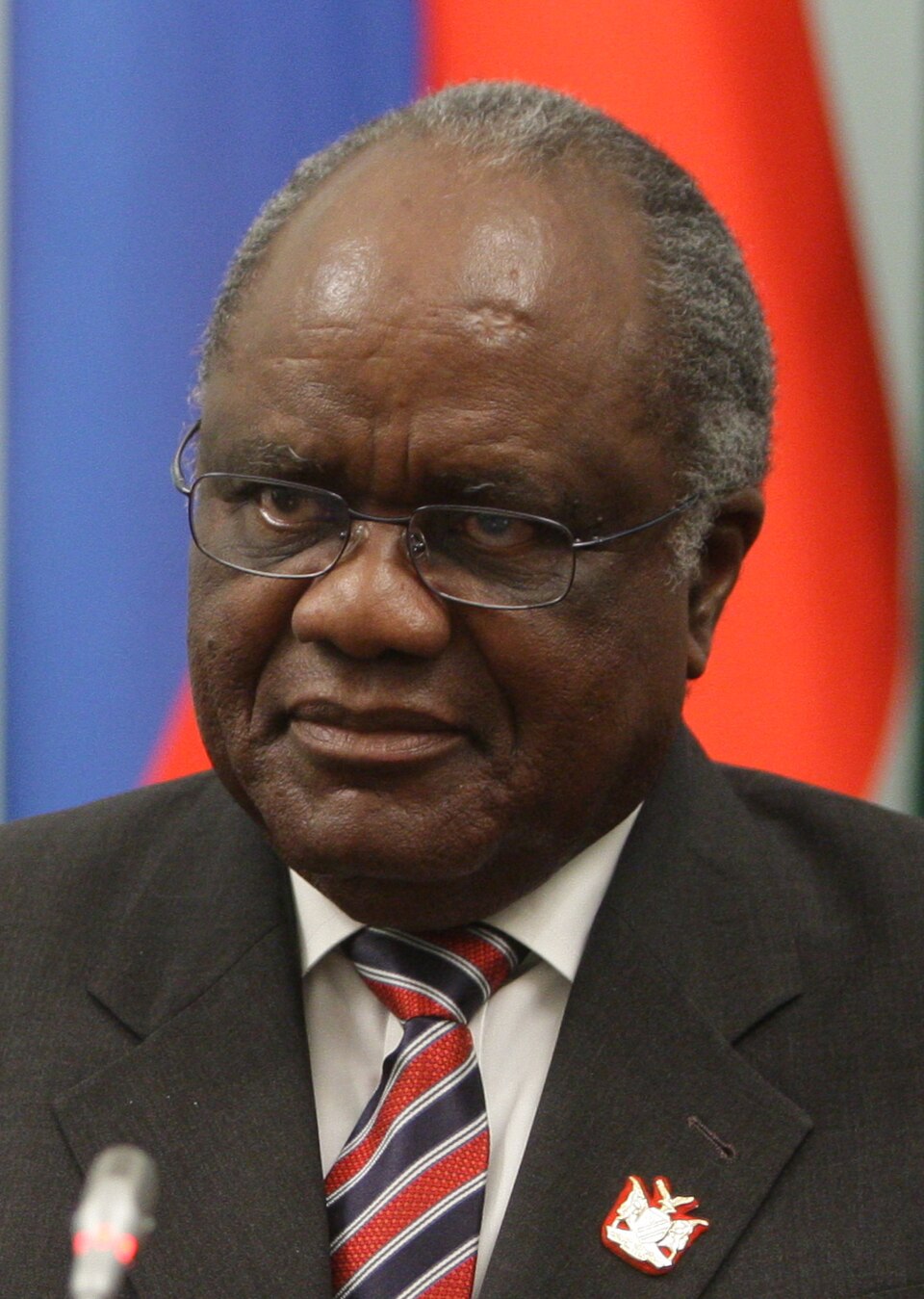
Born into Occupation
Hifikepunye Lucas Pohamba was born on 18 August 1935 in Okanghudi, in the Ondonga region of Ovamboland, in what was then South West Africa. The territory had passed from German colonial control to South African administration after the First World War under a League of Nations mandate — a transfer that exchanged one form of colonial rule for another. By the time Pohamba came of age, South Africa had extended its apartheid legislation to the territory, making South West Africa subject to the same system of racial classification, forced removals, pass laws, and economic subjugation that governed Black life across the Limpopo River.
Ovamboland, in the far north of the territory along the border with Angola, was the most densely populated region of South West Africa and the heartland of the labour migrant system. Hundreds of thousands of Ovambo men were contracted — under conditions that critics described as little different from indentured servitude — to work in the mines, farms, and domestic service of South Africa and of white settlers in the south of the territory. The contract labour system was one of the defining grievances that would fuel SWAPO's mass membership. Pohamba grew up immersed in the daily reality of this system: its humiliations, its disruptions of family life, and its revelation of the systematic design behind what colonial apologists preferred to describe as natural or economic necessity.
A Founding Generation
Pohamba was among the original members of SWAPO when the organisation was constituted in 1960 — transformed from the earlier Ovamboland People's Organisation (OPO) into a national body. He was twenty-five years old. The founding generation of SWAPO was small, largely from Ovamboland, and united by a conviction that the political moment demanded not just protest but organisation: disciplined, sustained, and capable of projecting itself internationally as the representative of Namibian aspirations. Sam Nujoma, the organisation's founding president, was from the same region and community as Pohamba. The bonds formed in these early years — of trust, shared commitment, and personal loyalty — would shape SWAPO's internal culture for generations and ultimately influence the succession to the presidency four decades later.
Like most of his generation of SWAPO founders, Pohamba was soon forced into exile. South African intelligence targeted SWAPO activists systematically, and remaining inside the territory meant arrest, torture, or death. He left Namibia in the early 1960s and joined the growing external apparatus of the liberation movement operating from neighbouring African states. Tanzania under Julius Nyerere and Zambia under Kenneth Kaunda were central nodes of this network — both countries hosted SWAPO offices and training facilities and provided the political support that gave the movement operational continuity.
"We did not struggle for independence so that a few could take for themselves what belongs to all Namibians."
— Hifikepunye Pohamba, 2005 inauguration addressArrest and Robben Island
Pohamba was arrested by South African authorities and sentenced to imprisonment on Robben Island — the notorious maximum security prison on an island in Table Bay off Cape Town that served as South Africa's principal site for political prisoners and whose inmates included Nelson Mandela, Walter Sisulu, Govan Mbeki, and many of the ANC's senior leadership. Pohamba's incarceration placed him in the company of the most important political prisoners of the southern African liberation struggle and brought him into direct contact with the intellectual and organisational culture of the ANC's underground.
Life on Robben Island was designed to break: hard labour in the limestone quarries, isolation from family, systematic degradation, minimal food, and the constant surveillance of a prison administration whose purpose was containment through psychological as well as physical attrition. For many of the island's inmates, the experience had the opposite effect — it became a site of collective education, political debate, and steeling resolve. The informal university that the prisoners created among themselves, reading and debating in whatever moments the regime allowed, was one of the remarkable facts of the South African and Namibian liberation struggle. Pohamba emerged from Robben Island not broken but deepened — his commitment to Namibian independence if anything reinforced by the costs he had personally paid.
After his release, Pohamba returned to SWAPO's external structures and resumed his role in the movement's operations. The years of imprisonment had not diminished his standing within the organisation — if anything, time on Robben Island conferred a specific kind of moral authority in liberation movement politics, a credential of sacrifice that no amount of diplomatic work abroad could entirely replicate.
Decades of Exile and Organisational Labour
The liberation struggle demanded from its senior figures a kind of sustained, unglamorous dedication — the slow accumulation of organisational capacity, the cultivation of international solidarity, the training and deployment of cadres, the management of camps, schools, and welfare services for Namibian refugees. SWAPO under Sam Nujoma had developed by the 1970s into a comprehensive government-in-exile, administering tens of thousands of Namibians living in Angola, Zambia, and other frontline states.
Pohamba held several important positions within this structure, including a period as SWAPO representative in Tanzania and later in other capacities within the movement's administration. He was known within the organisation as reliable, politically loyal, and free of the factional ambitions that complicated the careers of other senior figures. His relationship with Sam Nujoma was one of the most enduring and significant in Namibian liberation politics: both men were from Ovamboland, both founding members, and Nujoma's trust in Pohamba was deep enough to survive decades of the pressures and internal competitions that inevitably accompanied an organisation operating under siege conditions across multiple countries for thirty years.
The Return to a Free Namibia
When Namibia achieved independence on 21 March 1990 — the culmination of the diplomatic and military campaign that had consumed the adult lives of Pohamba and his entire generation — he was among the senior SWAPO figures who returned to participate in building the new state. He was appointed to cabinet by President Nujoma, serving in ministerial roles over the following fifteen years that gave him deep experience in the mechanics of governance: the Home Affairs ministry, which dealt with the practical management of citizenship, identity documents, and immigration in a country still integrating returned exiles and navigating the legacies of colonial demography; and other portfolios that developed his understanding of the relationship between state administration and the delivery of services to a population that had long been denied both.
Through this period Pohamba remained in the shadow of Nujoma — deliberately so. His was not a personality that sought the limelight or cultivated a public persona independent of the movement. He was, in the language of organisational politics, a loyalist — but not in a pejorative sense. His loyalty was to the project of Namibian liberation and to the party that had been its vehicle, and he expressed that loyalty through sustained, effective work rather than through the manoeuvring for position and profile that characterised some of his colleagues.
"Land remains the most important question. You cannot speak of true freedom in southern Africa while the land remains in the hands of the few."
— Hifikepunye Pohamba, address to the Namibian National AssemblyThe Presidency: 2005–2015
When Sam Nujoma announced that he would not seek a fourth presidential term, the succession question consumed SWAPO's internal politics. Nujoma made his preference clear: Pohamba was his choice. The decision was not without controversy — Hidipo Hamutenya, the Foreign Minister and a figure of considerable standing within the party, had his own aspirations and a significant support base. But Nujoma's backing was determinative within SWAPO's culture, and Pohamba won the party's nomination decisively. He won the November 2004 general election, and was inaugurated as Namibia's second president on 21 March 2005 — Independence Day, fifteen years to the day after Namibia's freedom.
Pohamba's presidency was defined by several commitments. Anti-corruption was the most prominent: he came to office with a public determination to address the culture of impunity around corrupt practices that had begun to take root in the state apparatus, and he established mechanisms including the Anti-Corruption Commission of Namibia with a mandate and operational independence that signalled genuine intent rather than cosmetic reform. The commission pursued prosecutions that touched on figures connected to the governing party, which required political will of a kind that not every liberation movement president in the region had been willing to exercise.
Land reform remained the other defining challenge of his decade in power. Namibia's land ownership pattern at independence was grotesquely skewed by colonial history: roughly 4,000 white commercial farmers held approximately 44 percent of the country's agricultural land, while the great majority of Namibians lived on communal land in the north. Pohamba's government pursued a willing-seller, willing-buyer model of land redistribution — slower and more cautious than some critics demanded, but producing real transfers over time without the dispossession-without-compensation approach that had caused economic devastation in Zimbabwe under Mugabe. His approach to land was pragmatic rather than revolutionary: he understood that the country's food security and economic stability depended on maintaining productive commercial farming while gradually expanding the land base available to the previously dispossessed.
He was re-elected in 2009 with a large majority and completed two full five-year terms, stepping down in March 2015 in accordance with Namibia's constitutional two-term limit. The orderly transfer of power to Hage Geingob — a SWAPO colleague of even longer standing who had been a leading figure in the independence negotiations — was itself a quiet demonstration of democratic consolidation in a region where term limits and peaceful transfers of power cannot be assumed.
Recognition and Legacy
In 2014, Hifikepunye Pohamba was awarded the Mo Ibrahim Prize for Achievement in African Leadership — the continent's most prestigious prize for heads of state who govern with demonstrable integrity and accountability, and then transfer power peacefully. The prize, worth five million dollars, is awarded rarely — the committee had declined to award it in several previous years for lack of a sufficiently qualified candidate. Pohamba's selection was a recognition not just of his ten years in office but of the whole trajectory of his life: the imprisonment, the decades of exile, the liberation work, and the subsequent commitment to governing a free Namibia with the integrity that the struggle had been about in the first place.
His legacy rests on several foundations. He was among the last generation of SWAPO leaders whose formation was entirely in the liberation era — who knew no adult life except the struggle for independence. He brought to the presidency a moral seriousness shaped by that formation and by the specific experience of Robben Island, where the question of what kind of society would succeed apartheid was debated in conditions of extreme adversity by some of the finest political minds of the twentieth century. That formation showed in the substance of his presidency: not flashy, not charismatic in the conventional sense, but earnest, institutionalist, and committed to the proposition that freedom was not an end in itself but a condition for the building of something better.
Pohamba remains alive at the time of writing — a living link to the founding generation of Namibian liberation, a figure of immense historical significance in a country that achieved independence within living memory and is still working out what independence, in its fullest sense, actually means.
Key Dates
-
1935Born on 18 August in Okanghudi, Ovamboland, South West Africa.
-
1960Becomes a founding member of SWAPO upon its formation from the Ovamboland People's Organisation.
-
Early 1960sArrested by South African authorities; sentenced to imprisonment on Robben Island alongside ANC and PAC political prisoners.
-
Mid-1960s onwardsReleased and goes into exile; takes up various organisational roles within SWAPO's external apparatus in Tanzania and other frontline states.
-
1978UN Security Council Resolution 435 establishes the framework for Namibian independence under UN supervision.
-
1990Returns to an independent Namibia on 21 March; appointed to cabinet by President Sam Nujoma.
-
1990s–2004Serves as Minister of Home Affairs and in other cabinet posts in the first decade and a half of independence.
-
2004Wins SWAPO presidential nomination, backed by retiring President Nujoma, defeating Hidipo Hamutenya; wins November general election.
-
2005Inaugurated as Namibia's second president on 21 March — Independence Day; pledges anti-corruption and land reform as governing priorities.
-
2009Re-elected with a large majority; continues land reform programme and strengthens Anti-Corruption Commission.
-
2014Awarded the Mo Ibrahim Prize for Achievement in African Leadership in recognition of his governance record and peaceful transfer of power.
-
2015Steps down after two full terms in accordance with constitutional term limits; succeeded by Hage Geingob.