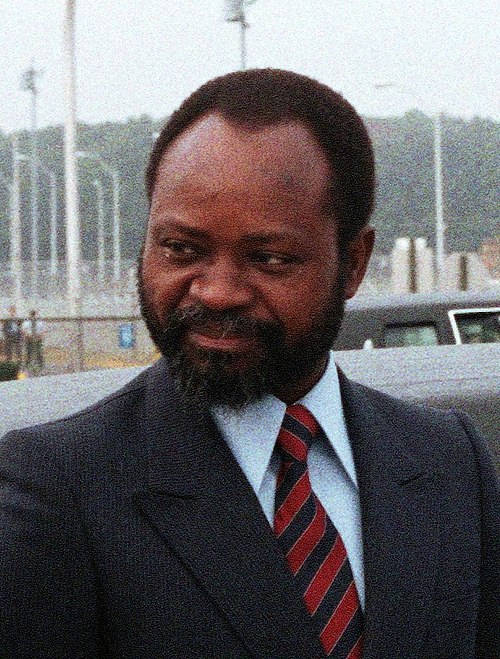
Jacinto Veloso, FRELIMO commander and Mozambique's security chief, photographed during his political career. Veloso commanded FRELIMO forces during the liberation war, led Mozambique's security and intelligence apparatus in the post-independence period, and conducted sensitive diplomatic negotiations with apartheid South Africa including the back-channel contacts that preceded the 1984 Nkomati Accord.
Mozambique · Africa

Jacinto Veloso

Jacinto Veloso operated in the spaces that liberation movements prefer not to acknowledge — the back channels, the secret negotiations, the pragmatic accommodations with opponents whose power cannot be wished away — while maintaining a public persona shaped by the liberation war service that gave him authority within FRELIMO's internal hierarchy. He had commanded FRELIMO forces during the liberation war, had been present at the critical moments of the independence transition, and had built the security and intelligence apparatus of the new Mozambican state. Then Samora Machel gave him the most difficult assignment of the post-independence period: to open and maintain communication with the apartheid South African government — the regime that was simultaneously funding RENAMO's campaign of mass murder in Mozambican villages — in the hope that a negotiated accommodation could stop or reduce the devastation. The negotiations that Veloso conducted — carefully, secretly, over years of back-channel contact — eventually produced the Nkomati Accord of 1984. The accord was imperfect, painful, and ultimately violated by South Africa almost immediately. But it reflected the specific kind of political courage that governing in the real world, as distinct from fighting for liberation in the ideologically clarifying conditions of a guerrilla war, requires: the willingness to negotiate with people whose values you find abhorrent because the alternative is the continued dying of your people.

Mozambique FRELIMO Military Commander Head of National Security — SNASP Nkomati Accord Back-Channel Negotiator 1984 Minister of State Security & Economic Affairs

Born: 1940, Mozambique — FRELIMO military commander during the liberation war; head of Mozambique's security and intelligence services SNASP; minister under Samora Machel; back-channel negotiator with apartheid South Africa; key figure in the post-independence security and diplomatic architecture of Mozambique

At a Glance

Full NameJacinto Soares Veloso — born in Mozambique in 1940; the specific details of his early life and colonial-period education are not thoroughly documented in the publicly available historical record; he joined FRELIMO and served as a military commander during the liberation war before moving into the security and intelligence roles that would define his post-independence career; he combined the military authority of a liberation war commander with the political intelligence and discretion that intelligence and diplomatic work requires
Born1940, Mozambique — he was part of the same generational cohort as Jorge Rebelo and Alberto Chipande, the group of Mozambicans who came of age in the early years of the liberation movement and who were formed by it in ways that shaped every subsequent dimension of their public lives; his specific regional and ethnic background is less thoroughly documented than that of the better-known figures of the liberation generation
Liberation warServed as a FRELIMO military commander during the armed liberation campaign of 1964–1974; the specific fronts and operations with which he was associated are not as prominently recorded as those of Alberto Chipande or the commanders of the Cabo Delgado and Tete fronts, reflecting the general pattern by which middle-ranking commanders are less thoroughly documented than the movement's most senior figures; his liberation war service gave him the institutional standing and personal authority within FRELIMO that his subsequent security and diplomatic roles required
SNASPHeaded SNASP — the Serviço Nacional de Segurança Popular, the National People's Security Service — Mozambique's primary intelligence and internal security organisation in the post-independence period; the SNASP was responsible for both external intelligence and internal security, including the surveillance of political opponents, the management of the country's prisons, and the counter-espionage work required to identify and neutralise Portuguese and later South African intelligence operations within Mozambique; leading this organisation in the conditions of the RENAMO war required managing the tension between the security imperatives of a state under existential threat and the political values that the liberation movement had claimed as its own
Diplomatic back-channelsWas entrusted by Samora Machel with the conduct of the back-channel diplomatic contacts with the apartheid South African government that eventually led to the Nkomati Accord of March 1984; these negotiations — conducted in secret, over an extended period, involving meetings with South African officials that the FRELIMO political tradition would have found deeply compromising to acknowledge publicly — required both the personal authority to represent Mozambique credibly and the discretion to manage the political sensitivity of what was being negotiated; Veloso provided both
The Nkomati AccordThe accord signed on 16 March 1984 at the Komatipoort border post between Mozambique and South Africa committed both countries to not supporting armed opposition movements operating against the other — Mozambique to curtail ANC activities, South Africa to end its support for RENAMO; the accord was a diplomatic achievement under desperate circumstances, forced by the devastating impact of RENAMO's campaign; South Africa violated it almost immediately by continuing to supply RENAMO, but the back-channel relationships it established contributed to the eventual political resolution of the Mozambican conflict
Post-independence ministerial careerServed in several ministerial positions in Mozambique's post-independence governments, including as Minister of State Security and in portfolios covering economic affairs; his ministerial career reflected the movement from security roles toward the broader governmental responsibilities that long FRELIMO service typically produced; he remained a significant figure within the movement's internal hierarchy throughout the post-independence period, his liberation war and security service credentials giving him standing that was independent of any particular ministerial appointment

Security and Liberation: Building the Intelligence State

The post-independence Mozambican state that FRELIMO constructed inherited both the ideals of the liberation movement and the practical requirements of governing a poor country in the most hostile regional environment in Africa. The apartheid South African state to the south was the dominant regional power and the most direct threat: it had the economic capacity, the intelligence services, and the military resources to destabilise any Mozambican government that supported the ANC and the broader anti-apartheid struggle, and it was prepared to use all of these instruments to that end. The Mozambican government's response — building a security and intelligence apparatus capable of protecting the state from the specific threats it faced — required compromises with the values of political openness and individual freedom that the liberation movement's theory had claimed as central.

Jacinto Veloso headed SNASP during the period when these compromises were most acute. The security service under his leadership operated in the conditions of a state under siege: extensive surveillance of suspected political opponents, harsh treatment of those detained, the use of security tools that the human rights standards that FRELIMO's own political framework nominally endorsed could not accommodate. This is the specific dilemma of revolutionary states confronting counter-revolutionary violence: the values that justified the revolution included political freedom and human dignity, but the exercise of those values was held to be contingent on the security of the revolutionary state, which could not be guaranteed without instruments that compromised them. SNASP under Veloso embodied this contradiction rather than resolving it.

The external intelligence work was, in some respects, less morally compromised than the internal security operations. Understanding the operations of South African military intelligence, identifying RENAMO's communication networks, tracking the movement of weapons across the Mozambican border — this was work whose necessity was hard to dispute given the scale of the RENAMO campaign's violence. Veloso's management of this external intelligence function gave him an understanding of the South African security establishment's internal dynamics and of the political relationships within the apartheid state that would become crucial when Machel decided that back-channel negotiation was necessary.

Negotiating with the Enemy: The Road to Nkomati

The decision to negotiate with the apartheid South African government was one of the most painful that Samora Machel ever made. FRELIMO's commitment to the ANC and the anti-apartheid struggle was not merely political convenience — it was an expression of the liberation movement solidarity that the PAIGC's Amílcar Cabral had articulated as a fundamental principle, the recognition that the liberation of Mozambique and the liberation of South Africa were expressions of the same project and that a genuinely liberated Mozambique could not stand aside from the struggle of its neighbour's people. Negotiating with the architects of apartheid, agreeing to limit the ANC's activities in Mozambique in exchange for South African promises to stop arming the movement that was burning Mozambican villages — this felt to many within FRELIMO like a betrayal of everything the liberation had been fought for.

Machel gave Veloso the task because Veloso had the combination of qualities the assignment required: the security clearance and institutional access to conduct secret negotiations without the information leaking to RENAMO's South African handlers, the personal authority to represent Mozambique credibly to South African interlocutors who needed to believe they were dealing with someone empowered to commit the Mozambican government, and the political intelligence to understand what Mozambique could genuinely offer and what it could not, and to negotiate accordingly. The back-channel contacts that Veloso developed — carefully, over months, through intermediaries and then through direct meetings — eventually produced the framework for the formal Nkomati Accord.

The accord was signed on 16 March 1984 at the Komatipoort crossing on the Nkomati River, at a ceremony at which both Machel and South African President P.W. Botha were present — the Mozambican liberation war's president and the architect of apartheid standing together at a border post, signing a document that both needed for different reasons. South Africa needed the accord to give international legitimacy to its regional position and to claim that it was not simply a destabilising bully. Mozambique needed it to stop the RENAMO war that was destroying its development. South Africa violated it almost immediately, continuing to supply RENAMO with weapons through networks that the accord's monitoring mechanisms proved unable to detect or disrupt. The negotiations that Veloso had conducted with such care had produced an agreement that the party he was negotiating with had no intention of fully honouring.

The Intelligence Chief's Dilemma: Means and Ends

Jacinto Veloso's career confronts, in a particularly stark form, the question that haunts every post-liberation security apparatus: how much of the liberation's values can be compromised in the service of the liberation's security without destroying the thing the liberation was trying to achieve? SNASP under his leadership used the instruments of surveillance, detention, and coercion that any security service in a state under existential threat was likely to use, and it used them in ways that the values of the liberation movement could not fully endorse. The Mozambican political prisoners held in SNASP facilities, the surveillance of suspected opponents, the intelligence cooperation with other security services that traded information across ideological lines — these were the instruments of governance that the post-liberation state required and the liberation tradition found difficult to acknowledge.

The back-channel negotiations with South Africa posed a different version of the same dilemma: the means — secret negotiations with the apartheid state, the limitation of ANC activities, the implicit acknowledgement that FRELIMO would prioritise Mozambican security over solidarity with the South African liberation — were in tension with the ends that the liberation had claimed as its purpose. Veloso conducted the negotiations because Machel ordered him to and because the alternative — continued RENAMO devastation — was genuinely worse. Whether it was the right call, whether a different strategy might have produced better outcomes, is a counterfactual that the historical record cannot resolve.

What the record does preserve is that Veloso performed his assignments with the competence and discretion that made him Machel's choice for the most sensitive tasks the presidency required. He was the liberation war commander who became the intelligence chief who became the back-channel diplomat — the man FRELIMO trusted with its hardest secrets and its most painful negotiations. That trust, and the things it required him to do, are the substance of his historical significance.

Mozambique Profiles

Mozambique Samora Machel FRELIMO commander; first President of Mozambique; died 1986 Mozambique Eduardo Mondlane FRELIMO founder; sociologist; assassinated 1969 Mozambique Graça Machel FRELIMO fighter; Education Minister; global humanitarian advocate Mozambique Marcelino dos Santos FRELIMO co-founder; poet Kalungano; Vice-President 1975–1986 Mozambique Joaquim Chissano FRELIMO diplomat; second President; Rome Peace Accords 1992 Mozambique Alberto Chipande Fired the first shot of the liberation war; FRELIMO commander Mozambique Jorge Rebelo FRELIMO information chief; poet of the liberation Mozambique Armando Guebuza FRELIMO militant; third President of Mozambique 2005–2015 Mozambique Jacinto Veloso FRELIMO commander; SNASP chief; Nkomati back-channel negotiator Mozambique Oscar Monteiro FRELIMO legal architect; minister of justice Mozambique Pascoal Mocumbi Prime Minister of Mozambique; public health champion
Share X Facebook WhatsApp LinkedIn