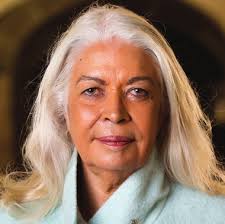
At a Glance
A Scholar Shaped by the Movement
Marcia Langton was born in 1951 in Brisbane, Queensland, into a Yiman and Bidjara family at a moment when the legal and political conditions of Aboriginal life in Australia were beginning, slowly and unevenly, to shift. The 1967 referendum was still sixteen years away. The land rights movement that would transform Aboriginal politics in the 1970s had not yet taken shape. But the intellectual and political currents that would produce both were already moving, and Langton — intelligent, combative, and possessed of an insatiable intellectual curiosity from an early age — was formed by them.
She grew up in Queensland, a state with a particularly harsh history of Aboriginal administration — the Queensland system of Protection Acts and reserve management had been among the most repressive in the country, and the conditions of Aboriginal life in rural Queensland, where Langton had family connections, were a direct education in the consequences of colonial dispossession. She developed early a dual orientation that would define her entire career: the conviction that the conditions of Aboriginal life demanded urgent political action, and the equally strong conviction that effective political action required rigorous intellectual engagement with the history, anthropology, law, and economics that had produced those conditions.
She was one of the first Aboriginal Australians to enter the Australian National University, studying anthropology in the early 1970s at a moment when the discipline was undergoing a profound internal reckoning with its historical complicity in colonial governance. Australian anthropology had a particularly troubled relationship with Aboriginal communities: it had, for most of its history, treated Aboriginal people as objects of scientific study rather than subjects with their own political and intellectual agency, and had frequently provided the intellectual cover for government policies that served the interests of the state rather than the communities being studied. Langton entered this environment with clear eyes and an intention to use the tools of the discipline for purposes its founders had not anticipated.
The Land Rights Movement and Early Activism
The 1970s were a decade of transformative Aboriginal political activity in Australia, driven by the energy released by the 1967 referendum, the election of the Whitlam Labor government in 1972, and the establishment of the Aboriginal Tent Embassy on the lawns of Parliament House in the same year. Langton was part of this movement — participating in protests, engaging with the Black Power politics that Gary Foley and others were developing in Redfern and across the country, and beginning to articulate a position that combined the movement's demands for sovereignty and self-determination with the analytical frameworks she was developing through her academic training.
The Whitlam government's commission of the Woodward Royal Commission into Aboriginal land rights — which eventually produced the Aboriginal Land Rights (Northern Territory) Act 1976, the first national land rights legislation in Australia — created a new arena for Aboriginal political engagement: the legal and administrative processes through which land rights claims would be made and adjudicated. Langton became increasingly expert in this arena, combining fieldwork in Aboriginal communities with advocacy work in the emerging land rights bureaucracy, and developing the combination of community knowledge and legal-anthropological expertise that would make her an indispensable figure in native title negotiations for the following four decades.
Her 1993 work Well, I Heard It on the Radio and I Saw It on the Television — a study of the representation of Aboriginal people in Australian media — established her as a major voice in the emerging field of Indigenous media studies and demonstrated the breadth of her intellectual interests. The work examined the way in which mainstream Australian media constructed images of Aboriginal people that served the interests of the settler state, naturalised dispossession, and made it harder for Aboriginal political claims to be taken seriously by a non-Aboriginal public shaped by those images. It was rigorous, polemical, and widely read — a model of the engaged scholarship that Langton had been developing since her undergraduate years.
Native Title, Negotiation, and the Cape York Agreements
The High Court's Mabo decision of 1992 — which overturned the doctrine of terra nullius and recognised the existence of native title in Australian law — created both an enormous opportunity and an enormous challenge for Aboriginal communities and their advocates. The opportunity was the prospect of genuine legal recognition of the connection between Aboriginal people and their country. The challenge was the complexity of the legal and administrative processes through which that recognition would need to be pursued, and the active resistance of mining, pastoral, and state interests that stood to lose from its implementation.
Langton became one of the most important figures in navigating this complexity. As an expert witness in native title cases, as a negotiator of agreements between Aboriginal communities and resource companies, and as an academic who was simultaneously producing the research that informed legal argument and policy development, she occupied a position of unusual influence at the intersection of law, politics, and scholarship. Her work on the Cape York Peninsula — one of the most ecologically significant and Aboriginal-populated regions of Australia — exemplified this integrated approach: she worked with traditional owners, government agencies, and conservation organisations to negotiate heritage protection agreements that recognised Aboriginal land rights while also addressing the environmental management challenges of a globally significant landscape.
"Native title is not a gift from the state. It is a recognition of something that existed before the state — something the state's own highest court has now acknowledged it cannot extinguish simply by pretending it was never there."
Her involvement in the Cape York Welfare Reform agenda — developed with Noel Pearson and others in the 2000s — brought her into some of the most contentious debates in Australian Indigenous policy: debates about the relationship between welfare dependency and self-determination, about the respective roles of individual agency and structural disadvantage in producing the conditions of Aboriginal life in remote communities, and about the appropriate form of intervention by governments that had caused the problems they were now seeking to address. Her positions were not always welcomed by all sections of the Aboriginal rights movement, and she has been willing throughout her career to hold views that are unpopular in one quarter or another — a mark of intellectual independence that has sometimes made her a divisive as well as an influential figure.
The Academy and the Public Square
Langton was appointed to the Foundation Chair of Australian Indigenous Studies at the University of Melbourne in 2000 — the first such chair in Australia — a position that gave her both an institutional platform and an obligation to build the academic infrastructure that Indigenous Australian studies required: courses, research programmes, mentorship of Indigenous scholars, and the development of a body of scholarship that could inform both public policy and community self-understanding. She has fulfilled that obligation with extraordinary energy and range.
Her Boyer Lectures for the ABC in 2012, published as The Quiet Revolution, reached a broad audience with a sophisticated argument about the transformative potential of resource agreements between mining companies and Aboriginal communities — agreements that, properly structured, could provide economic foundations for genuine self-determination rather than the dependency that welfare-based approaches had produced. The argument was controversial — the mining industry is not universally regarded as a benign partner for Aboriginal communities — but it was grounded in detailed knowledge of specific agreements and communities, and it demonstrated Langton's consistent preference for empirical engagement over ideological positioning.
Her book Welcome to Country (2018) brought her scholarly knowledge of Aboriginal history, culture, and governance to a general readership in accessible form, providing the kind of comprehensive introduction that Australia's education system had persistently failed to provide. It was, among other things, an act of cultural labour: an attempt to fill the gap between what Aboriginal Australians know about their own history and country, and what non-Aboriginal Australians are typically taught — a gap that has always served the interests of those who prefer the past to remain comfortable and the present to remain unchallenged.
Five Decades of Engagement
Marcia Langton is, at the time of writing, in her early seventies and remains one of the most active and prolific voices in Australian public intellectual life. She continues to publish, to teach, to advise governments and communities, and to engage — often combatively — with the political debates that determine the conditions of Aboriginal life in Australia. She was a prominent supporter of the Voice to Parliament referendum in 2023, and its defeat — by a majority of both voters and states — was a significant political disappointment that she has continued to analyse and respond to with characteristic rigour.
Her legacy is the combination of activist commitment and scholarly depth that she has maintained across five decades of engagement with some of the most difficult questions in Australian political and intellectual life. She has been appointed an Officer of the Order of Australia, received honorary doctorates from multiple universities, and been elected a Fellow of the Australian Academy of the Humanities — recognitions that reflect the breadth and depth of a contribution that has moved between the lecture theatre, the negotiating table, the courtroom, the community, and the broadcast studio with a consistency of purpose that few public figures can match.
She is, above all, a figure who has refused to accept the terms that Australian society has typically offered Aboriginal people who wish to participate in its institutions: the choice between an assimilation that requires the abandonment of Indigenous identity and a marginalisation that renders Indigenous perspectives invisible. She has insisted, throughout her career, that it is possible to be fully and proudly Yiman and Bidjara, fully and rigorously engaged with the intellectual and political traditions of European scholarship and governance, and fully committed to the transformation of the Australian society in which both of those identities must ultimately find their expression. That insistence is her most important contribution — and it has cost her, in terms of criticism, controversy, and the particular exhaustion of swimming permanently against several currents at once, more than is usually acknowledged.