At a Glance
The Land That Was Never Given Away
The story of Eva Rickard begins, as all great land rights stories do, with an act of dispossession and the question of how long a people will carry its memory before deciding to act. The land at Whaingaroa — known to Pākehā New Zealanders as Raglan, a surf town on the west coast of the Waikato — had been in the possession of the Tainui people since the earliest inhabited centuries of Aotearoa. When the New Zealand Wars erupted in the 1860s and the Crown's forces fought their way through the Waikato, the government responded to Māori resistance with the confiscation of vast tracts of land under the New Zealand Settlements Act 1863. This policy of raupatu — confiscation as punishment — stripped the Tainui of millions of acres that they had never sold, never ceded, and never agreed to surrender.
Among the lands taken was the Whaingaroa peninsula. A portion of it was used to build an aerodrome during the Second World War — a purpose its Māori owners had reluctantly accepted on the understanding that the land would be returned when the war was over. It was not returned. Instead, when the airfield was decommissioned, the Crown converted it into a golf course, maintained for the recreational pleasure of the predominantly white farming and professional class of the Raglan district. The Tainui families who had buried their dead in that ground, who had fished the harbour that bordered it, who had performed ceremonies on it for generations, were expected to drive past on their way into town and say nothing.
Eva Rickard was born in 1925 into this history. She grew up with direct knowledge of the confiscation and its consequences — the poverty, the dislocation, the deliberate forgetting that settler New Zealand had organised itself around. She was, by all accounts, a woman of extraordinary physical courage and extraordinary stubbornness, qualities that her community recognised and that the Crown would come to understand very clearly in 1978.
The Occupation: Standing on Sacred Ground
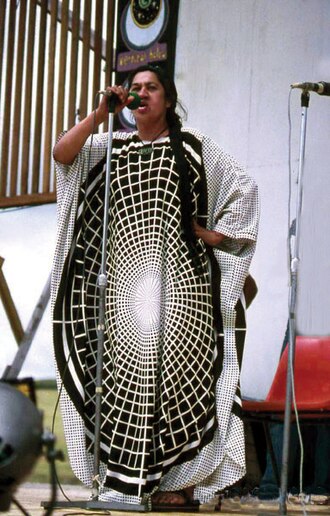
On 12 October 1978, Eva Rickard led a group of Tainui Māori onto the Raglan Golf Course and began what would become a landmark occupation of confiscated land. The action was not spontaneous. It was the product of years of failed negotiations, rejected petitions and official indifference to Tainui claims that the land had been illegally taken and should be returned. Every legitimate avenue had been tried and found closed. Direct action, Rickard had concluded, was not the first resort but the last one — and it was now necessary.
The occupiers set up a camp on the fairways and announced their intention to stay until the land was returned. The golf club members, the local council and the national press responded with a mixture of outrage, contempt and incomprehension that revealed, more nakedly than any academic argument could, the depth of Pākehā New Zealand's assumption that the question of Māori land rights had been settled — that the confiscations were unfortunate historical facts but not live injustices requiring remedy. Rickard and her people demonstrated, by the simple act of standing on the land and refusing to leave, that the question had never been settled at all.
"We are not squatters. We are not trespassers. We are the people of this land, and we have never agreed that it belongs to anyone else."
The occupation drew national and international attention. It coincided with — and helped intensify — the broader Māori political awakening of the late 1970s, a period in which Treaty issues were moving from the margins of New Zealand public life towards its centre. Whina Cooper's land march of 1975 had demonstrated that Māori were willing to take their grievances onto the street and into the living rooms of the nation. Rickard's occupation demonstrated that they were willing to go further: to reclaim the physical ground itself, and to hold it against the legal machinery of the state.
She was arrested. She was charged with trespass on land that her ancestors had occupied for centuries before the concept of trespass existed in New Zealand law. She appeared in court, was convicted, and returned to the land. The arrest and conviction did not end the occupation; they prolonged it and intensified the political pressure on the Crown to address the underlying claim. The image of Rickard — dignified, unbending, unimpressed by the authority of courts that derived their legitimacy from the very treaties they refused to honour — became one of the defining images of Māori political resurgence.
Victory: The Return of the Land
The occupation and the sustained political campaign around it eventually succeeded. In 1983, the Raglan Golf Course land was formally returned to Tainui ownership — one of the first significant returns of confiscated land in New Zealand's post-war history, and a precedent of enormous symbolic and legal importance. It demonstrated that direct action, combined with sustained political engagement and a clear articulation of the legal basis of the claim, could force the New Zealand state to acknowledge an injustice it had spent more than a century pretending did not exist.
The return was partial and contested. The golf club continued to operate on the land under a lease arrangement that many Tainui regarded as inadequate. The compensation for over a century of wrongful occupation was limited. But the principle had been established: confiscated Māori land could be returned, and the Crown's long-standing position that the raupatu was a closed chapter of history was no longer tenable. Every subsequent Treaty settlement negotiation — and there would be hundreds of them over the following four decades — was conducted in the shadow of Raglan and the precedent that Eva Rickard had forced into existence.
Beyond Raglan: A Career of Treaty Activism
Raglan was Rickard's most famous campaign, but it was not her only one. Throughout the 1970s and 1980s, she was a consistent and prominent voice in the broader movement for Māori rights — attending Waitangi Day protests, engaging with the Waitangi Tribunal process, speaking at hui and public meetings across the country, and building the network of connections and alliances that made the Māori political revival of that period possible. She was a founding figure in Māori direct-action politics, and her influence extended to a generation of younger activists who would go on to lead the Māori Party, the Treaty settlement process, and the continuing struggle for Indigenous rights in New Zealand.
She was deeply connected to the international Indigenous rights movement and understood, as did her contemporaries Whina Cooper and Nganeko Minhinnick, that the Māori struggle was part of a global pattern of Indigenous resistance to colonial dispossession. She participated in international forums, built relationships with Aboriginal Australians, Native Americans and other Indigenous peoples, and helped to create the networks of solidarity that would eventually produce the United Nations Declaration on the Rights of Indigenous Peoples.
Her political style was confrontational in a way that made many Pākehā New Zealanders uncomfortable — she was not interested in negotiating from a position of supplication, and she had little patience for the suggestion that Māori should be grateful for whatever the Crown chose to offer. She had studied the Treaty of Waitangi carefully, and she knew exactly what it said and exactly how comprehensively it had been ignored. That knowledge gave her a clarity of purpose that was difficult to argue with and impossible to dismiss without simply refusing to engage with the evidence.
The Shape of Her Legacy
Eva Te Tai Rickard died in 1997, a decade before the United Nations Declaration on the Rights of Indigenous Peoples was adopted, and before the bulk of the major Waikato-Tainui Treaty settlements were reached. She did not live to see the full flowering of what she had planted. But the seeds were unmistakably hers. The Waikato-Tainui settlement of 1995 — which included a formal apology from the Crown for the illegal raupatu confiscations and significant financial compensation — was the direct descendant of the legal and political arguments she had spent her life making.
Her contribution was not only to the specific cause of Tainui land rights, though that alone would have been sufficient to justify a place in any history of New Zealand. It was to the demonstration, carried out at considerable personal cost, that the Treaty of Waitangi was a living document with enforceable content; that the injustices of the 1860s were not ancient history but present wrongs requiring present remedy; and that Māori communities, if they were willing to stand on their own ground — literally and figuratively — could force even a reluctant state to acknowledge what it owed them.
In the harbour town of Raglan, where the land she occupied now belongs once again to the Tainui people she represented, her name is not on a plaque or a monument. It is in the title deeds.