At a Glance
A Knight Without a King
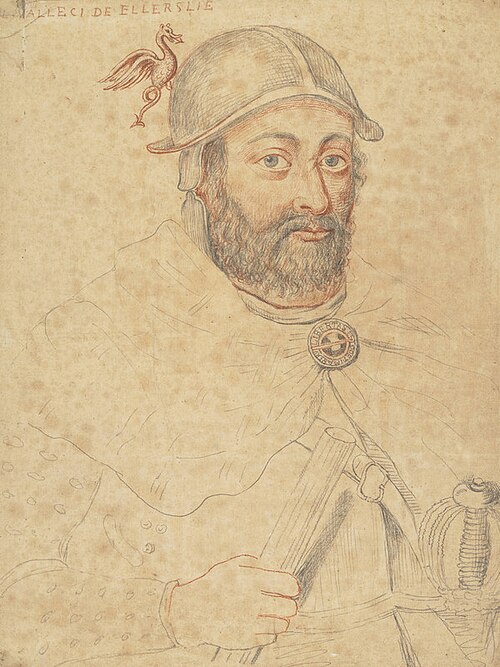
Almost nothing is certain about William Wallace's origins. The date and place of his birth, his family's precise social position, his education, his early adult years — all are either unknown or reconstructed from sources compiled after his death, shaped by the legendary status he had already acquired by the time anyone thought to write his biography. What the records establish clearly is that he was a knight of minor standing — not a great magnate, not a prince, not a man with the kind of dynastic claim that normally generated medieval military leadership — who emerged from relative obscurity in 1297 to lead a Scottish uprising that no one of his social position would have been expected to lead, and that achieved, at least briefly, something no previous uprising had managed: the military expulsion of English forces from most of Scotland.
The crisis that produced him was Edward I's annexation of Scotland following the deposition of John Balliol in 1296. Edward had collected the Scottish nobles' submissions, removed the Stone of Destiny from Scone to Westminster, and installed English administrators to govern what he now regarded as a conquered province. The Scottish aristocracy — caught between their lands in England and their identities in Scotland, most of them having already submitted — were largely quiescent. The resistance that broke out in 1297 came from below: from Wallace in the south-west, and from Andrew Moray in the north, two men without the dynastic stakes that kept the great nobles compliant and without the English landholdings that made defiance financially catastrophic.
Wallace's first documented act of resistance was the killing of the English Sheriff of Lanark, William Heselrig — an event that the later tradition connected to the murder of his wife Marion (or Mirren) by Heselrig's men, though the historical basis for this is uncertain. Whatever the immediate trigger, by the summer of 1297 he was operating as the leader of a significant insurgent force in Lanarkshire and Selkirkshire, conducting the kind of guerrilla operations that harassed English garrisons, disrupted supply lines, and made the occupation of the Scottish lowlands progressively more costly.
Stirling Bridge: The Battle That Changed Everything
September 1297 produced the moment on which everything else depends. An English army under John de Warenne, Earl of Surrey, and Hugh de Cressingham, Edward's treasurer in Scotland, advanced to cross the Forth at Stirling Bridge and crush the Scottish forces under Wallace and Andrew Moray that had gathered on the northern bank. The English force was substantially larger and included a significant cavalry contingent that, on open ground, would have been decisive. Warenne's army was professional, experienced, and confident — the kind of force that minor Scottish knights were not supposed to defeat in pitched battle.
Wallace and Moray waited. The English advance began to cross the narrow wooden bridge over the Forth — a structure that could pass only two horsemen abreast, funnelling the army into a bottleneck that neutralised its numerical advantage. When approximately half the English force had crossed, the Scots attacked. The cavalry on the Scottish bank charged down the causeway and cut off the English vanguard from the main body; the Scottish spearmen drove the English who had crossed into the Forth's marshy banks, where their heavy armour made movement impossible and escape impractical. Cressingham was killed, possibly flayed by the Scots afterward in a gesture of particular contempt. Warenne fled south. The English army had been destroyed in detail by a force that should, in conventional military logic, have been no match for it.
"I tell you the truth, it is not for glory, nor riches, nor honour that we fight, but for freedom — for that alone, which no honest man gives up but with life itself."
— Attributed to Wallace; later adapted in the Declaration of Arbroath
Stirling Bridge had immediate and dramatic consequences. English garrisons across Scotland surrendered or withdrew. Wallace led raids into northern England — into Cumberland and Northumberland — demonstrating that Scottish forces could now operate offensively rather than merely defensively. He was knighted and appointed Guardian of Scotland, ruling on behalf of the imprisoned King John Balliol in a capacity that represented the most significant exercise of independent Scottish authority since Edward's conquest. For a brief period in the autumn and winter of 1297, Scotland was, in practical terms, governed by a man of minor gentry origins who had beaten an English army and claimed the administrative functions of a kingdom.
Falkirk and the Long Resistance
Edward I's personal response was predictable and overwhelming. Returning from his French campaigns, he led an army of approximately 15,000 men north in the summer of 1298. At Falkirk on 22 July, the Scottish spearmen who had been so effective at Stirling found themselves unable to counter the coordinated use of English longbowmen and cavalry — the combined arms formula that Edward had refined in his Welsh campaigns. Wallace's schiltron formations held initially but were broken by arrow fire before the cavalry charges delivered the final blow. Falkirk was a decisive defeat. Wallace resigned the guardianship shortly afterward and disappears from the record for several years — possibly travelling in France and Rome seeking support for the Scottish cause, possibly conducting guerrilla operations in Scotland, the sources are contradictory and thin.
The resistance continued under other guardians — Robert Bruce and John Comyn alternated and competed for the role — but Scotland's formal independence was not re-established. Edward's campaigns of 1300, 1301, and 1303–04 progressively reduced Scottish resistance, and in February 1304 most of the remaining Scottish leaders made their submission at Strathord. Wallace refused. He remained in the field, a fugitive with a price on his head, for over a year after the general submission before he was finally betrayed and captured near Glasgow in August 1305.
Smithfield: The Trial and Execution
Brought to London and tried at Westminster Hall, Wallace was charged with treason — the same charge the English state would use against rebels for centuries, and the same charge that defined the political stakes of his resistance. His response, recorded in the chronicles, cut to the legal and moral heart of the accusation: he had never sworn allegiance to Edward I, and therefore could not be a traitor to him. The argument was technically sound and politically irrelevant. He was convicted and sentenced to the maximum punishment the medieval English state had developed for those it regarded as traitors.
On 23 August 1305, at Smithfield in London, William Wallace was hanged until nearly dead, then cut down and emasculated, then disembowelled and his entrails burned before his eyes, then beheaded and his body divided into four quarters. His head was placed on a spike on London Bridge. His quarters were sent to Newcastle, Berwick, Stirling, and Perth — the four corners of the land whose independence he had fought for — to serve as warnings. The display was intended to make his name a synonym for defeat and futility. It achieved the opposite. Scotland remembered him as the man who had not submitted, and built on his martyrdom a tradition of resistance that culminated, nine years later, at Bannockburn.
The Guardian's Permanent Commission
Wallace is the most mythologised figure in Scottish history, and the mythology has sometimes obscured the man. The Mel Gibson film of 1995 introduced him to a global audience in a form that Scottish historians found historically cavalier, but the film's emotional impact — and the renewed surge of Scottish nationalist sentiment that accompanied its release — was real and demonstrated something about the continued resonance of his story that purely academic accounts cannot capture. His statue at the Wallace Monument near Stirling, his face on commemorative merchandise, his name invoked at every significant moment in the ongoing argument about Scottish independence — these are the measure of what his refusal, at Smithfield, to call Edward his king, has accumulated across seven centuries.
The title Guardian of Scotland — which he held for less than a year — has proved the most durable thing about him. It expressed, with a precision that no subsequent title has quite matched, what he understood himself to be doing: not conquering, not ruling for his own benefit, not serving a dynastic claim, but guarding something that belonged to others and that others had temporarily lost the capacity to guard for themselves. The Scotland he guarded is still here. The argument about its independence is still alive. The man who refused to submit is still, in the iconography of that argument, the first and most uncompromising expression of its central claim.