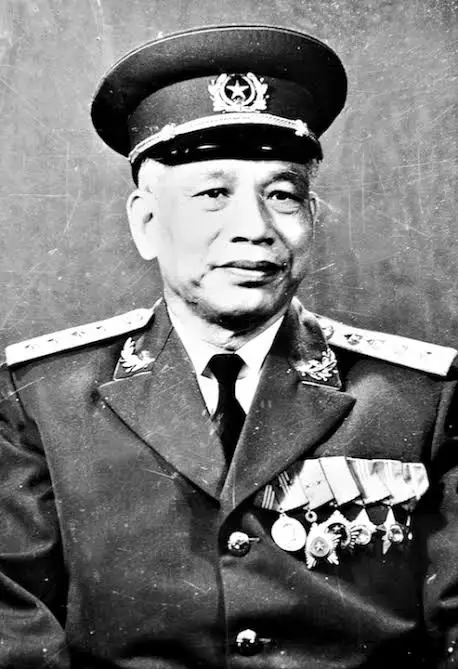
Key Facts
Origins and Working-Class Formation
Van Tien Dung was born on 2 May 1917 in Ha Dong Province, a district immediately south of Hanoi that has since been absorbed into the expanding capital. His background was working-class rather than scholarly — he came from a family of textile workers and himself worked in the textile industry as a young man, a background that distinguished him from many of the senior Vietnamese revolutionary figures who came from the educated mandarin or professional classes. His political formation came through the labour movement and through contact with the Indochinese Communist Party's organising work in the industrial areas around Hanoi in the 1930s.
He joined the ICP in 1937 and became an active organiser among workers in the Hanoi area, building the kind of cells and networks in the industrial working class that the Party's political line in this period prioritised. Like virtually all active Party members in this period, he was arrested by French colonial authorities — in his case in 1939 — and imprisoned. He escaped from prison in 1944, joining the Viet Minh forces that were building toward the August Revolution and receiving his first formal military experience in the guerrilla units that were training in the forests of northern Vietnam in the final year before independence.
The August Revolution of 1945 and the immediate onset of the First Indochina War gave Van Tien Dung his military career. He proved an able commander at the regimental and then divisional level, rising through the People's Army's command structure during the eight years of war against France. His abilities attracted the attention of the senior leadership, and in 1953 he was appointed Chief of Staff of the People's Army of Vietnam — the position he would hold continuously for the next twenty-five years, across the entire period of the American war and beyond.
Chief of Staff: Building the People's Army
The role of Chief of Staff in the Vietnam People's Army was not, as it might be in a Western military, primarily an administrative coordination role. In the PAVN's command structure, the Chief of Staff bore significant responsibility for operational planning, force development, logistics, and the overall military capacity of the armed forces. Van Tien Dung held this position across a quarter century that saw the PAVN transform from a guerrilla force equipped with captured French weapons and Soviet supplies into a modern combined-arms military capable of conventional offensive operations at corps and army scale.
The transformation was not linear or smooth. The People's Army of the early 1950s, which won at Dien Bien Phu in 1954, was primarily an infantry force organised around disciplined guerrilla operations supported by a limited artillery capability that Giap had built painstakingly over years. The PAVN of 1975 that took Saigon possessed armoured units, mobile artillery, surface-to-air missile systems, and the logistical infrastructure to sustain multi-division conventional offensive operations across hundreds of kilometres. The development of this capacity — the training programmes, the organisational structures, the logistics systems, the integration of Soviet-supplied weapons into Vietnamese tactical doctrine — was the work of Van Tien Dung's Chief of Staff tenure as much as it was Giap's work as Defence Minister and supreme military commander.
The relationship between Van Tien Dung and Vo Nguyen Giap is one of the more interesting command relationships in twentieth-century military history. They worked together as the two most senior figures in the PAVN for more than two decades, with Giap as the supreme military commander and strategic thinker and Van Tien Dung as the operational implementer and organisational builder. The relationship was productive but not without tension: as the war progressed and Van Tien Dung's operational experience and the Politburo's confidence in him grew, the balance of effective authority in the PAVN's operational planning shifted somewhat away from Giap and toward the Chief of Staff and the operational commanders in the field.
By the early 1970s, with the Paris Peace Accords having ended direct American military involvement and the strategic situation moving toward the possibility of a final offensive, Van Tien Dung was increasingly the central military figure in the operational planning for what everyone in the senior leadership understood was coming. Giap's health was not robust, and the younger man — twenty-one years his junior — had the physical and operational stamina that the final campaign's demands would require.
The 1975 Campaign: Planning and Execution
In January 1975, the Politburo sent Van Tien Dung south in secret — travelling incognito, his identity concealed even from many senior officials in the regions through which he passed — to take personal command of the final military campaign against the South Vietnamese government. The secrecy was not mere caution: if his presence in the south had become known to American intelligence, it would have signalled the imminence of a major offensive and potentially triggered a response that the Vietnamese side preferred to forestall.
The campaign plan that he arrived to execute had been developed in Hanoi over the preceding months. Its original timetable was conservative: a two-year campaign, beginning with operations designed to test South Vietnamese military responses and probe for weaknesses, gradually building toward a final decisive offensive in 1976 or 1977. The plan was based on a realistic assessment of South Vietnamese military capacity and on uncertainty about whether the United States would respond to a major North Vietnamese offensive with renewed military intervention.
What actually happened in the first weeks of the campaign overturned every assumption underlying that timetable. The initial offensive in Phuoc Long Province in January 1975 resulted not in a contested battle but in a rapid South Vietnamese collapse, and the United States showed no sign of military response. Van Tien Dung reported to Hanoi what he was seeing: the South Vietnamese military was disintegrating faster than anyone had projected, American re-intervention appeared politically impossible, and the window for a decisive campaign was open now, not in 1976 or 1977.
The Politburo, responding to his operational assessment, authorised the acceleration. The two-year campaign became a two-month offensive. The Central Highlands campaign of March 1975, which Van Tien Dung directed personally, resulted in the fall of Ban Me Thuot and triggered a catastrophic South Vietnamese withdrawal from the highlands that became a rout. Hue fell on 25 March. Da Nang fell on 29 March. The pace of the South Vietnamese military's collapse was exceeding even Van Tien Dung's accelerated projections.
The final offensive on Saigon — formally designated the Ho Chi Minh Campaign — was launched on 26 April 1975. Five corps-sized formations converged on the capital from multiple directions. The South Vietnamese government's last-minute attempt at negotiation was brushed aside. Van Tien Dung coordinated the assault from a forward command post, managing the convergence of forces, the timing of the final assault, and the communications with Hanoi that kept the Politburo informed of events as they unfolded in real time.
On the morning of 30 April 1975, North Vietnamese tanks breached the gates of the Presidential Palace in Saigon. President Duong Van Minh broadcast an unconditional surrender at noon. Van Tien Dung, present in the city as the surrender was announced, later wrote that the moment felt surreal — that the thing he had spent thirty years preparing for had arrived with a completeness and speed that left the mind struggling to process it. The war was over. Vietnam was unified. The price paid to reach that moment was, by any human accounting, staggering. The result was not.
Our Great Spring Victory
Van Tien Dung published his account of the 1975 campaign, Dai Thang Mua Xuan — "Our Great Spring Victory" — in 1976, within a year of the events it described. The memoir was translated into English and published internationally, becoming one of the most widely read primary accounts of the Vietnam War's final phase available to Western audiences.
The memoir is a commander's account: operational in focus, concerned with the decisions made at each stage of the campaign, the intelligence assessments that shaped them, the pace of events and the adjustments required when events outran plans, and the human texture of commanding an operation of this scale. It is not a reflective philosophical text in the manner of some military memoirs; it is the account of a general who was present at a decisive military operation and who understood that getting the operational details right — who was where, what decision was made when, what the ground situation actually was at each critical juncture — was the primary obligation of the historical record he was creating.
Unlike Tran Van Tra's memoir, which was suppressed, Van Tien Dung's account was published with official approval and indeed official encouragement. This partly reflects the difference in their subject matter: Van Tien Dung was writing about a military victory, in which the complexity of the strategic debate and the operational costs could be presented within a triumphant narrative frame. Tran Van Tra was writing about the whole southern war, including its catastrophic phases, in ways that complicated the official narrative. The contrast between the fates of the two memoirs is itself a document about what kinds of historical truth the Vietnamese government of the 1970s and 1980s found useful and what kinds it found inconvenient.
Post-War Career and Final Years
Following the war, Van Tien Dung continued as Chief of Staff of the PAVN until 1978 and then served as Minister of National Defence from 1980 to 1986 — the period encompassing Vietnam's occupation of Cambodia and the Chinese border war of 1979, which imposed severe military demands on an army that had just concluded thirty years of war and had not had the opportunity to demobilise, rest, or recover its strength before being committed to new operations.
The Cambodia intervention, in which he bore ministerial responsibility as Defence Minister from 1980, was militarily successful in its primary objective — the removal of the Khmer Rouge government and the installation of a Vietnamese-backed Cambodian government — but strategically costly. The decade-long occupation tied down significant Vietnamese military resources, sustained casualty rates that, while lower than the American war, were not trivial, and deepened Vietnam's international isolation in ways that compounded the economic hardships of the post-war period.
He retired from the Politburo and from active military and governmental service in 1986, at the Sixth Party Congress that adopted the Doi Moi reforms. He spent his remaining years in Hanoi, participating in veterans' organisations and historical commemoration activities. He died on 17 March 2002, aged eighty-four — long enough to see the Vietnam he had fought to reunify transformed by the economic reforms of the Doi Moi era into a country unrecognisable from the one he had commanded armies in. Whether he found that transformation wholly satisfying, or whether some part of him measured it against the revolutionary ideals of his youth, the historical record does not fully reveal.
Legacy
Van Tien Dung's place in Vietnamese military history is defined by a single operation: the Ho Chi Minh Campaign of 1975. He was the general in command when Vietnam was reunified, the man who took the Politburo's strategic decision and translated it into the operational movements that put North Vietnamese tanks in the streets of Saigon. In that specific, concrete sense, he was the commander of the final victory, and Vietnamese military history records him as such.
His broader significance — as Chief of Staff across twenty-five years, as the organisational builder of the PAVN through the American war, as the operational planner whose assessment of the 1975 situation persuaded the Politburo to accelerate the campaign — is less visible but arguably more consequential. Armies win wars not only through the brilliance of their commanders in the field but through the quality of their planning, logistics, training, and institutional capacity built up over years. Van Tien Dung, as Chief of Staff, built much of what the 1975 campaign required. The victory was not only his, but it could not have happened without what he had spent twenty-five years building.
His memoir, Our Great Spring Victory, remains the essential Vietnamese primary account of the war's final phase and continues to be read and cited by historians of the conflict. It is a significant contribution to the historical record of one of the twentieth century's defining military and political events. That it was written and published promptly, with clarity and operational specificity, by the commanding general of the final campaign is itself an achievement — a recognition that the historical record mattered, that getting it right was an obligation, and that the people who had paid the price of the victory deserved an account of how it was won.