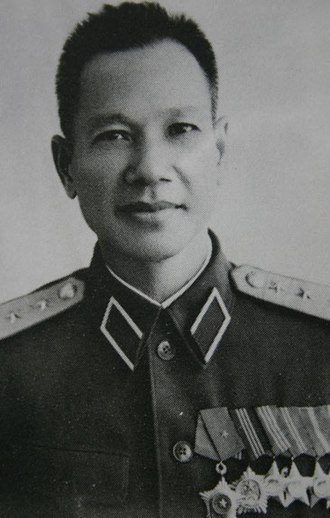
Key Facts
Origins and Early Revolutionary Service
Tran Van Tra was born on 15 February 1918 in Quang Ngai Province in central Vietnam, the same province that produced Pham Van Dong and a region with a long tradition of producing men who would play significant roles in the Vietnamese revolutionary movement. He came from a modest background and received a basic education before being drawn into political organising in the late 1930s, joining the Indochinese Communist Party and becoming active in the resistance networks that the Party was building across central Vietnam during the years of French colonial repression that preceded the Second World War.
He was involved in the revolutionary organising work that culminated in the August Revolution of 1945 and was present at the founding moment of the Democratic Republic of Vietnam. His subsequent career was entirely military: unlike some senior Vietnamese figures whose biographies combined military and political roles, Tran Van Tra was essentially a military commander throughout his active career, developing over three decades into one of the most experienced operational generals in the Vietnam People's Army.
His particular assignment — the one that would define the arc of his military career and make him one of the central figures in the southern war — was responsibility for the military situation in the south of Vietnam. From an early stage in his career he was associated with the B2 Theatre, the military command structure responsible for the southernmost regions of South Vietnam, including the Mekong Delta and the area around Saigon. This was arguably the most demanding and important military assignment in the entire southern war: the region closest to the enemy's political and administrative centre, the most heavily defended, and the region where the balance between political organisation and military operations was most critical.
Three Decades of Southern Command
Tran Van Tra's sustained command in the south — spanning major phases of both the First Indochina War and the war against the United States — gave him an intimate operational knowledge of the southern theatre that very few other commanders could match. He understood the specific geography of the Mekong Delta: its networks of rivers and canals, its flat open terrain that offered so little of the jungle cover that guerrilla forces in the Central Highlands or the northern mountains could exploit, its densely populated agricultural communities, and the specific challenges of maintaining revolutionary organisation in a region that was simultaneously the agricultural heart of South Vietnam and one of the most intensively patrolled by South Vietnamese and American forces.
The B2 Theatre that he commanded encompassed some of the most sustained and brutal fighting of the American war. The Mekong Delta was the target of intensive pacification operations by South Vietnamese forces, intensive bombing by American aircraft, and the Phoenix Program's systematic campaign against the NLF's political infrastructure. It was also the region where the NLF's popular support was in some respects deepest — where the peasant grievances against landlordism, taxation, and forced relocation that the revolutionary movement had organised around for decades were most acute and most politically productive.
Managing the military situation in this context — sustaining armed operations while protecting the political infrastructure, absorbing the losses inflicted by superior firepower while maintaining the capacity to operate, building the relationships with local population that gave guerrilla operations their necessary foundation — was work of extraordinary complexity and difficulty. Tran Van Tra's three decades in this command gave him a depth of operational experience and a specific knowledge of what the southern war actually looked and felt like from the inside that made him invaluable to the strategic planning of the war's final phase.
The Tet Offensive and Its Aftermath
Tran Van Tra was among the senior commanders involved in the planning and execution of the Tet Offensive of January–February 1968 — the coordinated nationwide assault on South Vietnamese cities that represented the most ambitious military operation the revolutionary forces had ever attempted. As commander of forces in the southern theatre, he was directly responsible for the attacks in the Saigon area, including the assault on the American Embassy compound that became the defining image of the offensive in the global media.
The Tet Offensive was, from the perspective of Tran Van Tra and the commanders who executed it, a military catastrophe as well as a political triumph. The expected popular uprising in the cities did not materialise — the southern urban population, whatever their sympathies, did not join the attacking forces in the numbers or with the speed that the offensive's planners had hoped. The attacking forces, heavily committed to initial assaults that achieved tactical surprise, suffered devastating casualties when South Vietnamese and American forces recovered and counter-attacked. The NLF's southern military structure, built over years of patient organising and fighting, was severely damaged in the Tet battles and took years to rebuild.
Tran Van Tra was acutely aware of these costs. His later memoir, written with the frankness of a man who had been there and felt entitled to say what he had seen, was notably candid about the human price of the Tet Offensive's military failures alongside its political achievements — a candour that would eventually make the memoir politically controversial in the reunified Vietnam that officially celebrated Tet as an unambiguous revolutionary victory.
The Ho Chi Minh Campaign and the Fall of Saigon
The final military campaign of the war — the operation that would take Saigon and complete the reunification of Vietnam — began in early 1975 with a series of probing offensives that revealed the unexpected rapidity of South Vietnamese military disintegration. Tran Van Tra played a central role in the planning and execution of what became the Ho Chi Minh Campaign, serving as Deputy Commander and Chief of Staff of the campaign under the overall command of General Van Tien Dung.
His specific contribution to the final campaign's planning was shaped by his decades of operational experience in the south: his intimate knowledge of the terrain around Saigon, his understanding of the South Vietnamese military's dispositions and vulnerabilities, and his assessment of how quickly the South Vietnamese command structure would collapse once the external pressure became sufficient. The assessment that events would move faster than the Hanoi Politburo's original timetable anticipated — an assessment that allowed the campaign to be accelerated dramatically when the pace of South Vietnamese collapse exceeded everyone's expectations — drew significantly on the operational intelligence and situational judgment that his thirty years in the southern theatre had built.
On 30 April 1975, North Vietnamese tanks entered Saigon. South Vietnamese President Duong Van Minh broadcast his unconditional surrender at noon. The war was over. Tran Van Tra was present in Saigon as it fell — in the city where he had been fighting, in various forms, for three decades. The emotional weight of that moment, for a man who had spent his entire adult life working toward it and who had watched so many people die in its pursuit, is not something the historical record captures fully. It is present, between the lines, in the memoir he subsequently wrote.
The Memoir and Its Suppression
In the years following reunification, Tran Van Tra undertook the writing of a comprehensive military history of the southern war from his personal perspective as one of its principal commanders. The work, eventually running to five volumes under the overall title "Ket Thuc Cuoc Chien Tranh 30 Nam" (Concluding the 30-Year War), was an ambitious attempt to document the military history of the southern theatre with the specificity and honesty that he believed it deserved.
The first volume was published in Ho Chi Minh City in 1982. It was suppressed almost immediately. The reasons for the suppression were multiple and in some respects contradictory, but they centered on a consistent pattern: the memoir was too honest about things that the official narrative of the war preferred to present differently. It acknowledged the catastrophic military costs of the Tet Offensive more directly than official histories did. It was candid about strategic disagreements within the Vietnamese military leadership, including disagreements between the southern commanders and the Hanoi Politburo about operational priorities and resource allocation. It gave credit to the southern NLF forces — the fighters who had borne the weight of the war in the south — in ways that complicated the official narrative of a unified, seamlessly directed revolutionary struggle. And it implicitly raised questions about whether the costs paid by the southern resistance had been justified by the strategic decisions made in Hanoi.
These were not small matters in the political context of reunified Vietnam in 1982. The Party's authority rested in part on the narrative of correct revolutionary leadership throughout the war, and a memoir by one of the war's senior commanders that complicated that narrative — however honestly and without political malice — was politically inconvenient. The suppression of the memoir was a significant act: it demonstrated that even a man of Tran Van Tra's standing and record could not, in the political climate of the early 1980s, tell the full truth about the war he had fought without official intervention.
Portions of the memoir were eventually published or circulated in various forms, and it has been used extensively by historians of the Vietnam War working from Vietnamese sources. Its suppression, paradoxically, drew more international attention to its contents than its open publication might have done. The portions that became available became key documents for historians attempting to understand the war from the perspective of the Vietnamese revolutionary command structure rather than from American or South Vietnamese sources.
Final Years and Death
Tran Van Tra spent his later years in Ho Chi Minh City, the city whose fall he had helped direct and where he had been based for much of his career. He was politically marginalised following the memoir controversy — not imprisoned or publicly disgraced, but clearly outside the circle of fully trusted senior figures. He continued to participate in veterans' organisations and historical commemoration activities, and remained a figure of considerable personal respect within the military community, whatever his official standing.
He died in Ho Chi Minh City on 20 April 1996, aged seventy-eight. He had spent virtually his entire adult life in military service to the Vietnamese revolution — from the August Revolution of 1945 through fifty years of war and its aftermath — and had risen to command the forces in the theatre that was both the most politically important and the most militarily demanding of the entire conflict. He had then written honestly about what he had seen and done, and paid a political price for that honesty. Both the service and the honesty were, in their different ways, acts of courage.
Legacy
Tran Van Tra's legacy operates on two distinct levels. As a military commander, he was one of the most experienced and operationally significant generals of the Vietnam People's Army — the man who sustained revolutionary military operations in the most difficult theatre of the southern war across three decades, who co-directed the final campaign that completed reunification, and whose operational judgment was central to the Ho Chi Minh Campaign's success. That military record is substantial and clear.
As the author of a suppressed memoir, he represents something less common in the history of revolutionary movements: a senior figure who chose honesty about his own experience over the requirements of official narrative. The suppression of his memoir is itself a historical fact of significance — evidence of the gap between the Vietnamese revolutionary movement's public narrative of the war and the more complicated reality that its own commanders experienced and sometimes tried to document. That Tran Van Tra tried to close that gap, at personal political cost, is part of his historical significance.
Historians of the Vietnam War have used the available portions of his memoir as essential primary source material precisely because it offers what so few documents do: the perspective of a senior southern commander on the strategic decisions that shaped the war, written from inside the command structure with the authority of direct operational experience. Whatever political judgments one makes about the suppression of the memoir or the political system that ordered it, the historical value of what Tran Van Tra tried to preserve is not in question.